
Best DFS Tools 2026: Sims & Optimizers, Ranked
July 16, 2026

Best DFS Tools For 2026: Sims, Optimizers & Projections, Ranked
Search "best DFS tools" and the results blur into one long list of optimizers that all promise the same thing: plug in projections, hit a button, get the "best" lineup under the cap. The trouble is that the button is the easy part. Any optimizer can solve for the single highest-projected build. What actually separates a serious tournament tool from one that just fills out a lineup is how it handles the thousands of ways a slate can go sideways: variance, correlation, and the fact that in a tournament you are not beating a projection, you are beating the field.
That is the lens this guide ranks on. Below is an honest read on the DFS tools worth paying for in 2026: what each one is best at, who it fits, and where Stokastic lands in the mix. Every tool here is live and active as of July 2026, and we will be straight about the ones that do a job better than we do.
Quick Summary
- Best DFS Tool Overall For Tournaments: Stokastic. The contest Sims simulate a slate tens of thousands of times and rank lineups by simulated ROI, while the DataHub pairs projections, ownership and stacks in one place, the sim-plus-data combination most single-purpose optimizers do not carry.
- The Job Every Tool Does: turn a set of projections into a lineup. The job the good ones do: account for variance, correlation and ownership so the build is aimed at where a top-heavy contest actually pays.
- Most Tools Overlap On The Basics. The real differences are how (or whether) they simulate the field, how deep the projections and ownership data run, the sports covered, and price.
- Start Free. Stokastic's Sims have a free entry point, so you can build a tournament pool before you pay. Code NFLWEEK2 takes 10% off through Monday, September 21 a Stokastic Sims subscription when you upgrade.
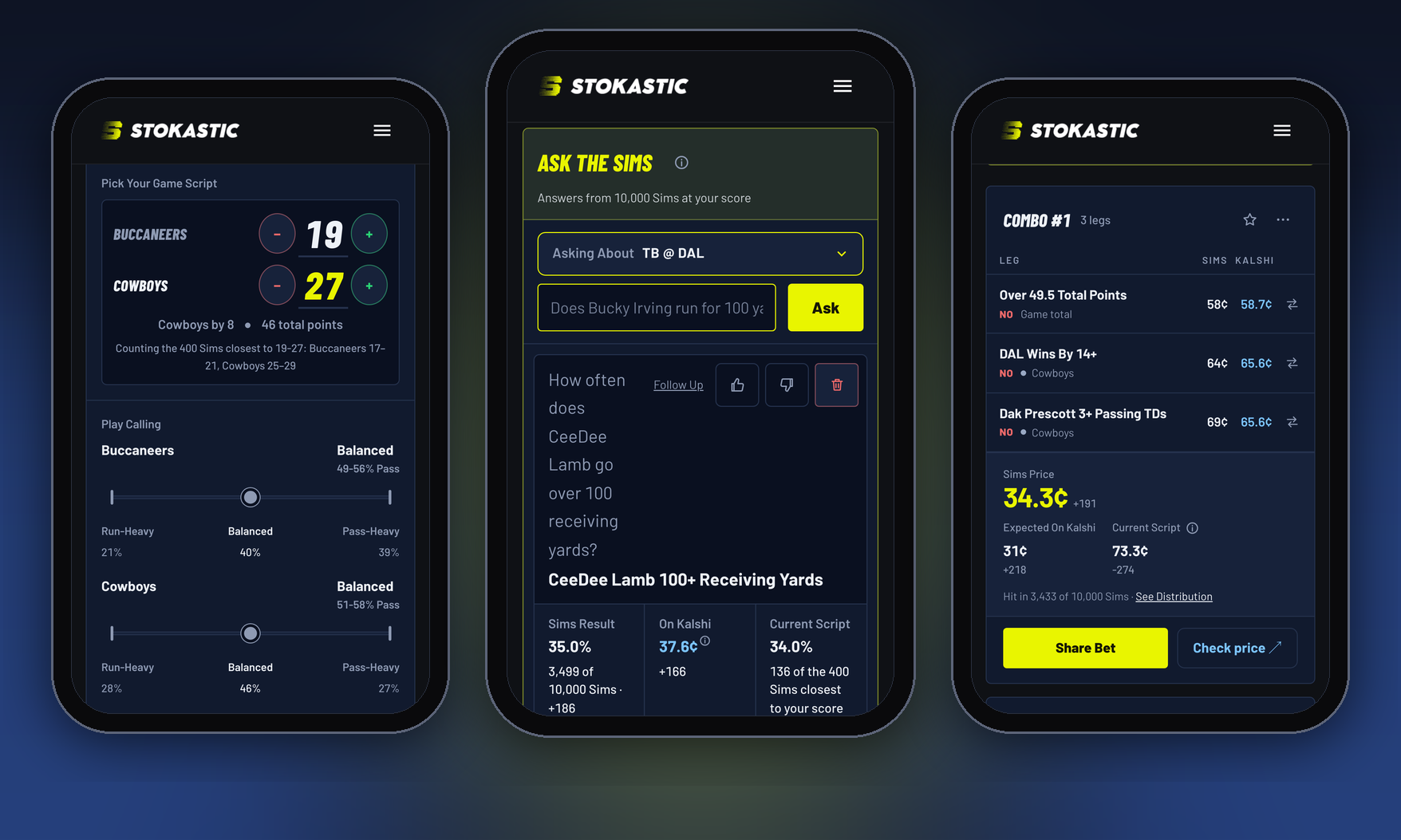 Price the combo before you buy it. The Kalshi Combo Simulator plays this week's NFL game 10,000 times and prices any combo you build next to the price on Kalshi, on your phone, free, no login.
Best DFS Tools At A Glance
| Tool | Best For | What It Does | Price |
|---|---|---|---|
| Stokastic | Tournament simulation + full data suite | Contest Sims (simulated ROI), Ownership Projections, Top Stacks, Boom/Bust, late-swap re-sims, DataHub projections | Free Sims entry, then Data + Sims / Sims MAX paid tiers |
| SaberSim | Hands-off sim optimization | Play-by-play game sims feeding a custom optimizer across many sports | $97 to $297/mo tiers, low-cost 7-day trial |
| The Solver (ETR) | Partner-projection optimizer | Syncs ETR (and partner) projections into an optimizer + bankroll tracker; separate simulator products where supported | Paid subscription |
| RotoWire | Value all-in-one | Editorial projections and a straightforward optimizer | Below the premium sim tools; single-sport/bundle tiers vary |
| 4For4 | Projection accuracy | Award-winning rankings, DFS projections and downloadable salary spreadsheets | Paid subscription |
Prices change often and most of these run a trial, so treat the price column as a category, not a quote. Confirm the current number on each tool's own site before you subscribe.
What DFS Tools Actually Do
Every tool on this list starts from the same raw material, a projection for each player and the salary cap, and the floor of what they offer is identical: build the highest-projected lineup that fits. That single-number build is much closer to the right starting point for a cash game, where floor matters more than leverage and you only need to beat about half the field. The problem is that it is solving for the median outcome, and a tournament does not pay the median. A large-field GPP pays the top fraction of a percent, so the tools worth their subscription do three harder things on top of the optimize step:
- Simulate the outcome, not just the projection. Instead of treating your forecast as the result, a simulator runs the slate thousands of times so foul trouble, busted game scripts and a stack going nuclear all show up in the distribution rather than getting flattened into one number.
- Model correlation. A tournament ceiling comes from players whose outcomes rise together, like an MLB team stack that hits a crooked-number inning, or a quarterback paired with his top receiver in a shootout. A good tool understands why those move in tandem instead of just applying a stacking toggle you handed it.
- Price in ownership. Your score only matters relative to the field, most of which is built off the same public projections you have. Getting over the crowd on players it is underrating (leverage) is the actual currency of tournaments, and only a tool that models the field can find it.
If those ideas are new, our DFS strategy guide covers the framework and the deeper sims vs optimizers breakdown walks through the mechanics. The short version: no tool changes what happens on the field, and none can promise a profit. What the good ones do is aim your builds at the part of the outcome distribution a top-heavy contest actually pays.
Stokastic: Best For Tournament Simulation
Stokastic is built for the player who wants to win tournaments, not just fill out a legal lineup. Its core is the contest Sims: instead of asking "what is the best lineup if everyone hits their projection," the Sims build a full player pool, generate a field of lineups, and run the slate tens of thousands of times, letting every player's outcome vary the way it really does. Then it ranks every build by simulated ROI against a real payout structure: how much equity a lineup returns in the tournament, not how it scores on a scoreboard no GPP pays out on.
Two things separate it from a plain optimizer. First, it folds in Ownership Projections, so the leverage is baked into the build: the Sims can see how often a low-owned player beats expectations and steer exposure toward that under-owned upside on purpose. Second, the Sims sit inside the DataHub, where the projections, ownership and stacks that feed the build all live in one screen, so you can read MLB DFS projections, ownership and stacks in the DataHub (and the same for NBA, NFL, CFB, PGA, NASCAR, MMA and more) instead of exporting a spreadsheet into a separate optimizer. Top Stacks and Boom/Bust let you sanity-check correlated pairings before you commit exposure, and you can re-run the sim as news breaks so your pool reflects the confirmed lineup, not a scratched starter.
The honest boundary: SaberSim is the closest sim-first competitor here, so we are not the only tool on this list that simulates. The case for Stokastic is the sim paired with a full data hub, ownership leverage you can read on every name, per-sport coverage, and a free entry point to test it all before you pay.
New to the Sims? Stokastic simulates the whole contest tens of thousands of times and ranks every lineup by simulated ROI, with ownership leverage and correlation built in. Try the Sims free, and code NFLWEEK2 takes 10% off a Stokastic Sims subscription when you upgrade.
What Stokastic Surfaces On A Normal Slate
It helps to picture the workflow, because that is where a tool earns its subscription. When lineups and salaries post for the day's games, you pull the slate into the DataHub, read the projections and ownership, then build a tournament pool in the Sims. What comes back is a lineup pool ranked by simulated ROI, each build carrying the exposure and leverage numbers that tell you why it simulates well:
- A Pool Ranked By Simulated ROI. The tool surfaces the builds that return the most equity against a real GPP payout first, so you enter the lineups aimed at the top of the leaderboard instead of the crowded median.
- Ownership Leverage On Every Name. Exposure-minus-ownership is the number I keep coming back to before I lock, because it tells me where my pool is getting over the field rather than piling onto the same chalk as everyone else. When the field is 35% owned on a play and I can get similar production from a name at 8% owned, that gap is the edge I am actually buying.
- Correlation The Sim Actually Models. When an NFL game simulates as a high-total shootout, the pass-game combinations that benefit rise together across the runs, so the stack surfaces because it wins in that scenario, not because you forced a toggle.
- A Live Re-Run As News Breaks. Re-running the Sims on a late scratch or a confirmed batting order means late swap, the highest-value in-slate move there is, is built on the real slate.
How thick the edges are on any given night depends on the slate, the sport in season and the contest you are playing. Some slates are loaded with leverage; others are flat, and the honest move is to trust the process over a large sample, because even the best build by simulated ROI can finish deep in the field on a single night.
A Worked Example: Why Simulated ROI Changes The Build
Make the difference concrete. Say two GPP lineups project for almost the same total, call it 270 on a DraftKings NBA slate. Lineup A is the optimizer's favorite: all the popular high-projection names, every one of them 25% to 40% owned. Lineup B keeps the same projected total but swaps two of those chalk plays for similarly projected names sitting at 6% owned.
A plain optimizer is basically indifferent between them, and often nudges toward Lineup A because the chalk carries a hair more raw projection. Run both through the tournament sim, though, and the picture flips. Lineup A is wedged into the most crowded part of the field, so even when its players hit, hundreds of near-identical builds hit with it and the prize gets split a thousand ways. Lineup B wins far less often, but when its low-owned plays click it is sitting almost alone near the top of a top-heavy payout. Rank the two by simulated ROI instead of projected points and Lineup B comes out ahead, because it is built to win the contest, not the scoreboard. That single shift, from projected points to simulated ROI, is the whole reason the sim exists, and it is the ownership leverage idea in action.
SaberSim: Best Hands-Off Sim Optimizer
SaberSim is the other genuine simulator on this list, and it earns its spot. It runs play-by-play game simulations that feed directly into its own optimizer, so the lineups it builds account for variance and game flow the same way a sim should. Its reach is wide: it covers the major DFS sports plus a deep bench of niche and esports slates, and its pitch is automation: point it at a slate, set your rules, and let the machine build a large, sim-aware pool with minimal hand-tuning.
Where it comes down to preference: SaberSim is a simulation-and-optimizer engine first, so if you want the field simulation without also living in a projections-and-ownership data hub, it is a clean, powerful choice, though at a premium relative to the field, with tiers that run into the low hundreds per month (a low-cost short trial lets you test it first). If you also want to read the projections, ownership and stacks yourself and build off that data screen, that is the piece Stokastic pairs the Sims with. Both simulate well; the split is how much of the surrounding data suite you want alongside the engine.
The Solver (ETR): Best Partner-Projection Optimizer
The Solver is a separate DFS optimizer that integrates Establish The Run's projections for eligible subscribers, and its strength is that projection pedigree. ETR's numbers are among the most respected in the industry, and The Solver wraps them in an optimizer and a bankroll tracker, with separate simulator products available in supported sports, so the ideas and the build tool live together. For a player who already trusts ETR's projections and wants a clean way to turn them into a lineup pool, it is a natural fit, and it is the same optimizer 4for4 subscribers sync their projections into.
The trade-off is scope. The Solver is a strong projections-and-build bundle, but the ownership-leverage-first tournament workflow (reading exposure-minus-ownership on every name and ranking a pool by simulated ROI against a specific payout) is where a dedicated contest simulator like Stokastic's Sims goes a layer deeper. If projections are your anchor and you want them wired straight into an optimizer, The Solver is an easy recommendation.
RotoWire: Best Value All-in-One
RotoWire is the budget-friendly workhorse. Its optimizer is backed by one of the most established editorial teams in fantasy sports, it covers every major DFS sport, and its DFS plans generally land below the premium sim suites on price, split across single-sport, all-sport and bundle tiers (confirm the current number on RotoWire's own subscribe page). For a casual-to-serious player who wants reliable projections and a solid optimizer without a big monthly outlay, it is the best value on this list.
What you are trading for that price is depth. RotoWire's optimizer is a projections-driven build tool rather than a full contest-simulation-and-leverage suite, so it is excellent for a high-floor cash build or a straightforward tournament lineup, and less suited to the exposure-minus-ownership, simulated-ROI tournament workflow. If you mostly play cash or want a dependable all-in-one at a low price, start here.
Buying tip: the optimize step is table stakes; every tool here does it. The real decision comes down to four things: whether it simulates the field, how deep the projections and ownership data run, the sports you play, and price relative to your volume.
4For4: Best For Projection Accuracy
4for4 built its name on projection and ranking accuracy, and that is still its edge. Its DFS projections, value scores and downloadable salary spreadsheets are a useful data feed, and it now syncs those numbers straight into The Solver for the actual lineup building. If your process starts from trusting the raw projections and ownership reads more than any one optimizer, 4for4 is the data source to weigh.
The honest framing: 4for4 is a projections authority that leans on The Solver for the optimizer, rather than a self-contained simulation suite. It is strongest as a data feed that pairs with a build tool. Stokastic's advantage is that the projections, ownership and Sims live in the same workflow.
How To Choose The Right DFS Tool For You
The features blur together across these tools, so choose on what actually differs. Match the tool to how you actually play:
| If You... | The right fit |
|---|---|
| Play Large-Field GPPs And Want Simulated ROI + Ownership Leverage In One Suite | Stokastic |
| Want Hands-Off, Sim-Driven Optimization Across A Huge Range Of Sports | SaberSim or Stokastic |
| Anchor On ETR's Projections And Want Them Wired Into An Optimizer | The Solver (ETR) |
| Want A Reliable All-In-One Optimizer At The Lowest Price | RotoWire |
| Trust Raw Projection Accuracy Above All And Pair It With A Build Tool | 4for4 + The Solver |
The deciding factors behind that table:
- Does It Simulate The Field? A simulator aimed at a top-heavy payout beats a single-number optimizer for tournaments. For cash games, the reverse is true: a high-floor optimized build is the right tool, and the full split lives in our GPP vs cash guide.
- How Deep Is The Data? Weight projections and, for tournaments, ownership. Leverage is only findable if the tool models the field.
- Which Sports Do You Play? Coverage varies. Confirm the tool runs the slates you actually enter before you subscribe.
- Free Entry And Price Relative To Volume. A subscription is worth it when the edge clears the cost. Start with a free entry point where one exists, and for a smaller bankroll, size your entries to your roll first.
Your First Week With A DFS Tool
You do not need to master everything on day one. A simple ramp:
- Start on the free Sims entry and build a tournament pool for tonight's slate without entering anything. Get a feel for how ranking by simulated ROI reshuffles the lineups an optimizer would have handed you.
- Read the ownership before you build. Pull up the DataHub, find the two or three chalk plays the field is piling onto, and note the similarly projected names sitting at low ownership. That gap is your leverage.
- Enter a few small tournament lineups from the top of the simulated-ROI pool, sized to your bankroll, and judge the process over a large sample; a good build still loses plenty of individual nights.
- Set your "percentage to first" to the contest. A top-heavy single-entry tournament rewards a different pool than a flat-paying contest, and that one setting reshapes which lineups simulate well.
- Re-run before lock. As news breaks, re-run the Sims so your pool reflects the confirmed slate. Being the one who acts on the news is where a lot of the edge lives.
The Bottom Line
The best DFS tool is the one that matches how you play. Every name here can turn projections into a legal lineup; the separation is what happens after that: whether the tool simulates the field, prices in ownership, and models the correlation that builds a tournament ceiling. Most of these do at least part of that job well, and the right pick depends on whether you want value, projection pedigree, or a full simulation suite.
For the player whose main game is large-field tournaments and who wants one place to read the projections, find the leverage, and rank a pool by how it actually performs against a real payout, Stokastic is the most complete option on this list, and you can build your first pool free before you decide.
Want to see it on tonight's slate? Stokastic simulates the whole contest tens of thousands of times, ranks every lineup by simulated ROI, and reads projections, ownership and stacks in one DataHub. Try the Sims free, and use code NFLWEEK2 for 10% off a Stokastic Sims subscription.
More on this: CFB DFS Picks Today: Projections & Top Plays · DraftKings NFL DFS Cheat Sheet: Week 1 Picks And Stacks · FanDuel NFL DFS Cheat Sheet: Week 1 Picks And Stacks · College Football DFS Strategy: How To Win CFB DFS · DFS Projections Vs Simulations: Why Medians Lose NFL GPPs