
MLB DFS Picks Today (7/20): Kirby Leverage & Stacks
July 20, 2026
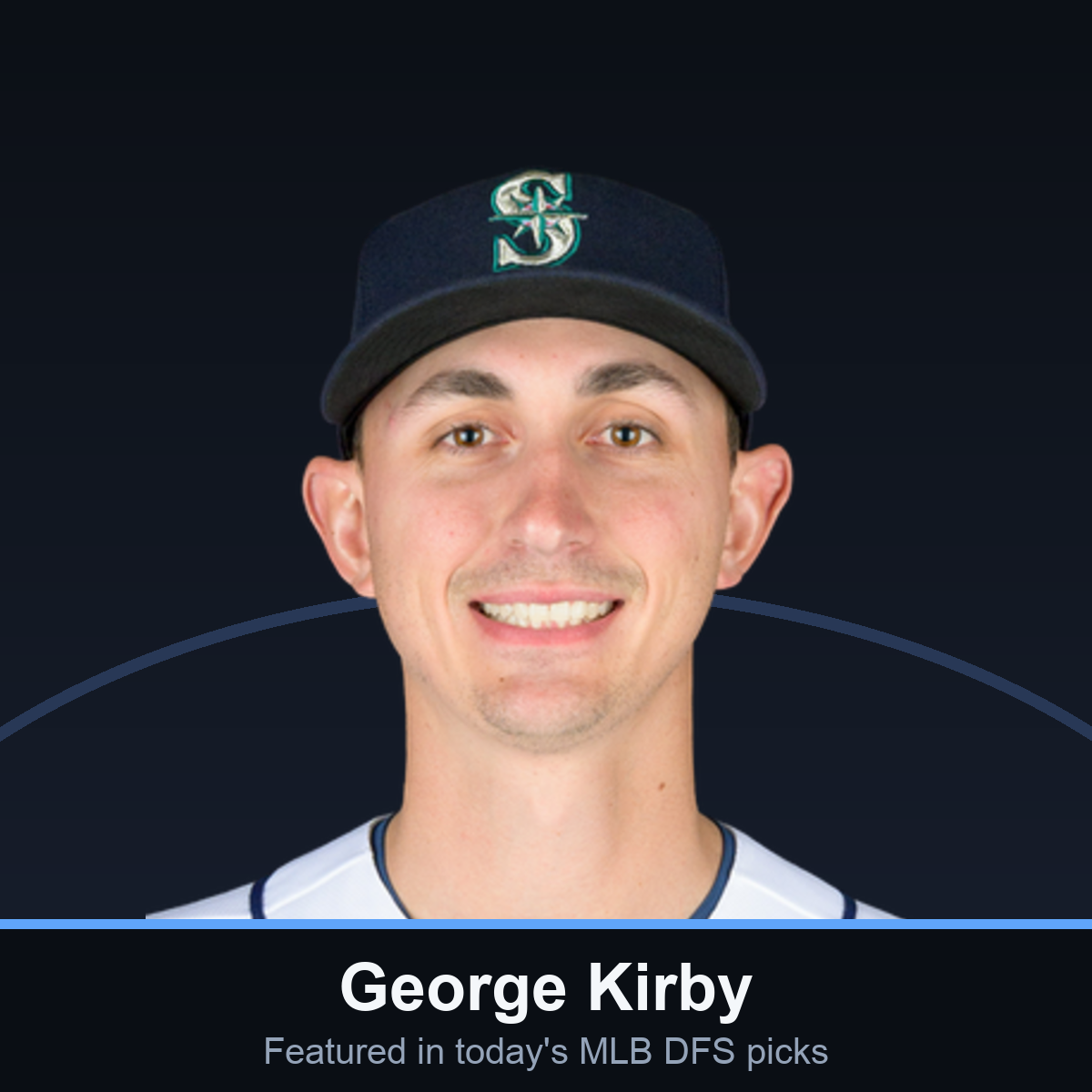
George Kirby — one of the featured players on today's slate.
In Summary
MLB DFS picks today land on a 14-game monster slate, the biggest of the season, and here is the counterintuitive part: a board this large is not harder to solve, it is a leverage buffet. Ownership spreads so thin across 28 teams that arms the field would normally hammer go under-owned, and low-team-total value pitchers plus spread-out stacks become the edge. The one I keep coming back to is George Kirby, who draws the most favorable park-and-matchup spot on the board yet sits at just 14-15% ownership. Under him: value arms Ryan Weathers ($7,700) and Shane Baz ($7,500), and a stack menu led by Washington, Detroit, Arizona and a low-owned San Francisco pivot. This is an applied tournament read, not a primer, so if roster construction is still new to you, start with the DFS 101 beginner guide and come back.
Watch The Video
The full breakdown, including the live Data Hub and Sims walkthrough where we cap the chalk pitchers and watch the leverage plays climb, is in the episode below. Watch on YouTube.
The 14-Game Slate Thesis: Chalk Spreads, Leverage Opens
A lot of players see a 14-gamer and assume it takes five hours to solve. It is often the opposite. On a five- or six-game slate every marginal arm and lineup gets forced into play because the pool is shallow, so the nuance is endless. With 14 games you can wave off whole teams and pitchers entirely, not out of laziness but because ownership is going to be so spread that you do not need to get cute.
That spread is the whole thesis. Watch what happens to pitcher ownership below, and hold onto one number as you read: a 90 wRC+ against right-handed pitching, tied for dead last in the league. It shows up twice on this slate, and both times it is the reason to attack.
SP1: George Kirby Is The Leverage Play Nobody Is On
Start at the top, where Jacob Misiorowski ($12,000) and Dylan Cease ($10,500) own the pitcher chalk. Misiorowski sits around 34% against the Mets, Cease around 25% against Tampa Bay, and both earn it: these are two of the nastiest strikeout arms in baseball, with K rates up around the 40% range. Cease is second in all of baseball with a 37% strikeout rate and a 15% swinging-strike rate, coming off an eight-inning, one-hit, 11-strikeout gem.
But the one I keep coming back to is George Kirby, and the case is a matchup that is impossible to ignore. In case you have not looked yet, this Kirby start against the Reds is not at Great American Ball Park, where balls fly out in the summer. It is in Seattle at T-Mobile Park, arguably the most pitcher-friendly venue in the league and about the worst home-run park there is. The Reds' active roster carries a 24% strikeout rate against righties. They have some pop, a 171 ISO, but that power is strongly negated by a park where it is not easy to homer at all. And their wRC+ against right-handed pitching? A 90, tied for dead last in the league.
Kirby is not the strikeout monster Misiorowski or Cease is, sitting at a 21.5% K rate, so he cannot mitigate damage the way they can. But no one on this slate gets more favorable conditions. He carries a 6.5-strikeout prop juiced to the over, an 18.5-out prop and a 1.5 earned-run prop, and he is getting only 14-15% ownership because he is bookended by two 40% strikeout freaks. On any other slate, Kirby and Jacob deGrom are 30%-plus owned, easy.
There is one loose thread on the top chalk worth naming and then setting down: Misiorowski was scratched from his last start before the All-Star break with arm fatigue. I raise it only to dismiss it. Nothing in the prop market says to worry, a contender is not going to short-leash a talent like that mid-pennant-race, and even a five-inning outing from him carries a very high floor. So this is not a fade-Misiorowski argument. Kirby's case stands entirely on its own park-and-matchup merits, and it just happens to come at a fraction of the ownership.
The leverage read in one line: same park, same matchup, on almost any other slate George Kirby is 30%-plus chalk. Tonight he is 14%. That gap is the whole play.
Here is the tell. When we cap Misiorowski and Cease at 30% in the Sims just to see what happens, Kirby climbs to roughly 25% projected. The process wants far more of him than the field is giving. Call it leverage.
| Pitcher | Salary | Opponent | Ownership | Why |
|---|---|---|---|---|
| Jacob Misiorowski | $12,000 | vs. Mets | ~34% | ~40% K rate, elite floor, but priciest arm on the board |
| Dylan Cease | $10,500 | vs. Rays | ~25% | 2nd in MLB at 37% K rate, 15% swinging-strike rate |
| George Kirby | premium | vs. Reds | ~14-15% | Best park-and-matchup spot; Reds 90 wRC+ vs. RHP |
| Jacob deGrom | mid | vs. White Sox | low | Great arm, quiet spot; 16% top-two-pitcher probability |
The row that matters most is Kirby's: the same conditions that make him a mediocre 14% play here would make him mega-chalk on a normal night. His ownership is a slate artifact, not a verdict on the spot. That gap between the ownership and the process is exactly what the Stokastic MLB Data Hub is built to surface, where top-two-pitcher probability, stack score and projected ownership sit side by side.
Value Pitchers: Weathers And Baz Print At The Bottom
If you would rather punt an arm and pay up for bats, two value pitchers make sense, and both are attacking the same weakness: a team total nobody wants to hit into.
Ryan Weathers ($7,700) draws Pittsburgh, which owns a 3.7 team total, the fifth lowest on the entire slate. For context, the only teams with lower totals today are the ones facing the highest-priced arms on the board, the Mets against Misiorowski, the White Sox against deGrom, the Rays against Cease and the Reds against Kirby. Weathers is not in that tier of pitcher, but at $7,700 with a 6.5-strikeout prop and a 17.5-out prop against a lineup that low, the price is doing a lot of work.
Shane Baz ($7,500) is the one I like most in the value range, and this is where that dead-last number pays off. Remember the 90 wRC+ against righties we flagged on the Reds? Boston posts the exact same 90 wRC+ against right-handed pitching, also tied for dead last. Baz is a righty, which is what you want against a Boston lineup that has been far better against lefties. The Red Sox grade 29th in the league in weighted on-base average against righties at .307, bottom five in ISO at .153, sixth-highest in strikeout rate and second-lowest in walk rate. Yes, Boston is riding a 13-game win streak. But a streak does not un-do a full season of profile, and you cannot predict when it starts or ends, so I am not letting a hot run scare me off a bottom-five-ISO matchup at $7,500.
| Value Arm | Salary | Opponent | K Prop | The edge |
|---|---|---|---|---|
| Ryan Weathers | $7,700 | vs. Pirates | 6.5 | Pittsburgh 3.7 team total, 5th lowest on slate |
| Shane Baz | $7,500 | vs. Red Sox | 5.5 | Boston 90 wRC+, .153 ISO vs. RHP, both bottom five |
Baz over a name like Freddy Peralta today is the contrarian call, and the numbers back it: a bottom-five ISO lineup that has to face a righty is exactly the wildly-inconsistent-arm spot you want to pick.
The Stacks: Washington Leads, San Francisco Is The Pivot
Now the bats. Because this is a 14-gamer, no stack runs away with ownership, so the exercise is finding a good team the field is ignoring.
Washington against left-hander Kyle Freeland is the most-rostered build, and here is the piece the rate stats bury: this is the Coors Field game, the 12-run total around 96 degrees that shows up again in the weather section below. The Nationals rank seventh in wRC+ against lefties, top 10 in ISO at .167 and seventh in weighted on-base average at .337, and they get to carry all of that into the best hitting environment in baseball. The park is the real reason this is the number-one stack, not the .167 ISO on its own. Detroit at Wrigley is right there too, with a 16 mph wind blowing out and an 11-run game total, one of the three highest on the slate. Arizona against Jeffrey Springs was a surprise on the exposure sheet, but the Diamondbacks do not strike out and carry a 5.3 team total, the seventh highest of 28 teams, so it makes sense.
The pivot is San Francisco at Kansas City. Kauffman Stadium is sitting near 95-96 degrees with a little wind blowing out, the game has a 10.5 total, and the Giants come in with a 5.5 team total but only about 4% ownership. In the Data Hub they grade third in stack score, so you are getting close to double the field's exposure on a top-tier stack that nobody else is touching. A 14-gamer is the only place that edge lives.
| Stack | Opposing SP | Ownership | Why it works |
|---|---|---|---|
| Washington | Kyle Freeland (L) | ~13% | 7th in wRC+, top-10 ISO vs. LHP |
| Detroit | at Wrigley | ~13% | 16 mph wind out, 11-run total |
| Arizona | Jeffrey Springs | low | Low-K lineup, 5.3 team total (7th highest) |
| San Francisco | at Kansas City | ~4% | 10.5 total, 3rd in stack score, low-owned pivot |
The row I would circle is San Francisco's: a 4% projected ownership on a stack the Sims rank third by score is the single best leverage bat spot on the board, the hitting-side mirror of what makes Kirby work on the mound.
Worked Example: Building The 14-Game Board In The Sims
Here is how I actually ran it. I built 150 lineups with no uniques, which on a big slate keeps exposure honest instead of forcing artificial diversity. The pitcher exposure came back heavy on Misiorowski and Cease with a healthy chunk of Weathers, and Kirby at only 14%, a spot I wanted to boost. So I opened the top-stacks tool in the Stokastic MLB Data Hub and read it in order: top-stack probability, then stack score, then projected ownership.
That read is what surfaced San Francisco. Detroit and Washington were carrying the ownership at roughly 13% each, but San Francisco showed a top-three stack score at 4% ownership, a gap the raw exposure sheet buries. Then I capped Misiorowski and Cease at 30% and re-ran, which pushed Kirby and Weathers up exactly where the process wanted them. Swap a player, re-run the single-lineup Sim, compare the Sim ROI and chance-to-win, and the leverage build grades out ahead of the chalk one in seconds. If you want the full method on correlated bats, our MLB DFS stacking guide walks through it, and the how-to-build-winning-MLB-DFS-lineups guide covers roster construction end to end.
The Fades And The Weather
A few names to note. Cristopher Sánchez ($11,000) against the Dodgers is the classic bookend fade: at that price I would rather pay down to Cease or up to Misiorowski, and the Dodgers stack you would normally leverage against him is a non-starter here because we are not rostering Shohei Ohtani in this spot. That takes the whole matchup off the board on both sides. Andrew Abbott is enticing if you want to get weird in the very same T-Mobile pitcher's park that makes Kirby, and Payton Tolle against Baltimore grades fine, but on a 14-gamer none of them are necessities.
On weather, the three highest-total games are the ones to know: Wrigley at an 11 total with the wind out, Coors Field at a 12-run total around 96 degrees, and Kansas City at 10.5. There is no real inclement-weather risk to lineups today, with the Data Hub showing a 0% postponement risk even on the Cubs game that had some early storm chatter. That clean weather board is one more reason the leverage reads, not rain-outs, decide this slate.
The Bottom Line
The 14-game board comes down to three plays the field cannot afford: George Kirby in the best park-and-matchup spot on the slate at 14% ownership, Shane Baz attacking the same dead-last 90 wRC+ that makes the Reds a fade, and a 4%-owned San Francisco stack the Sims love. The repeatable move is the one from the worked example, not just tonight's result: cap the two chalk arms at 30% and let the Sims resurface the leverage the ownership is hiding. Get to it, let the tools grade it, and let the field pay full price for the chalk.
Get The Stokastic MLB Sims
Ready to build your own leverage lineups? The Stokastic MLB Sims, projections and Top Stacks tool power every read above. Use code MLBSTRATEGY for 15% off any Stokastic subscription — weekly, monthly or all-access, core or max. Lock in 15% off at checkout →
For today's full pitcher board, stack ranks and projected ownership, head to the MLB DFS picks hub and the Stokastic MLB Data Hub. Start your Sims subscription and put them to work tonight →