
MLB DFS Picks Today (7/23): Sale-Williams Squeeze, Ramirez Value
July 23, 2026
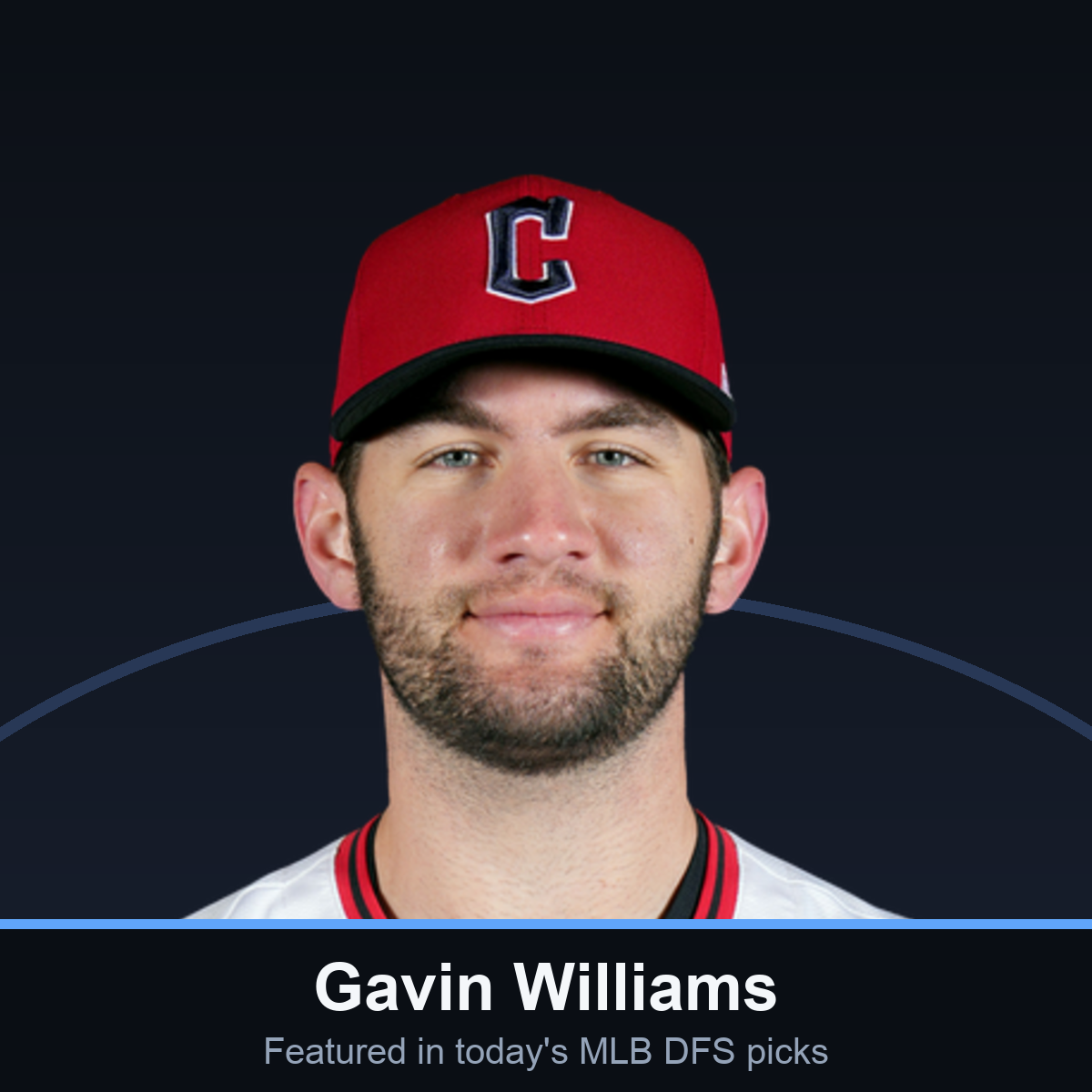
Gavin Williams — one of the featured players on today's slate.
In Summary
MLB DFS picks today come from a small board: three games, five games total across both slates, and only three pitchers worth building around. That scarcity is the whole story. The Stokastic Sims land on Gavin Williams (CLE) at 91% exposure and Chris Sale (ATL) at 60%, a combined 151% on two arms, which is the number I keep coming back to because it means most rosters tonight are living or dying on one of two starts. The pivot that actually diversifies without giving up quality is Jose Ramirez (CLE), priced at $4,800 after a six-week IL stint knocked $1,000 off his salary, still with 24 stolen bases and real power. Taj Bradley (MIN) gets a tougher version of that same Cleveland lineup now that Ramirez is back, Ian Seymour (TB) took a mid-slate role downgrade to probable long reliever that changes his price appeal, and the stack picture runs heavy Toronto and Tampa Bay against a nearly empty Minnesota column. If DFS roster construction is new to you, start with our DFS 101 beginner guide and come back for the slate read below.
Watch The Video
Full breakdown of today's slate, run live in the Stokastic MLB Data Hub with the exposures and stacks pulled straight from the Sims. Watch on YouTube.
Three Games, Three Pitchers That Matter
Thursday's board is thin by design: three early games (Atlanta Braves vs. San Diego Padres, Cleveland Guardians vs. Minnesota Twins, and Toronto Blue Jays vs. Tampa Bay Rays), then a separate two-game night slate that starts at 5 p.m. with nothing after it. On a card this small, the pitcher decision isn't really "can I play this arm," it's "how much of my exposure do I put on which of three or four options," because Chris Sale, Gavin Williams and Taj Bradley are the only starters on the day slate with real strikeout stuff. Everyone else, Griffin Canning, Ian Seymour and Shane Bieber, is priced down for a reason. That gap between the top three and the bottom three is what pushes the Sims to such lopsided pitcher exposure, and it's the thread worth following through the rest of the slate.
Gavin Williams (CLE) Is Sitting At 91% Exposure
Gavin Williams (CLE) is $8,700, down $700 from where he was priced a month ago, and carries a 6.5-strikeout prop at -130 to the over. He's put together back-to-back 11-strikeout starts, including a 7-inning, 2-earned-run outing against this same Minnesota Twins lineup two starts ago, though his very next start went the other way: 5 earned runs and 3 home runs allowed alongside another 11 strikeouts. That boom-or-bust range is real, but the underlying matchup still favors him. Minnesota is a sub-20% strikeout team against right-handed pitching, but their team total sits at just 3.5, low enough that even a shaky Williams start likely comes with a soft offensive ceiling on the other side.
The number worth sitting with is the 91%. That's not a typo, and it isn't the Sims overreacting either, since Williams' price got cut $700 while his strikeout stuff stayed the same. It's just what happens on a slate with only three real pitcher options: the best price-to-production gap draws almost everyone.
Chris Sale (ATL) Against A San Diego Lineup That Can't Hit Lefties Either
Chris Sale (ATL) is the highest-projected pitcher on the entire slate and the most expensive by roughly $2,000 over Williams, carrying a 7.5-strikeout prop that's juiced to the under. San Diego is 29th in wRC+ against left-handed pitching with a .294 weighted on-base average, dead last in the league, even though they're a middling 18th in strikeout rate. San Diego's team total sits at 3.4, the lowest of the three day games, at 86 degrees with no notable wind flagged. Sale has been excellent at home this season, and while his own Sims projection is barely half a fantasy point ahead of Williams' at a $2,000 higher price, the matchup quality is the same tier: a bad offense that also happens to be historically bad against his specific arm side.
That's the concentration risk laid out plainly: Sale and Williams add up to 151% combined exposure on a 3-game slate, and the Sims are pairing them together constantly, roughly 80 of the top 150 favored lineups by simulated ROI carry both arms at once. It isn't hard to build around; it's just worth knowing your roster's ceiling and floor both run through the same two games.
| Pitcher (Team) | Price | Opponent | K Prop | Exposure |
|---|---|---|---|---|
| Gavin Williams (CLE) | $8,700 | vs. MIN | 6.5 (-130 over) | 91% |
| Chris Sale (ATL) | $10,700 | vs. SD | 7.5 (juiced under) | 60% |
| Taj Bradley (MIN) | $8,400 | vs. CLE | 6.5 (-166 under) | 32% |
| Ian Seymour (TB) | $7,400 | vs. TOR | no prop posted | 10%, downgraded mid-slate |
| Shane Bieber (TOR) | $6,600 | vs. TB | 4.5 (-154 under, FanDuel) | under 10% |
| Griffin Canning (SD) | $5,000 | vs. ATL | 3.5 (-140 under) | roughly 0% |
The row worth circling is the top two: Williams and Sale combine for more exposure than the other four pitchers put together, which is exactly what a 3-arm slate looks like when the Sims agree on where the real strikeout equity lives.
Taj Bradley (MIN) Gets A Tougher Cleveland Lineup Now That Jose Ramirez Is Back
Taj Bradley (MIN) is $8,400 with a 6.5-strikeout prop juiced to the under (-166), and some books post a 5.5 line with heavy juice the other direction. His opponent, the Cleveland Guardians, sits at a 3.9 team total, not a huge number, but it undersells what changed this week: Jose Ramirez (CLE) returned to the lineup yesterday after a roughly six-week absence, and that single return pushes Cleveland's numbers against right-handed pitching up to a 102 wRC+ (18th in MLB) and a .315 weighted on-base average. Bradley's own numbers back up the caution, too: he's allowing 1.34 home runs per nine this season, right around league average but not a suppressor, and Ramirez is a switch-hitting power-speed threat who makes any pitcher's night harder. Take this same matchup before the All-Star break, without Ramirez in the lineup, and it looks meaningfully better for Bradley. With him back, it's still playable, just no longer a clean fade-the-offense spot. Bradley sits at 32% exposure in the Sims, third among the six pitchers on the board.
The Value Pivot: Jose Ramirez (CLE) At $4,800
Here's the callback worth making: the same Jose Ramirez return that downgrades Taj Bradley's matchup is also the slate's best value angle on the hitting side. Ramirez is priced at $4,800, a full $1,000 below where he sat in his last few games before landing on the IL ($5,500 to $5,800), despite carrying 24 stolen bases and real over-the-fence power into a lineup that just got meaningfully better with him in it. The Sims put his value score at 1.83x, projecting 8.8 fantasy points, one of the strongest pre-flop value numbers on the entire board, and he isn't even the highest-owned player at his own position tonight. He's currently drawing somewhere between 43% and 47% exposure in the Sims build, alongside Junior Caminero (TB) as another power bat the process likes regardless of price.
| Player (Team) | Salary | Note | Exposure |
|---|---|---|---|
| Jose Ramirez (CLE) | $4,800 | Down $1,000 off IL return; 24 SB, 1.83x value, 8.8-pt projection | 43-47% |
| Alejandro Kirk (TOR) | catcher chalk | Highest-owned catcher on the slate | 46% |
| Drake Baldwin (ATL) | $5,300, batting leadoff | Combines with Kirk for 85% of catcher exposure | 39% |
| Vladimir Guerrero Jr. (TOR) | 1B | Next-highest exposure after the catcher duo | 37% |
The row that matters most there is Ramirez's: a $1,000 price cut on a player who didn't lose any of his skill set is the same kind of gap that makes a DFS slate interesting, and it's the reason he's the pivot this recap keeps returning to.
Ian Seymour (TB) And Griffin Canning (SD): Priced Down For A Reason
Ian Seymour (TB) was $7,400 against a Toronto lineup that's tricky to read: bottom-4 in wRC+ against left-handed pitching and bottom-4 in strikeout rate at the same time, a below-average offense that also doesn't miss many bats, with a .148 ISO that ranks 18th in MLB. Mid-slate, Toronto's total also ticked up to 4.3, not a big number but not the softest matchup either. The bigger issue arrived during the show itself: Seymour got moved to probable long reliever, a real change from a pitcher who's thrown as many as 90 to 94 pitches in some outings this season. That's a workload downgrade that matters more than the matchup, and the expectation is that his roughly 10% exposure largely redistributes into Sale, Williams and Bradley rather than into Griffin Canning.
Griffin Canning (SD), also a probable long reliever, is $5,000 with a 3.5-strikeout prop juiced to the under, and he draws Atlanta, which owns the highest team total on the entire slate, a full half-run ahead of the next-best mark. There's no real argument for rostering him today, and the Sims exposure reflects that at essentially zero.
Shane Bieber (TOR) is the other name worth naming and setting down. At $6,600 he looks like a min-priced strikeout arm, but his 4.5-strikeout prop is juiced to the under (-154 on FanDuel) and he's had exactly one start all season that looked sharp, his most recent one against the White Sox. The caution sample: three days ago a Toronto rotation-mate went out against this same contact-heavy Rays lineup, struck out seven, but gave up three earned runs on seven hits and two home runs. Tampa Bay puts the ball in play well (.335, 7th in MLB), carries a 113 wRC+ against right-handed pitching and only strikes out 18.9% of the time, which is a tough combination for a cheap arm leaning on swing-and-miss. Bieber's exposure stays under 10% in the base build.
The Stacks: Toronto And Cleveland Get The Chalk, Minnesota Sits Empty
Stack ownership follows the pitcher board closely. Toronto and Tampa Bay are the two most-rostered stacks in the Sims, with Toronto running roughly 2.5 times the projected field and Cleveland close behind at about 2 times the field. San Diego sits at 17% against Chris Sale, compared to a projected field of roughly 10%. Atlanta, despite owning the slate's highest team total, is actually underweight, drawing about 13% against a field projected closer to 26%, since Griffin Canning isn't drawing anyone off Atlanta's own bats the way a real threat at the plate would. Minnesota is the most extreme gap on the board: a projected field ownership around 15%, against essentially 0% in the Sims build, just a single lineup carrying a Twins stack.
| Stack | Opposing Pitcher | Host Exposure | Field Estimate | Note |
|---|---|---|---|---|
| Toronto | vs. Ian Seymour (TB) | ~2.5x field | — | Most overweight stack on the slate |
| Cleveland | vs. Taj Bradley (MIN) | 25% | ~2x field | Correlates with the Ramirez return |
| San Diego | vs. Chris Sale (ATL) | 17% | ~10% | Bad offense, priced-down leverage |
| Atlanta | vs. Griffin Canning (SD) | 13% | ~26% | Highest team total, still underweight |
| Minnesota | vs. Gavin Williams (CLE) | ~0% | ~15% | Widest gap on the board |
The row to sit with is Minnesota's: a team total of only 3.5 explains part of the fade, but a field sitting at 15% while the process lands at essentially zero is the kind of gap worth knowing about even if you don't act on it, because it tells you where the rest of the field is likely to be light.
Beyond the pitcher-correlated stacks, the individual bats worth knowing include George Springer (TOR), Cedric Mullins (TB), Chandler Simpson (TB), Steven Kwan (CLE) and Chase DeLauter (CLE), who spread the outfield exposure out fairly evenly rather than concentrating it the way catcher and third base are concentrated. Ernie Clement (TOR), Taylor Walls (TB), Xander Bogaerts (SD) and Luis Rengifo (SD), around 20% exposure, round out the shortstop mix. Fernando Tatis Jr. (SD) has the platoon advantage against the left-handed Sale, but the Sims aren't rewarding him for it given his recent form, and Michael Harris II (ATL) and Ozzie Albies (ATL) carry modest exposure in an Atlanta build that's underweight overall. On pure simulated ROI at standard settings, the individual standouts are Alejandro Kirk, George Springer, Steven Kwan, Vladimir Guerrero Jr. and Jose Ramirez, a group notable for how cheap most of them are relative to their production.
Worked Example: What Happens When The Build Forces More Uniques
Running the same slate down to the 150th-favored lineup by simulated ROI, instead of the standard build, is a useful gut check on how fragile that 151% Sale-Williams number really is. Pitcher exposure does smooth out some: both Sale and Williams come down roughly 15 points each, Bieber climbs from under 10% toward 11%, and Canning ticks up from under 1% toward 3%. Catcher spreads out further away from the Kirk-Baldwin duopoly. The stacks move more than the pitchers do: Minnesota picks up some exposure, San Diego and Cleveland both come down slightly, and Atlanta is the single biggest mover on the slate, jumping from 13% up to roughly 27% once the build is forced to diversify. Jose Ramirez comes down too, from the mid-40s to around 28%, which is the one trade-off worth flagging if you go this route: you give up some of the slate's best value to buy the diversification.
None of that means the standard build is wrong. It means the standard build is a deliberate bet that Sale, Williams and Ramirez are simply the best plays on a thin slate, and the more-unique version is a hedge against the specific scenario where all three miss on the same night. Our MLB DFS stacking guide covers how we weigh that kind of trade-off more generally.
The Bottom Line
Today's slate really is a two-pitcher story: Gavin Williams and Chris Sale combine for 151% exposure in the Stokastic Sims on a 3-game day, and everything else on the mound, Taj Bradley, the newly-demoted Ian Seymour, Shane Bieber and Griffin Canning, exists in their shadow. The move that actually manages the concentration without sacrificing quality is Jose Ramirez at $4,800, a genuine value outlier off his return from the IL, with Toronto and Cleveland as the stacks the process likes most on the bat side. Track Ian Seymour's workload before lock in case his role shifts again, and let the Stokastic MLB Data Hub, with exposures, top stacks and strikeout props side by side, do the rest of the build.
Get The Stokastic MLB Sims
Ready to build your own lineups around today's reads? The Stokastic MLB Sims, projections and Top Stacks tool power every number above. Use code MLBSTRATEGY for 15% off any Stokastic DFS or Props package, weekly, monthly or all-access. Lock in 15% off at checkout →
For today's full pitcher board, stack ranks and projected ownership, head to the MLB DFS picks hub and the Stokastic MLB Data Hub. Start your Sims subscription and put them to work tonight →