
NFL DFS Leverage: The Game Theory Behind Big GPP Wins
July 8, 2026
NFL DFS leverage is the reason the sharpest tournament players are not simply chasing the highest projection on the slate. They are chasing the correlated outcome nobody else is going to build. In a large-field GPP on DraftKings 🎁 or FanDuel 🎁 you are up against tens of thousands of lineups, and the ones that take down the top prize almost always share a trait: they got somewhere the field didn't, and they got there as a unit. That is what leverage is in football, and it looks different from every other sport, because NFL scoring is game-correlated. Points do not arrive one player at a time; they arrive in offenses and in shootouts. So the richest leverage in NFL DFS is not a single low-owned name; it is a low-owned stack. Here is how I actually find that edge and apply NFL DFS game theory to a tournament, with the tools doing the work inside the reasoning instead of bolted on the end. If you are newer to tournaments, our broader guide to winning DFS tournaments covers the fundamentals this piece builds on.
What NFL DFS Leverage Actually Means
Leverage in NFL DFS is rostering a player (or a combination of players) owned lower than their real chance of landing in the winning lineup. You are not just picking good players. You are picking good players the field is going to under-roster, so that when they hit, fewer entries rise with you and your lineup climbs the leaderboard alone.
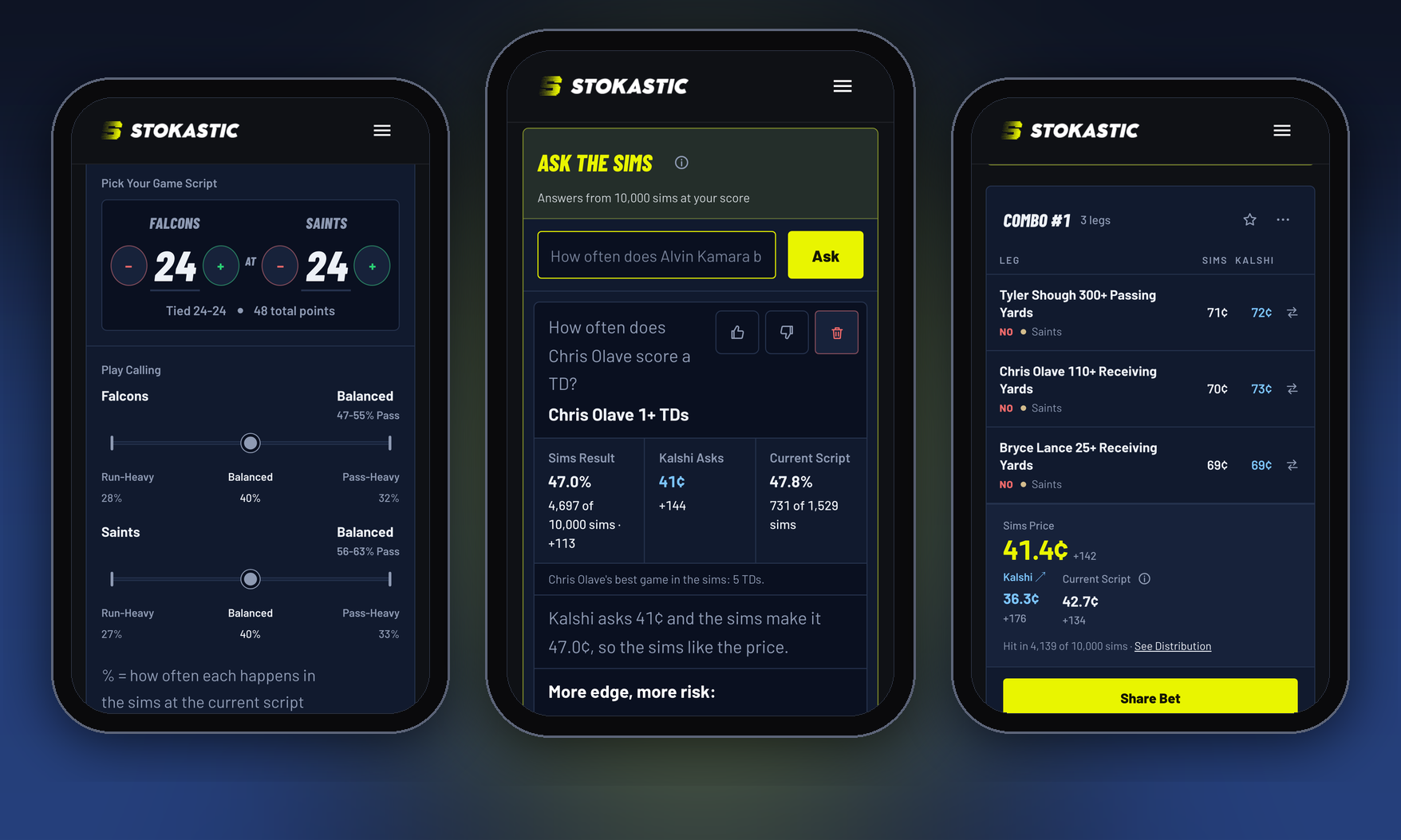 Price the combo before you buy it. The Kalshi Combo Simulator plays this week's NFL game 10,000 times and prices any combo you build next to the price on Kalshi, on your phone, free, no login.
The math is simple once you see it from the field's side. If a player is in 40% of lineups and he books a ceiling game, you gained nothing on the 40% who also rostered him; you only separated from the 60% who didn't. If a player is in 8% of lineups and he books that same game, you just gained on 92% of the field at that spot. Identical points, wildly different tournament value. That gap between real production and what the crowd expects is the entire game.
The trap is thinking leverage means "play weird guys nobody likes." Fading a chalk play only wins when that chalk actually underperforms. So the target is never low ownership for its own sake; it is a mispriced projection: a player, or a game, the field is sleeping on for a reason that no longer holds.
Where NFL Leverage Actually Comes From: Correlation The Field Underweights
If you take one thing from this article, take this. In the NFL, the single richest source of leverage is a correlated game stack that the field is under-owning, and the piece I keep coming back to is the bring-back nobody wanted. I will pay that off in a minute; first, why correlation is the engine.
Football points do not happen in isolation. A quarterback throwing for 350 yards and four scores means his pass-catchers ate too; the QB's ceiling and his receivers' ceilings are the same event. Correlation like that is the whole reason stacking a QB with a primary pass-catcher is the backbone of NFL tournament play. The problem is everyone knows it. On any given slate the obvious stack, the chalk QB in the highest-total game paired with his WR1, tends to draw ownership quickly, because projections, salaries, and media attention often point the whole field at the same QB-pass-catcher pairing. Rostering it means you win with the field, not ahead of it.
Leverage lives one step off that obvious pairing. It shows up in three repeatable places:
- The Secondary Pass-Catcher. When the field piles onto QB + WR1, the same game's WR2, slot receiver, tight end, or pass-catching back captures most of the same upside at a fraction of the ownership. If the game shoots out, they score too, and you are one of the few who got there.
- The Bring-Back. This is the one I promised. In a projected shootout, a piece from the opposing offense completes the stack: when your QB and receivers erupt, the other team was usually throwing to keep pace, so a receiver on the other side rides the same scoreboard. Plenty of lineups still underuse the right bring-back, especially when the opposing piece is expensive or less obvious, which is how it stays lower-owned while carrying real, correlated ceiling.
- The Under-Owned High-Total Game Entirely. Sometimes the leverage is not a player but a game. A second shootout the field has ignored, because it lacks a marquee name or sits in a bad time slot, lets you build a full, correlated stack almost nobody else has.
The through-line: in NFL you are not leveraging a player against the field, you are leveraging a correlated outcome against it. Get the whole environment the crowd skipped, not just one name from it. For the full breakdown of which pieces correlate and how tight to build, our NFL DFS stacking guide goes deep on the mechanics this section leans on.
Turn a low-owned shootout into a differentiated stack. The Stokastic NFL Sims rank your lineups by simulated ROI across tens of thousands of simulated contests, not by one projected score, so the correlated builds the field skipped rise to the top on their own. New to Stokastic Sims? Code NFLWEEK2 takes 10% off through Monday, September 21 your first payment.
Using The Boom/Bust Tool To Find Leverage Plays
Once you know what creates leverage, you need to find it fast across a full slate. The Stokastic NFL Boom/Bust tool is built for exactly that. (For the metric itself end to end, the DFS Boom/Bust probability guide walks through it.) It hands every player a few numbers that matter for tournaments:
- Boom Probability is the chance a player exceeds his salary-based expectation, the signal he has real ceiling. This is your upside filter.
- Bust Probability is the chance he fails to return value. A player can still have upside with a high bust number, but if you want a safe floor, hunt low bust.
- Optimal Lineup % is how often a player appears in the optimal lineup across the simulations. The higher it is, the more integral he is to the best possible builds, which is what winning a large-field GPP actually requires.
- Leverage Score is the column that ties it together: it compares a player's Optimal Lineup % to his projected ownership. A high, positive Leverage Score means the field is under-rostering a player relative to how often he belongs in the winning lineup. A negative score means the public is too high on him.
By itself, boom probability just tells you who is good. The leverage comes when you lay it next to Ownership Projections, which is exactly what the Leverage Score automates. The profile you are hunting is a high Optimal Lineup % sitting well above its projected ownership. Say a mid-priced receiver projects into the optimal lineup 16% of the time but is only owned by 4% of the field, because he had a quiet week and the crowd moved on. That 12-point gap between where he belongs and where the field has him is enormous leverage: if he hits, you gain on nearly the entire field at that spot.
| Leverage Score | What it tells you | What to do |
|---|---|---|
| High, Positive | The field is under-rostering real optimal-lineup equity. | Strong leverage candidate. Consider overweight exposure when the ceiling, correlation, and contest type fit. |
| Near Zero | Ownership roughly matches optimal-lineup equity. | Fine player, no separation. Use where the floor is truly worth it; he won't move you up alone. |
| Negative | The public is over-rostering him versus how often he's actually optimal. | The chalk trap. If he busts, thousands of lineups sink together, so you want to be underweight. |
The most interesting row is the top one, and it is worth saying out loud: a positive Leverage Score is not a hunch, it is the tool telling you the crowd's ownership has drifted away from the simulation's own answer for who belongs in the winning lineup. That is the whole point of NFL DFS ownership leverage: the tool surfaces the high-optimal, low-owned profiles for you, so you spot them in seconds instead of eyeballing the slate for an hour.
NFL DFS Game Theory: Play The Field, Not Just The Slate
Game theory in DFS means thinking one level up: not "who is the best play," but "what is everyone else going to do, and how do I get an edge on that?" You are not just projecting players. You are projecting the field.
That reframes the whole build. A slate where the obvious values pile onto two or three names (the chalk QB stack, the cheap value RB everyone found) is a slate where being different pays a premium, because so much of the field is stacked on the same spots. A slate with no clear chalk is one where you can play closer to optimal and still be differentiated. Reading the room is half the edge.
Three ways I apply it in NFL specifically:
- Read The Chalk Before You Fade It. Use Ownership Projections to see who is going to be over-owned. Popular NFL plays come from the obvious high-total stack, a fat salary discount, or a soft matchup everyone can see. A value back at 45% projected ownership is often a correct play and an over-owned one at once, which is the setup for leverage. You don't need every chalk play to bust; you just need to be underweight the ones that do.
- Leverage Through The Stack, Not Just The Player. If the field is going to hammer one QB-WR1 pairing, the leverage is the same game through a different door: the WR2, the tight end, the pass-catching back, or the bring-back. You get the same shootout exposure at a fraction of the ownership.
- Let The Game Environment Set The Ceiling. NFL correlation is a game, not a batting order. A high implied team total flags a game with a lot of scoring chances; a big spread flags blowout risk: a favored starter who gets rested once the game is decided, with his clock-grinding carries vultured to a backup, or a trailing pass-catcher who gains garbage-time volume. It also caps the favored passing game's ceiling, so the QB-WR1 stack you wanted to leverage may be the one to avoid. Read the Vegas number first and let it tell you which players' ceilings are real.
How To Build Leverage Into A Large-Field GPP Lineup
Here is the repeatable process, not a one-off, and it sits at the center of any real NFL DFS GPP strategy. NFL slates hinge on a handful of inactives and a Vegas number, so a routine beats improvising. For the full slate-reading framework this fits inside, see our NFL DFS strategy guide:
- Start from the game environment. Pull the implied team totals and spreads. The highest-total games hold the ceilings; that is your stacking pool before you look at a single projection. Note which shootout the field will obviously target and which one it will skip.
- Build the stack, then find its off-ramp. For each target game, sketch the obvious QB + primary pass-catcher pairing, then the leverage version: the secondary receiver, the tight end, the pass-catching back, or the bring-back that rides the same scoreboard.
- Filter for ceiling. Run those names through Boom/Bust and keep the ones with real boom probability and high Optimal Lineup %, not just a warm body in a good game.
- Overlay ownership with the Leverage Score. Prioritize the high-optimal, low-owned profiles and note the negative-Leverage chalk you'll be leaning under. Remember the 12-point gap from earlier; that spread between optimal-lineup equity and ownership is the number you're maximizing across the whole lineup.
- Simulate, don't guess. Build the pool in the Stokastic NFL Sims (full workflow in how to use the NFL DFS Sims), which rebuild the actual tournament and run it tens of thousands of times. Instead of one projected score, every build is ranked by simulated ROI: how profitable it was across the whole simulated field, inside the payout structure, with win rate, top-10, and min-cash shown as supporting columns. That surfaces the builds that best turn the projection-versus-ownership trade-off this article is about into profit, automated.
- Nudge exposure. Boost the leverage stacks you believe in, negatively boost the chalk you want to be under, and let the exposure controls diversify a multi-entry portfolio so your lineups differ meaningfully from each other. For the biggest fields, our Milly Maker Sims walkthrough shows how to press this at scale.
Balance Chalk And Contrarian: Don't Just Be Reckless
Every lineup wins under some set of outcomes. You want yours to be the winner under the broadest set of outcomes, which is not the same as being the weirdest lineup on the site. Going completely off the board usually hurts you as much as blindly following the crowd.
The build that works is a blend: a correlated core the field will share some of (a real QB stack in a real spot), leveraged at two or three seams: the secondary pass-catcher, the bring-back, the low-owned second shootout. Rostering nothing but sub-3%-owned dart throws is a losing strategy even when every one of them is technically underowned, because you have stacked so many low-probability outcomes that the lineup almost never hits enough of them at once to contend. You've torched your median without actually buying a path to first. Use leverage selectively, around the correlated spots where the upside case is still real. Evaluate ownership and optimal-lineup equity for the whole lineup, not player by player.
The steeper the payout structure, the harder you differentiate. In a top-heavy, winner-take-most GPP, chalk helps you reach a cashing score but does very little to win one, so you lean into leverage and correlation. In a flatter contest where a big chunk of the field cashes, you can afford to carry more chalk. Match the aggression to the contest.
Injuries: The NFL Leverage Multiplier
Correlation is the engine, but injuries are the multiplier that resets a whole slate. When a WR1 is ruled out, his targets do not vanish; they redistribute, and the next man's target share can spike while his salary and ownership still reflect last week's smaller role. It is the same mispriced-opportunity profile the Leverage Score is built to catch, now handed to you by the inactive report.
The key is to work off this week's inactives, not the depth chart. A vacated target share on a pass-heavy offense in a high-total game is worth far more than the same share on a run-first team that's favored by two touchdowns. And an offensive-line injury cuts the other way: a starting tackle out spikes the pressure allowed and quietly caps the whole passing game's ceiling, another reason the stack you wanted to leverage might be the one to avoid. Always confirm the news before you trust the spike, then feed it back through Boom/Bust and ownership.
A Realistic Word On Variance
NFL DFS is a high-variance game, and I judge myself on long-run process, not one Sunday's result. The best lineup you can build pre-lock can finish near the bottom, and a build you weren't thrilled with can take the whole thing down; one blown coverage or one red-zone stop moves a stack's whole outcome. That range is the game. None of this is a promise of profit; it is an edge you press over a large sample, with sane bankroll management so the swings don't take you out. Start in the biggest, softest low-stakes tournaments where the field puts in the least work, and step up as your competition sharpens.
In Summary: NFL DFS Leverage
Leverage is not about being different for its own sake. It is about finding real, mispriced, correlated opportunity and getting there before the crowd does. The whole process in five lines:
- Leverage = Optimal-Lineup Equity The Field Is Under-Rostering. A high Optimal Lineup % at low ownership is usually worth more in a tournament than the same ceiling carrying heavy ownership.
- Correlation Is The NFL Engine. The richest leverage is a low-owned stack (the secondary pass-catcher, the bring-back, or a whole shootout the field skipped), not an isolated name.
- Boom/Bust Confirms The Ceiling; The Leverage Score Confirms The Field Is Asleep. High Optimal Lineup % with low ownership is the profile; negative Leverage Score is the chalk trap.
- Game Theory Sets The Mix. Keep a correlated core the field will share, differentiate at two or three seams, and read the Vegas number before you trust a ceiling.
- The Sims Turn It Into Simulated ROI. Rebuilding the full contest again and again shows how often builds win, cash, or finish near the top, then ranks them by ROI inside the payout structure, which is the projection-versus-ownership trade-off automated.
Ready to press real leverage instead of guessing at it? The Stokastic NFL Sims, Boom/Bust, and Ownership Projections turn the slate's implied totals and this week's inactives into low-owned, correlated upside and rank your lineups by simulated ROI, not median points. New to Stokastic Sims? Use code NFLWEEK2 for 10% off your first payment.
More on this: NFL DFS Hub: Every Live Stokastic NFL Page · NBA DFS Leverage: Game Theory For Large-Field GPPs · NFL Week 1 DFS Picks 2026: DraftKings Stacks, Value Plays & Main Slate Strategy · Stokastic Vs FantasyLabs: Which NFL DFS Tool Wins In 2026? · NFL DFS Milly Maker: How Sims Won Me A Million
Code NFLWEEK2 takes 10% off your first payment on any Stokastic NFL or All Access package through Monday, September 21. Week 2 projections and ownership are live in the Sims.
Use code NFLWEEK2
Get Started