
Stokastic DFS Winner: $30,000 In A Month With The Sims
By Sam Smith
August 7, 2026

A Stokastic DFS winner put up more than $30,000 in winnings in a single month of MLB DFS on DraftKings, in a sport he had never played before June, and he documented the whole run himself in the Stokastic DFS Hall of Fame. His name is Michael Scott, and this page is a case study, not a victory lap: what he was playing, what Stokastic Sims put on his screen each night, and the one decision that separated this month from his previous ten years on DraftKings. The Sims are a paid product, part of Stokastic's DFS Weekly and Monthly packages, and code CASH15 discounts them at the link below.
The Quick Answer
Michael Scott, a Stokastic member, won more than $30,000 on DraftKings in the span of a month playing MLB DFS with lineups he built from Stokastic Sims, the paid simulation engine inside every Stokastic DFS Weekly and Monthly package, and code CASH15 discounts those packages at checkout. The run is documented in the Stokastic DFS Hall of Fame, in his own posts. The documented numbers, the screens that produced them, and the single decision that mattered most are all below.
The Setup: A First MLB DFS Season, Ten Years Into DraftKings
The detail that makes this case study worth your time is not the dollar figure. It is that Michael Scott was not new to DraftKings, only to this way of playing it. In his own words:
"I have won more in DFS in the month of July than I have in the last 10 years of playing on DraftKings. I had never even played MLB DFS until I started using the tools in June." — Michael Scott
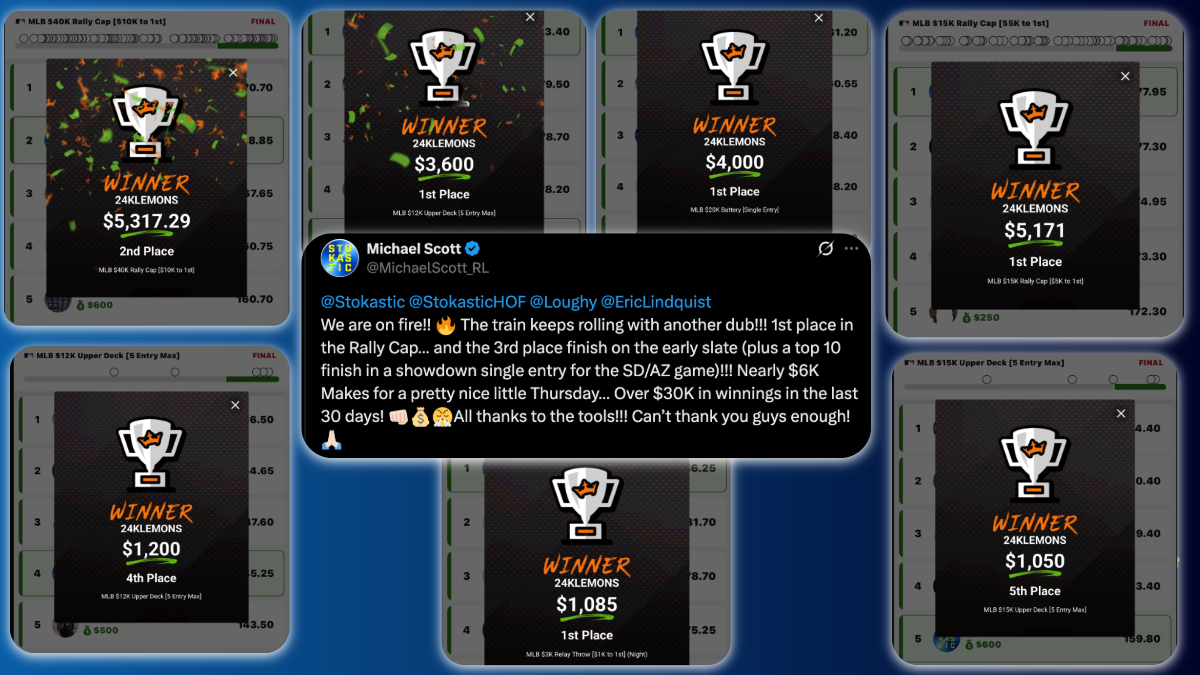
So the setup is plain: a ten-year DraftKings player picks up Stokastic Sims in June, starts entering MLB DFS tournaments, many of them single-entry, and by the end of July his posted results look like this. Everything in the table comes straight from his Hall of Fame posts, and nothing has been added to it. Entry fees and field sizes are not in his posts, so they are not on this page.
| Documented Result, In His Own Posts | What his posts show |
|---|---|
| Four First-Place Finishes In Single-Entry Tournaments In One Month | At least $3,000 each |
| One Night: Two First-Place Finishes, Plus A 5Th, 6Th And 11Th | Part of a $25,000-plus 30-day total at that point |
| Another Night: Two More Top-10 Finishes In The Upper Deck | Part of the same 30-day run |
| One Thursday: 1St In The Rally Cap, A 3Rd On The Early Slate, A Top-10 In A Showdown | Nearly $6,000 |
| One Quiet Tuesday: A 5Th And A 9Th | $1,000, "not too bad for a Tuesday" |
| The 30-Day Total He Posted | Over $30,000 |
The 30-day totals are running figures he posted along the way, not single-night payouts.
The row I keep coming back to is the Tuesday. A month that ends over $30,000 still includes nights where two top-10 finishes pay about $1,000, and he posted that night too. That distribution, a few huge nights carrying a lot of ordinary ones, is not an accident. It is what MLB tournament DFS looks like when it is going well, and it is exactly the shape the Sims are built around. Which brings us to the screens.
What Stokastic Sims Showed Him
MLB is the most volatile DFS sport there is. Pitchers get pulled early, a lineup's best hitter goes 0-for-4, and one team's offense erupts for ten runs while its hitters all score together. A static projection column gives you one number per player and asks you to trust it. Stokastic Sims play the slate out tens of thousands of times instead, so every hitter and pitcher carries a full range of outcomes, including the correlated ones where a whole offense pops at once, which is why stacking teammates matters in the first place.
Out of those runs come the numbers a winning MLB build is made from: projected value for every player at his salary, top-150 exposure, which tracks how often a player appears in the top-150 scoring lineups across all those simulated contests, and an ROI-ranked lineup pool that orders complete builds by how they performed across every run, set against the field's projected ownership. DFS edge comes from those two things working together: accurate projected value, and leverage against the ownership the field actually shows up with. A hitter whose top-150 exposure runs well ahead of what the field will roster him at is the kind of name that decides a tournament, and finding that gap every night is the entire job. That gap is also the only realistic way to read a run like this one. Four single-entry firsts in a month means four nights where one build beat an entire field, and single-entry play gives you no room to spray lineups and hope. The Rally Cap win, the Upper Deck top-10s, the showdown finish in the SD/AZ game: each of those was one leveraged build against a full field, which is exactly the contest shape the ROI-ranked pool exists to grade. The Stokastic Sims lineup-building walkthrough shows the screens themselves, and the same projections and ownership numbers start in the MLB DFS projections, ownership and stacks in the DataHub.
The read in one line: projected value says a player is worth his salary; top-150 exposure against projected ownership says the field is going to miss him. A winning MLB build needs both, and the second one is what a month like this is made of.
We do not have his exact exposures or roster calls, and I am not going to invent them. What his posts document is the process around them: night after night, he entered the builds those screens produced, in a sport where he had no old habits to fall back on. His shortest summary of the month is the honest one: "It's the tools."
The Sims that produced this output are part of every Stokastic DFS Weekly and Monthly package, and code CASH15 discounts them.
The Worked Example: How $30,000 In A Month Actually Adds Up
Walk the documented numbers forward and the month stops looking like a lottery ticket. Four single-entry firsts at $3,000 or more is at least $12,000 on its own, roughly 40 percent of the posted total from four entries. Add the nearly $6,000 Thursday and you are around $18,000 from a handful of peak nights, with the rest accumulated in top-10 finishes and a $1,000 Tuesday along the way.
That arithmetic is the worked example, and it drives the decision this whole page is about. Large-field GPP (Guaranteed Prize Pool) tournaments are top-heavy on purpose, so almost all of a month's money arrives on the few nights a leveraged build lands near the top of the standings. A player who chases that with hunches has no way to know whether his process is working through the quiet nights. A player working from a simulated lineup pool does, because the pool tells him what a good build looks like before first pitch, win or lose. Our guide to how to win DFS tournaments covers that leverage framework in full.
The Decision That Mattered
Here is the call I keep coming back to, because every winning month has one. Michael Scott had ten years of DraftKings instincts, and in a brand-new sport none of them applied: no favorite players, no old rules of thumb, nothing to override the numbers with. He let the Sims output decide what a good lineup was. In a format where most players' worst habit is talking themselves out of the uncomfortable roster spot, he simply did not have the habit to fight.
That is the decision that separated this month from the ten years before it, and it is the part anyone can copy. Every subscriber gets the same value and leverage numbers on the same screens; the follow-through of entering the build the runs kept surfacing, night after night, was his.
What A $30,000 Month Does And Does Not Mean
The honest part, and I would rather write it than have you find it out the hard way. Over $30,000 in a month is one documented outcome, and it is not a typical one. Most entries in large-field tournaments lose, most nights, for everyone, including people using very good tools. Nothing here is a promise that the Sims produce this result on any schedule, and DFS is not an income stream.
Two more things worth being straight about. These figures are contest winnings, the amounts DraftKings boards pay out, and his posts do not state his entry spend, so this page will not pretend to know his net. And one verified winner is evidence of exactly one verified winner. I am not going to pad that with claims about thousands of others. What I can point to is documented: this run, our $230,000 DraftKings winner case study before it, and the running feed of recent Stokastic Hall of Fame winners, all posted by the members themselves. The Sims do not remove risk. They improve the process, which is the only part of DFS you control. Variance decided which nights paid him. Process is why his builds kept being in position when they did.
More on this: Stokastic DFS Winner · Stokastic DFS Winner: $50,000 On The DK MLB Bat Flip · Stokastic DFS Winner: $230,000 On DraftKings With The Sims · Stokastic DFS Winner · Stokastic DFS Winner
How To Run The Same Setup
If you want to test the same path he took, it is short:
-
Start with code CASH15 on any Stokastic DFS package that includes the Sims, Weekly or Monthly. For this run that was an MLB package.
-
Open the slate's projections and ownership in the DataHub, which is where value and the field's tendencies first come into focus.
-
Run the Sims for your contest type and work the ROI-ranked lineup pool for the same gap that powered this case study: players whose top-150 exposure sits well above the ownership the field is projected to give them.
-
Enter the build you trust, single-entry if that is your style, and judge yourself on process through the quiet nights. The quiet Tuesday in the table above is part of how a $30,000 month actually happens.
Would this have worked for you? The screens he used show the same numbers to every subscriber, every slate. The month belonged to the player willing to enter what they surfaced, night after night. That part, no tool can sell you.
Stokastic Sims DFS packages (Weekly or Monthly) with code CASH15 — the paid simulation engine behind this documented $30,000 month on DraftKings.
Use code CASH15
Get Started