
Stokastic DFS Winner
By Sam Smith
August 26, 2026
Most winner stories are about confetti. This one is about a results screen. A Stokastic DFS winner who plays on DraftKings as cagea65 and posts as DFSGolden1 on X took down the DraftKings Bat Flip, the MLB tournament, with a lineup that scored 210.15 points and finished first for $50,000, and the Stokastic Sims results board for that contest shows the visible slice of his entry pool in one table: 18 lineups, finishes from 1st to 1,094th, and a winning build that looks nothing like the safe ones around it. This is a case study, not a victory lap. I am going to walk through what that board shows, cell by cell, because one row of it is the part you can actually learn from. One practical note up front, since this page exists to answer "would this have worked for me": the Sims are a paid product, part of Stokastic's DFS Weekly and Monthly packages, and code CASH15 takes 10 percent off them at the link below. The rest of the page is about whether the tool earns it.
The Quick Answer
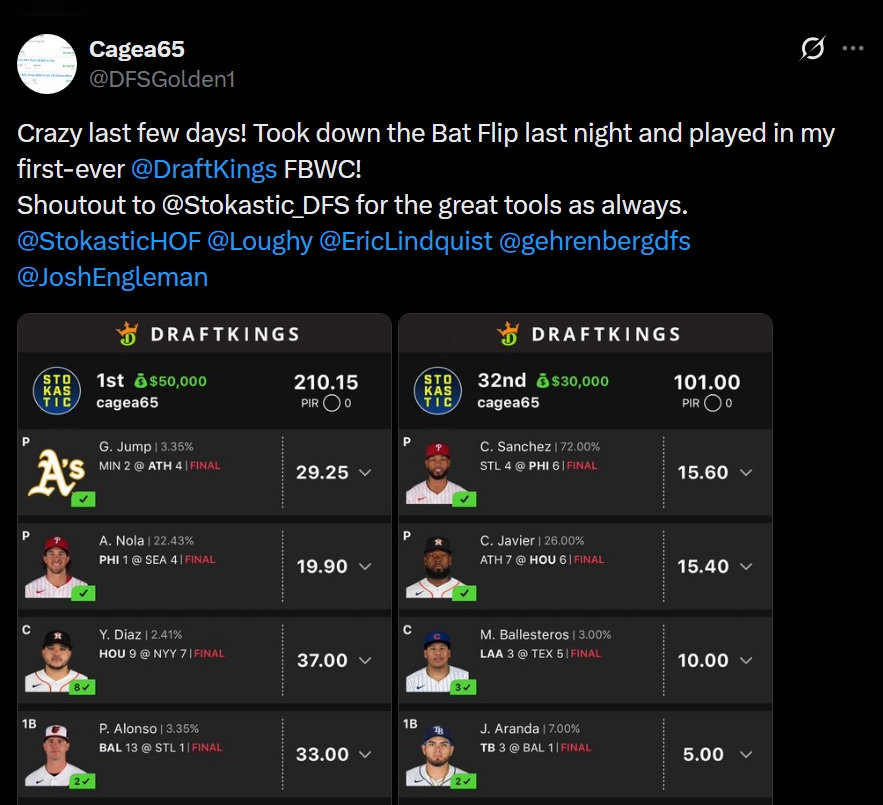
A Stokastic member playing on DraftKings as cagea65, known on X as DFSGolden1, finished first in the DraftKings Bat Flip, an MLB DFS tournament, scoring 210.15 points and winning $50,000. He built his entries with Stokastic Sims, the paid simulation engine inside Stokastic's DFS Weekly and Monthly packages, and the Sims results board for his contest documents the whole run. Code CASH15 takes 10 percent off those same packages at checkout.
See the Sims packages with CASH15
Below: what that results board actually shows, row by row, and the single build decision the $50,000 turns on.
What The Sims Board Shows
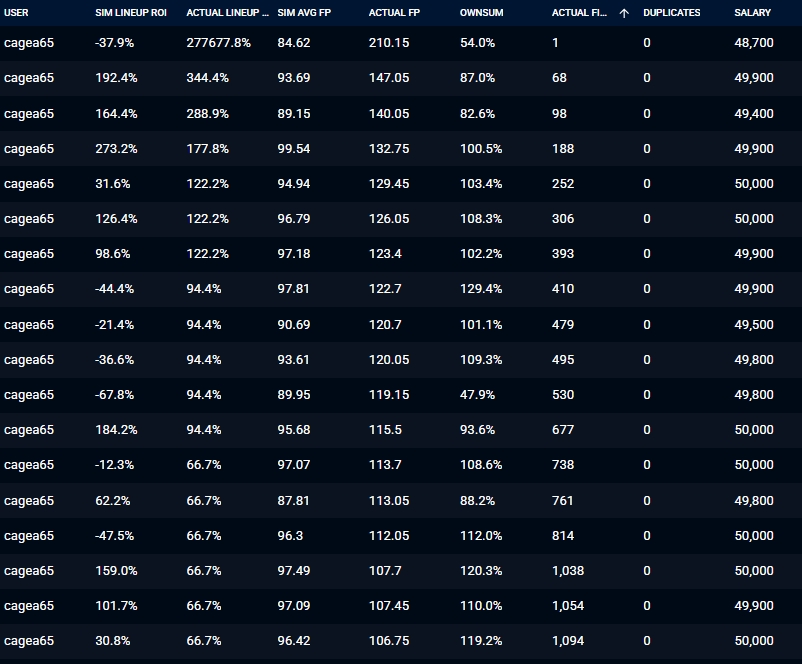
The board lists his entries sorted by finish, with the Sims' pre-contest numbers sitting next to what actually happened. Here are five rows from it, a few columns trimmed for width, every number exactly as the screen shows it:
| Actual Finish | Sim Lineup ROI | Sim Avg FP | Actual FP | Ownership Sum | Salary |
|---|---|---|---|---|---|
| 1 | -37.9% | 84.62 | 210.15 | 54.0% | $48,700 |
| 68 | 192.4% | 93.69 | 147.05 | 87.0% | $49,900 |
| 98 | 164.4% | 89.15 | 140.05 | 82.6% | $49,400 |
| 188 | 273.2% | 99.54 | 132.75 | 100.5% | $49,900 |
| 530 | -67.8% | 89.95 | 119.15 | 47.9% | $49,800 |
The winning lineup carried the lowest simulated scoring average on the entire visible board, 84.62 points, and posted 210.15. Its ownership sum, the column that adds up the field's ownership across every roster spot, reads 54.0 percent. All but one of his other entries sit between 82.6 and 129.4 percent, and the lone exception, a 47.9 percent build, finished 530th, which is worth pausing on: low ownership alone did not decide anything. The winning build also left salary unspent, $48,700 of the $50,000 cap, while two-thirds of the pool spent to within a hundred dollars of the max. And the duplicates column reads zero on every visible row, his winner included, so when that lineup hit, nobody else in the contest was holding it and first place did not have to be shared.
So what did the Sims actually contribute, if the winning row simmed below average? Everything around it. Stokastic Sims play the slate out tens of thousands of times instead of handing you one static number per player, and out of those runs come the outputs this pool was built from: projected value for every player at his actual salary, top-150 exposure, which tracks how often a player appears in the top-150 scoring lineups across all those simulated slates, and an ROI-ranked lineup pool that orders complete builds by how they returned across every run, with the field's projected ownership sitting alongside. The board above is that process graded after the fact: a spread of builds, not one guess, with the safer shapes banking deep finishes at 68th, 98th and 188th while one deliberately unpopular shape carried the ceiling.
The read in one line: projected value tells you a player is worth his salary; leverage against the field's ownership tells you what happens if he hits. The winning row is what a 54 percent ownership sum looks like when it hits.
That combination, accurate projected value plus leverage against the field's final ownership, is the entire DFS edge, and it is the specific thing the Sims are built to surface. If you want the full framework, our guide to how to win DFS tournaments covers ownership and leverage in depth, and the Stokastic Sims lineup-building walkthrough shows the screens themselves.
Every Stokastic DFS Weekly and Monthly package includes the Sims that produce this exact output, and code CASH15 discounts them.
The Decision That Mattered
Here is the promise from the opening paragraph, paid off: the decision this win runs through is entering the top row at all. That build simmed at a negative 37.9 percent ROI, which means that across all those simulated contests it lost money on average. Its 84.62-point simulated average was the lowest of any visible entry. A player who only trusts the average never submits that lineup. But a tournament like the Bat Flip does not pay the average, it pays the extreme top of the leaderboard, and the extreme top belongs to builds the rest of the field is not holding. At a 54.0 percent ownership sum, roughly half the crowd exposure of his own other entries, this was that build. When its night came in, there was no crowd standing on the same score, and the zero in the duplicates column meant the $50,000 was not split.
The same lesson runs the other direction too. His strongest build by simulated ROI, the 273.2 percent row, finished 188th. Solid, deep, and worth a fraction of first. The pool structure is the strategy: let the high-average builds bank the frequent outcomes, and let a low-ownership build carry the one outcome that pays for everything. Our contest archetype breakdown covers exactly this, why the lineup most likely to take first is often not the lineup with the best average, and how the Sims grade builds differently depending on the tournament you are entering. No simulation clicks the submit button, though. The tool put the whole spread on a screen before lock. Entering the uncomfortable row was his call.
What This Win Does And Does Not Mean
Here is the honest part, and I would rather write it than have you find it out the hard way. $50,000 is one outcome, and it is not a typical one. Large-field MLB tournaments are top-heavy on purpose: most entries lose, most nights, for everyone, including people using very good tools. The same board that documents the win says so in plain numbers, a build that simmed at 273.2 percent settling for 188th while a build that simmed negative took first. Averages are honest over the long run; any single night swings far around them, in both directions. Nothing on this page should read as a promise that the Sims produce this result on any schedule, and they are not an income stream.
One verified winner is evidence of exactly one verified winner. I am not going to dress that up with claims about thousands of others, because I cannot document them, and you should not trust a page that pretends to. What I can document is this: a real member, a real first-place $50,000 score, a real results board with his username on every row, and a specific paid tool in the middle of it.
The Sims do not remove risk. They improve process, which is the only part of DFS you control. Variance decided that this was the night the leverage build paid. Process is why that build existed and was entered when it did.
More on this: Stokastic DFS Winner: Another $50,000 On The DK MLB Bat Flip · Stokastic DFS Winner: $50,000 On The DK MLB Bat Flip · Stokastic DFS Winner · Stokastic DFS Winner · Stokastic DFS Winner: $30,000 In A Month With The Sims
How To Run The Same Setup
If MLB DFS is a world you play in, or want to, here is the same path, step by step.
- Pick a Stokastic DFS package that includes the Sims, Weekly or Monthly, using code CASH15 at the link below.
- Start with the MLB DFS projections, ownership and stacks in the DataHub, which is where the slate's pricing and field tendencies come into focus. Those are the inputs the whole board above was built from.
- Run the Sims for your contest type and build a pool, not a single lineup. Take some entries from the top of the ROI rankings, then add at least one with the winning row's documented fingerprint: a simulated average that lags the rest of your pool and an ownership sum near the bottom of it. That is the 84.62-sim-average, 54.0-percent-ownership shape that scored 210.15. The way you find those players on the Sims screens is top-150 exposure running well ahead of the ownership the field is projected to give them. The build will feel uncomfortable to enter. It is supposed to.
- Enter the builds you trust, and size your entries to what you can comfortably lose, because most tournament entries do not cash.
Would this have worked for you? The screens he used show the same numbers to every subscriber, and some version of his gap shows up on most slates: a build the runs keep surfacing at ownership the field will not match. The $50,000 belonged to the player willing to enter that row and live with it. That part, the Sims cannot sell you.
Stokastic Sims DFS packages (Weekly or Monthly) with code CASH15 — the paid simulation engine behind this documented $50,000 DraftKings MLB win.
Use code CASH15
Get Started