
MLB DFS Picks Today (8/17): Snell Anchors An Ugly Slate
August 17, 2026
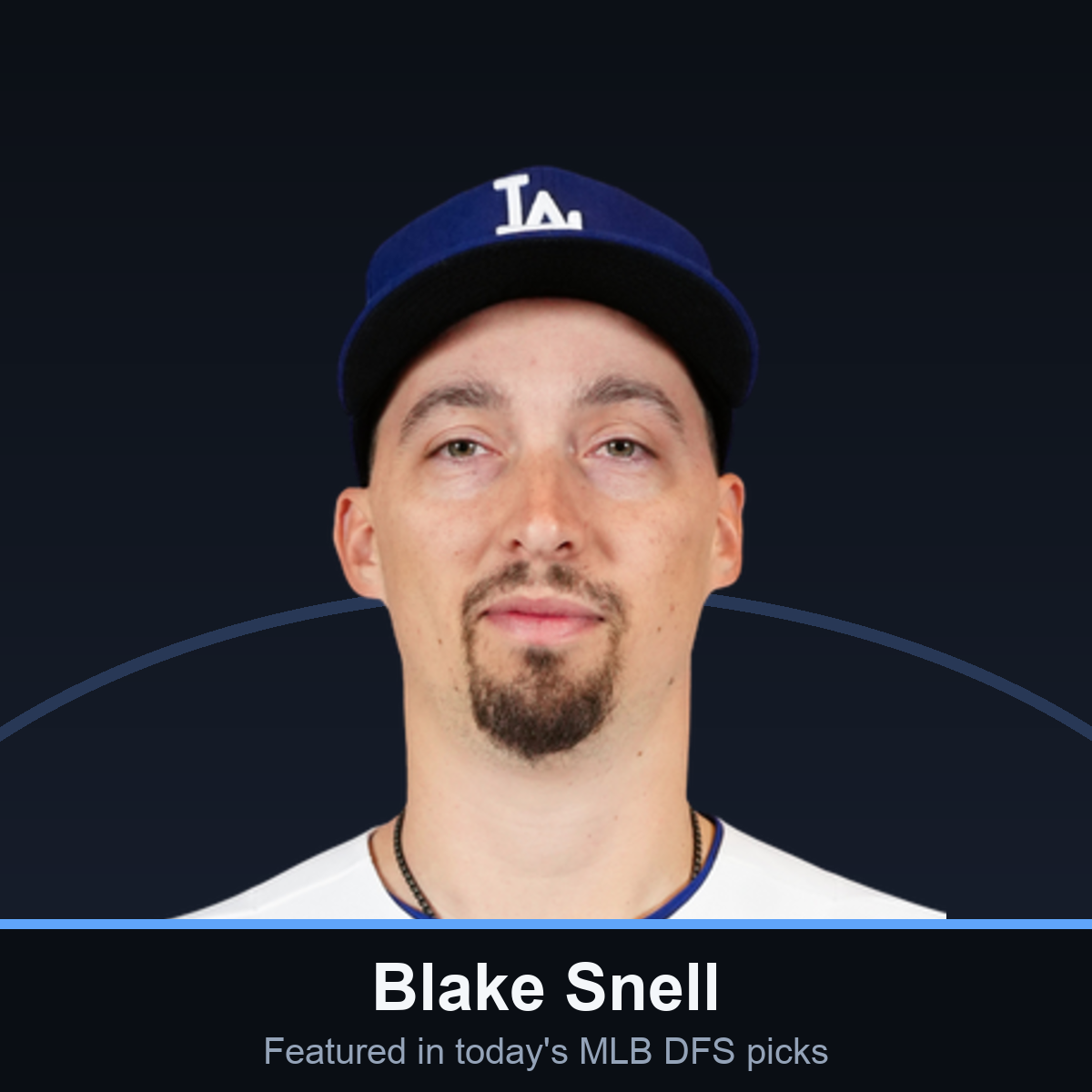
Blake Snell — one of the featured players on today's slate.
The Quick Answer
Monday's seven-game slate is, in the show's own words, the worst pitching board in about a month. There is no elite arm sitting in an elite spot. **the best available arm is still Blake Snell (LAD) at $9,000 even though he is throwing at Coors Field, while the Los Angeles Dodgers are the runaway top stack. That turns the day into a leverage exercise: the three arms the show force-boosted are the cheap ones nobody wants, and the stacking decision is really about how much Dodgers you can afford. The full pitcher board, the Dodgers pricing math and the three leverage arms are below.
A Slate With Nowhere Safe To Hide At Pitcher
Start with the thesis, because it drives every decision that follows: this is a bad pitching slate, and the show does not try to talk itself out of that. "Pitching sucks," was the blunt framing, and the ownership numbers back it up. When you scroll the Stokastic MLB Data Hub top-stacks and pitcher tools, the tell is not any one arm; it is how thin the whole board is. There is no version of "just pay up for the safe ace" today, because the safest arm on the slate is pitching a mile above sea level.
That single fact reframes the build. On a normal slate you build around a pitcher and work outward. Here the foundation is a stack, the Dodgers, and then you fight over which flawed arm to pair with it. Hold that idea, because it pays off when we get to the leverage plays the show forced itself to name.
The Pitching Board: Snell Leads, Then It Gets Thin Fast
Here is the shape of the pitcher pool, ranked the way the slate's ownership sorted it, with the strikeout props that expose just how little upside sits below the top three. The show gave firm salaries only for the arms it dug into (Snell at $9,000, Valdez at $7,500, Wacha at $8,800), which appear in the sections below.
| Pitcher (Team) | Matchup | Ownership | Strikeout prop |
|---|---|---|---|
| Blake Snell (LAD) | @ Rockies (Coors) | ~45% | 6.5–7.5 (juiced over) |
| Shota Imanaga (CHC) | vs. White Sox | 33% | 5.5 |
| Framber Valdez (DET) | @ Pirates | ~25% | 5.5 |
| Nolan McLean (NYM) | vs. Padres | 21% | 5.5 |
| Michael Wacha (KC) | vs. Athletics | ~13% | 4.5 |
| Walker Buehler (SD) | @ Mets | 12% | 3.5 |
| Luis Castillo (CWS) | @ Cubs | 11% | 4.5 |
| Tomoyuki Sugano (COL) | vs. Dodgers | 7% | 2.5 |
| Carmen Mlodzinski (PIT) | vs. Tigers | 5% | 2.5 |
The row that tells the whole story is the bottom two: a 2.5 strikeout prop on Sugano and Mlodzinski. When multiple probable starters are lined at two and a half strikeouts, the market is telling you nobody expects a ceiling game. The practical read for builders is that the lineups facing those arms, the Dodgers against Sugano and Detroit against Mlodzinski, become the stacks worth targeting, which is exactly why the show kept circling back to leverage over talent.
Blake Snell Is The Best Arm, Even At Coors
Snell being the top-owned pitcher on a Coors slate feels wrong until you look closer. He is a left-hander, and the Colorado Rockies are abysmal against left-handed pitching, with a 90 wRC+ on the year with a 25% strikeout rate. They get a small bump from hitting at altitude, but even at home they strike out at the 11th-highest clip in the league, and Snell has genuine swing-and-miss stuff.
Then there is the form. This is only his second start of the season and his first since May 9, back from a layoff of more than three calendar months. In that return he went six innings, allowed three hits and one earned run, and struck out 10 against Kansas City. The props reflect the confidence: a strikeout line of 6.5 to 7.5 juiced to the over, an outs prop of 17.5 (about six innings), and an earned-runs prop of 2.5 heavily juiced to the under. At $9,000 the show calls him a deal, noting "he can easily be $9,500-plus."
The honest counterpoint is ownership. Snell is heading toward roughly 45%, and possibly closer to 50%, on a seven-game slate. That is a lot of the field on one arm, so the real question is not whether he is good; it is whether you go over the field or under it. The show's answer leaned toward simply eating it: on a slate this thin at pitcher, being contrarian off the one arm with a real ceiling is its own risk.
The Chalk Behind Him: Imanaga And Valdez
Two more arms drew real ownership, and neither is a clean smash.
Shota Imanaga (CHC) is home against the White Sox, whose 3.9 implied team total is the lowest on the board, and he sits around 33% ownership. The matchup is good; the concern is his own recent ceiling. His last tournament-winning start was May 7 (30 DraftKings points), and he has not cleared 23 DraftKings points in any game since. He is fine; he just has not been a lineup-winner lately.
Framber Valdez (DET) at $7,500 is the definition of hit-or-miss, and the show said so plainly: "the range of outcomes for him is absurd." He draws Pittsburgh, which strikes out 24% of the time against lefties, in a pitcher-friendly PNC Park with a 4.1 Pirates total, a perfectly reasonable spot. But his strikeout rate is down about 5% from a year ago, his swinging-strike rate sits at 8% (three points lower than last season), and he carries a single-digit strikeout-minus-walk rate. He does not give up much power, which is the one thing keeping him viable, but "he could give you 30 or he could just give you a strong minus-5." At ~25% ownership, that volatility is why the show treats the Pirates as a quiet hedge stack rather than fading the game entirely.
The Three Leverage Arms The Show Forced Itself To Boost
Here is the forward promise paid off. The show ran a live exercise: among the pitchers who are not Snell, Imanaga or Valdez, name three to boost above field level. The answer was not about who is good (none of them are). It was about where the leverage sits.
- Michael Wacha (KC), $8,800. He faces an Athletics lineup that is genuinely broken right now. Their active roster ranks 29th in baseball against right-handers across more than 2,000 plate appearances: a .304 wOBA (29th), a .129 ISO (dead last, and by 13 points), a 7.3% walk rate (29th), with much of their top-end talent on the injured list. Wacha's 19% strikeout rate is only league average, and at $8,800 with a 4.5 strikeout prop he is a tough price to stomach, but this offense is so bad you could see him go seven or eight clean innings. "If he goes seven scoreless, I might look real smart."
- Nolan McLean (NYM), 21% Owned. He draws a getable San Diego team and has a real ceiling, even if he has been, in the show's words, "painfully average for two months." The case is leverage: he is expensive but noticeably less owned than Snell and Imanaga.
- Martin Perez (ATL). A pure dart. He has limited runs well lately but will not miss bats and is likely on a short pitch count in the high-70s to low-80s. "Once you get down here, you're just throwing darts at a moving target." He makes the list only because the tier below the top three has no good answers.
Callback to the thesis: this is what a bad pitching slate does. On a good slate you would never force yourself onto three arms this shaky. Today, the leverage in the pitcher pool is the whole game.
Stacking: The Dodgers Are The Anchor, But Price Caps You
If the pitching is a minefield, the hitting has a clear headliner. On the top-stacks tool the Dodgers show a roughly 30% top-stack probability, the highest stack score on the board, and a team total near seven runs, nearly two runs higher than the next-closest team (Kansas City at 5.2, with the Rockies themselves at 4.3). When one team's total is almost two runs clear of the field, that says plenty.
The problem is affordability, and it is worth seeing in the salaries.
| Dodgers Hitter | Salary | Note |
|---|---|---|
| Shohei Ohtani | $7,000 | 1B/OF eligible |
| Freddie Freeman | $6,200 | ~15% owned |
| Max Muncy | $5,700 | |
| Andy Pages | $5,600 |
Line those four up and the math turns hostile fast: try to five-man stack the most expensive Dodgers and you are left with about $4,000 for two pitchers and three more hitters, which does not work. That is why the show is mostly building three- and four-man Dodgers stacks, landing around 24% total exposure (roughly 11% three-man, 7% four-man) rather than loading five-mans. Against a 17% field ownership on the Dodgers, 24% on a seven-run Coors team is actually restrained; the price is doing the fading for you.
Where The Secondary Bats Live
Because you cannot only play Dodgers, the secondary stacks matter more than usual. The show is getting its most five-man exposure to Kansas City (5.2 total) and Boston. The Royals draw Athletics starter Mason Barnett, who has served up six home runs over his last two starts and is running a 2.6 HR/9 across 38 innings, in a Kaufman Stadium that plays friendlier to power this year; Salvador Perez batting cleanup at $3,300 with multi-position eligibility is a tough value to pass up, and Bobby Witt Jr. is drawing heavy exposure (around 35%). Boston is a straight platoon play against Arizona left-hander Mitch Bratt. The Red Sox rank top-five in wRC+ against lefties, bottom-eight in strikeout rate, fourth in weighted on-base average and top-five in ISO. Atlanta (5.1 total) against Minnesota's Bailey Ober, who "got blown up last time," rounds out the double-digit-exposure teams.
Notably, the show is off the Chicago Cubs entirely against Luis Castillo. Castillo did just shred Cincinnati for 38 DraftKings points (seven one-hit innings, 10 strikeouts) last time out, and at Wrigley with four-mile-per-hour winds blowing in, the show would rather leave the Cubs bats alone than chase that spot.
A Worked Example: Building Around The Dodgers Without Going Broke
The show ran this math live, and it is a clean template for anyone building today:
- Start with the Dodgers, then test the expensive five-man. Line up the priciest bats: Shohei Ohtani ($7,000), Freddie Freeman ($6,200), Max Muncy ($5,700) and Andy Pages ($5,600), plus a fifth. That core alone leaves roughly $4,000 for two pitchers and three more hitters, which simply does not fit.
- Drop to a three- or four-man Dodgers core. Keep two or three of the bats above, then fill the rest of the stack with cheaper hitters lower in the Los Angeles order. This is why the show is landing near 24% Dodgers exposure in three- and four-man shapes, not five-mans.
- Pair it with one leverage arm, not the full chalk. Instead of paying all the way up for Snell and a big Dodgers stack, slot in Michael Wacha ($8,800) or a cheaper dart, keeping salary for the bats.
- Fill the remaining hitter slots from a cheap secondary stack. Salvador Perez ($3,300) batting cleanup for Kansas City against Mason Barnett, or a Boston bat against Mitch Bratt, opens the money the Dodgers core costs you.
That four-step sequence is the whole difference between an unbuildable five-Dodgers dream and a lineup that actually clears salary. Lean on correlation as you do it, keep options open with late swap, and if you are newer to slate construction, the how to win at MLB DFS primer and the MLB DFS glossary cover the vocabulary behind all of this.
The Bottom Line
Zoom back out and the day resolves cleanly. This is a slate with no safe pitcher, so the process inverts: build around the Dodgers, accept that price keeps you to three- and four-man versions, and find your edge in the arms and stacks the field is avoiding. Snell is the one pitcher worth simply eating the chalk on; Wacha, McLean and Perez are the leverage darts. Kansas City and Boston are the secondary bats that make a Dodgers-light lineup work. On an ugly pitching slate, the winning lineup is not the one with the best pitcher. It is the one that navigated the risk everyone else is stuck with. Run today's full MLB DFS projections, ownership and stacks in the Data Hub before you lock, and cross-check the MLB DFS picks hub for the latest board.
Watch The Video
The full live Data Hub build for Monday's slate (pitcher tiers, the Dodgers stack math and the forced leverage exercise) is on the Stokastic MLB DFS Strategy Show. Watch on YouTube.
Get The Stokastic MLB Sims
Every number above came off the same MLB Data Hub run pulled up live on today's show.
Use code MLBSTRATEGY for 10% off any Stokastic DFS or Props package, weekly, monthly or all-access.
Get 10% off with MLBSTRATEGY →
For more on building around a volatile board, see our contrarian and multi-entry strategy guides, or the Stokastic Sims tutorial if you're new to the tools.
More on this: MLB DFS Hub: Every Live Stokastic MLB Page · MLB DFS Picks Today (9/16) · MLB DFS Primer For DraftKings And FanDuel