
MLB DFS Picks Today (8/20): Gavin Williams
August 20, 2026
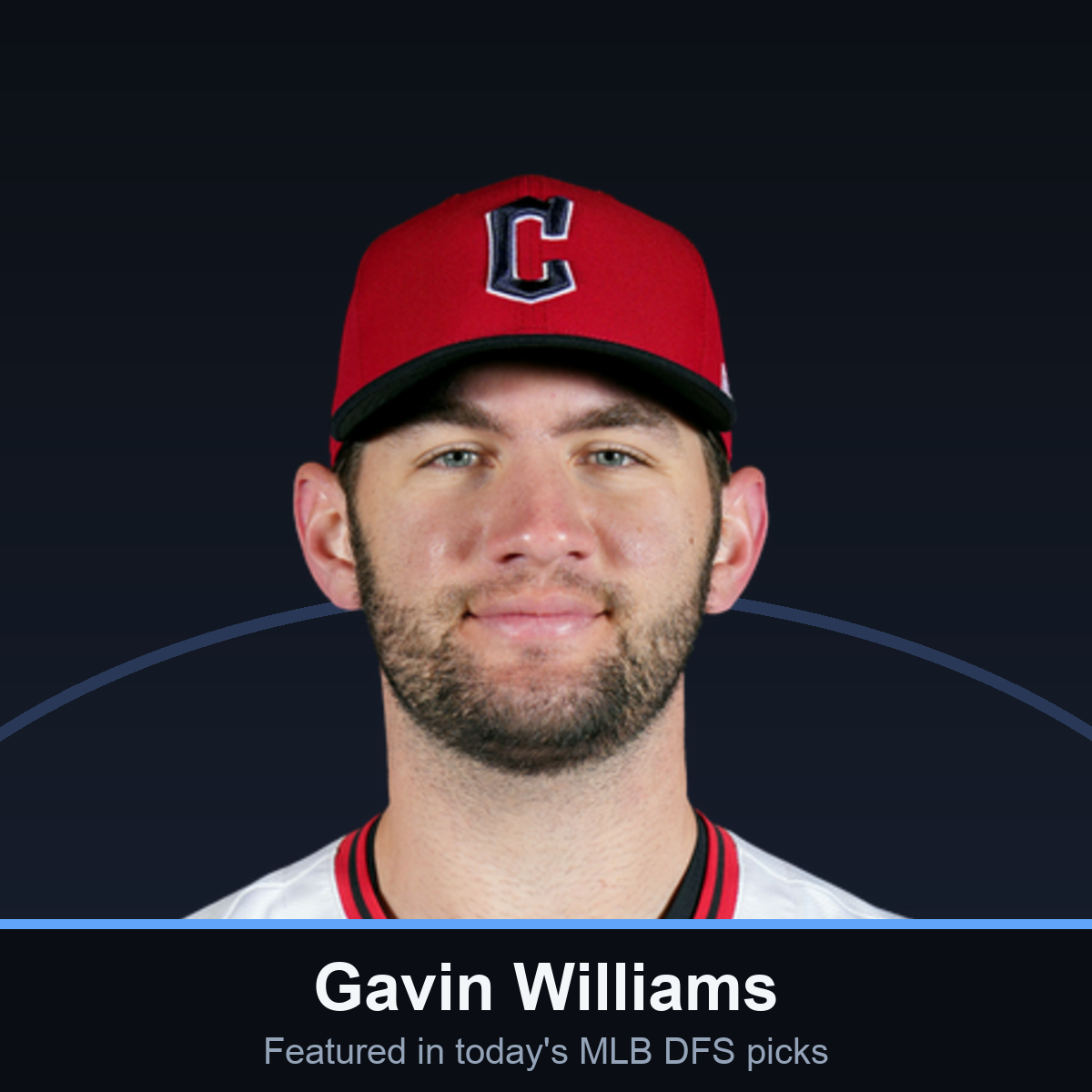
Gavin Williams — one of the featured players on today's slate.
The Quick Answer
Thursday's six-game early MLB DFS slate (Cardinals-Reds, Giants-Guardians, Blue Jays-Rays, Athletics-Royals, Braves-White Sox, Mariners-Brewers, all locking between 12:40 and 2:10 PM ET) finally has what this week's boards haven't: a pitcher who separates. Gavin Williams at $9,800 is the first arm our Sims have projected over 20 DraftKings points on a main slate all week, and our builds carry him in 88% of lineups. Because everyone will be on him, the real differentiation moves downstream, to a Cleveland stack the Sims are building at four times the field's rate. The full pitcher board, the Seymour-vs-Kirby call, and where that stack leverage lives are below.
Watch The Video
We broke this early slate down live on the Stokastic MLB Strategy show. Watch on YouTube.
A Slate That Finally Has A Ceiling Arm
A day after a flat four-game board where nobody separated at pitcher, Thursday flips the script. This is the first show all week where a pitcher projects over 20 DraftKings fantasy points on a main slate, and it's Gavin Williams at 22, roughly 6.5 points clear of the next-best arm. When one pitcher towers like that, the slate stops being about finding the right arm and starts being about what you do around the arm everybody already found. That's the thesis for Thursday: play the obvious pitcher, then win the slate at the stack board, where the totals are bunched, the ownership is bunched, and one team our Sims love is sitting almost untouched by the field. We'll get to that team.
First, the case for the chalk.
The Gavin Williams Case
Williams draws the Giants in Cleveland, and the profile is everything you want in a ceiling play. He runs a 32% strikeout rate against a 7% walk rate, and his last start, a rare stinker, doesn't change the underlying skill set; he's going to throw a clunker now and then, and he's usually very good. The market backs the bounce-back: his strikeout prop sits at 7.5 with juice to the over, the only number on the slate above 5.5, his outs prop is 17.5 or 18.5 depending on the book with massive juice to the over, and his earned-run line is just 1.5 at even money on both sides.
Here's the outlier stat, though: at $9,800, Williams is the No. 1 value score in the entire DataHub. Sub-$10K pitchers essentially never lead the slate in value; DraftKings does this on shorter slates, pricing genuinely elite arms below where they'd sit on a full board, and it's why he's so hard to get away from. Our Sims agree, rostering him in 88% of builds against a 45% top-two-pitcher probability that actually sits below his projected ownership.
The honest risk: San Francisco's active roster ranks third in wRC+ against right-handed pitching with a .340 wOBA, so this is not a soft matchup on paper. But the team-level strikeout number is misleading. Look at the individual bats and five or six hitters in this lineup carry 25%-plus strikeout rates against righties, which is exactly the kind of lineup a 32% strikeout arm feasts on. And if you're worried about the recent starts where he didn't complete six innings, check the pitch counts instead: 102 and 91 in two of his last three. Cleveland isn't limiting him; he just hasn't been maximally efficient, and efficiency noise is not a workload cap.
The Rest Of The Board
| Pitcher | Team | Price | Matchup | K Prop | The Read |
|---|---|---|---|---|---|
| Gavin Williams | CLE | $9,800 | vs. Giants | 7.5, juiced over | First 20+ point projection of the week; 88% of our builds |
| Ian Seymour | TB | $8,800 | vs. Blue Jays | 5.5, juiced under | Toronto is at 74 wRC+ vs. lefties, and Vladimir Guerrero Jr. is out of the lineup |
| Robert Gasser | MIL | — | vs. Mariners | 5.5 | The Sims' No. 2 arm at 30% of builds; discounted with a 17.5 outs prop |
| George Kirby | SEA | ~$300 off Seymour's $8,800 | at Brewers | — | Milwaukee is 7th in wRC+ vs. righties with the league's highest walk rate |
| Michael McGreevy | STL | — | at Reds | — | 17% strikeout rate caps it, but 79 degrees in Cincinnati defuses the park |
| Gage Jump | Athletics | — | at Royals | 4.5, -162 over | The strongest prop-market signal among the value arms |
| Landen Roupp | SF | $8,000 | at Guardians | 4.5 | Paying $8,000 for a tough matchup; light exposure |
| Randy Dobnak | KC | $7,200 | vs. Athletics | 3.5, juiced under | 14% strikeout rate; lowest projection on the slate |
| Shane Bieber | TOR | Cheapest on slate | at Rays | 3.5 | Not bad, just no strikeout path to value |
| Grant Holmes | ATL | — | at White Sox | — | 19% strikeout rate and about 75 pitches per start lately |
Before the passes, the host's own top three: Williams, Gasser, and, in his words, disgusting as it sounds, McGreevy. The Sims agree on the second name. Gasser is our No. 2 exposure at 30% of builds, a discounted arm carrying a 5.5 strikeout prop and a 17.5 outs line against a Seattle offense that has gone stagnant, and he deserves core treatment, not afterthought treatment. McGreevy's 17% strikeout rate wouldn't play on a full board, but on a six-gamer with Cincinnati sitting at a mild 79 degrees instead of its July furnace, he's a real piece at 11% of our builds.
The row worth narrating is Dobnak, because he's the cleanest illustration of why a good real-life pitcher can be a fantasy pass. His run prevention is genuinely impressive: a 54% ground-ball rate, a 5% home-run-per-fly-ball rate, and a 3.7% barrel rate allowed this year mean nobody is squaring him up. But he pairs a 14% strikeout rate with a 9% walk rate across just 41 innings, his strikeout prop is 3.5 with the juice pulling under, and at $7,200 he isn't even priced like the punt he'd need to be. Six strikeouts last time out came against the Angels, and everybody strikes out the Angels. Threading the needle to a usable score requires everything to break right. Bieber is the same story from a different angle: the cheapest pitcher on the slate not because he's expected to get hit, but because a 3.5 strikeout prop and a normal 16.5-outs, 2.5-earned-runs market profile leaves no ceiling to pay for.
Seymour Over Kirby Is The Call We Keep Coming Back To
Below that core, the one genuine tiebreaker on this board is the two mid-priced arms sitting basically at the same price, and the Sims lean is Ian Seymour at 26% exposure against George Kirby at 5% or less. The matchup gap is the whole argument. Toronto doesn't strike out much against lefties, true, but they sit at a 74 wRC+ against left-handed pitching, ahead of only the Giants, with a .276 wOBA and a .113 ISO in the split, and now Vladimir Guerrero Jr. is out of Thursday's lineup on top of it. Seymour brings real strikeout stuff (117 strikeouts in 97.1 innings, a rate that doesn't need a whiff-happy opponent to clear a 5.5 prop) and has thrown 90-plus pitches in three straight starts, so the leash is there even against a contact-first lineup.
Kirby's problem is the other dugout. Milwaukee ranks seventh in wRC+ against righties, eighth in wOBA, and draws walks at the highest rate in baseball; they make pitchers work even when they're not slugging. Kirby's strikeout rate is also down 6% from last season, and his road splits have been the ugly half of his profile, which matters with Seattle playing in Milwaukee. If you want him as a pivot, know that he projects to be lightly owned at around 17% on a six-game slate, so the leverage is real. But with only about $300 separating him from Seymour's $8,800 tag, the easier path is the lefty facing the lineup that can't hit lefties. Seattle's season tells the same story from a distance: a rotation this talented sitting at 60-67, somehow still just four games back in the AL West, keeps shooting itself in the foot.
Stacks: Flat Totals, One Real Leverage Play
Remember the thesis: with Williams locked in as the slate's one tower, this is where Thursday is actually won. There are no monster team totals on this board, and the ownership shows it; nine different teams project between 8% and 12% stack ownership, which is about as bunched as a six-game slate gets. St. Louis grades out No. 1 in both stack score and value in the DataHub, with Cincinnati grading out just behind them on both measures, so the natural build is a Cardinals-Reds game stack in Cincinnati, where a mild 79-degree day takes the scariest version of that park out of play.
But here's the number that does more differentiating than any pitcher decision on this slate: our Sims are building Cleveland stacks against Landen Roupp into 24% of lineups, while the field is stacking the Guardians less than 6% of the time. That's four-to-one leverage on a team that grades well on value and costs almost nothing in ownership. The logic follows from the pitcher chalk. Because our builds are heavy on Williams, Seymour and the other popular arms, the Sims naturally rotate stack exposure away from the chalky offenses and toward the spots the field leaves empty, and Cleveland against an $8,000 Roupp in a tough matchup is that spot. It's the same construction principle covered in our correlation strategy guide: when pitcher ownership concentrates, stack ownership is where you earn your uniqueness back.
| Team | Opposing Pitcher | Our Exposure | The Read |
|---|---|---|---|
| Guardians | Landen Roupp | 24% | Field is under 6%; the slate's clearest leverage |
| Reds | Michael McGreevy | 18% | Grades just behind St. Louis in stack score and value |
| Cardinals | Brady Singer | ~15% | No. 1 stack score and value; near the field's ownership |
| Giants | Gavin Williams | 7% | The hedge inside the 12% of builds without Williams |
| Royals / Athletics | Gage Jump / Randy Dobnak | Field-level | Slightly over the field on the A's |
| Brewers / Blue Jays / White Sox | Kirby / Seymour / Holmes | Underweight | Fading the offenses our pitchers face |
Two rows deserve the extra sentence. The 7% Giants exposure is not a mistake; it lives inside the 12% of lineups that don't roster Williams, so if he does get torched, some builds are on the right side of it. And the Rays are missing from the board entirely because they carry the lowest value score of any team, which is a pricing story, not a talent story: Tampa Bay just came home from a stretch that ran through Coors Field and Sacramento's Sutter Health Park, and prices like Junior Caminero at $6,600 and Yandy Díaz at $5,600 still look inflated from that run environment. Facing Bieber isn't scary; paying those tags is.
A Worked Example: 20 Entries, Built The Way The Sims See It
Here's what those exposure numbers mean across 20 entries. At 88%, Williams anchors 18 builds, and the 7% Giants stack lives inside the two without him, so the one scenario that sinks the chalk (that third-ranked wRC+ offense getting to him) is the same scenario where a slice of your entry profits from it. The 24% Cleveland position puts Guardians bats in roughly five of your 20 builds while a field under 6% holds about one, and the construction logic stacks cleanly: Cleveland bats can share a lineup with Williams, their own starter, and the game script where the Guardians pile runs on Roupp is the same one where he works deep with a lead. The rest spreads across St. Louis and Cincinnati, the teams that actually top the stack scores, so the leverage never costs you raw projection. Match the field where the field is right, and be four times different where it's asleep.
The Hitters Behind The Numbers
José Ramírez is our highest hitter exposure on the slate at 44%, and this is a conviction call, not a hot-hand call. He hasn't homered since returning from the injured list, but the shape of his game is intact: a pair of stolen bases inside his last ten games, two doubles over his last four, and a three-hit game on Tuesday. When the pieces come together, he still delivers monster lines, and on a slate where his stack is the leverage play, he's the anchor. Around him, Steven Kwan headlines the outfield mix and a pair of Cleveland bats land at 13% each in the infield, alongside St. Louis pieces like Iván Herrera, Alec Burleson and Joshua Báez, plus Cincinnati's Matt McLain and Elly De La Cruz, who draws heavy exposure against McGreevy.
The other pattern worth noticing: we're not stacking Kansas City much, but Bobby Witt Jr. and Maikel Garcia both come in well over the field as individual exposures against Gage Jump, the same way Ronald Acuña Jr. hits 27% against Anthony Kay while the Braves stack overall sits at half the field. Not stacking a team and not rostering its stars are different decisions, and the Sims make them separately. One aside from the catcher pool: Cal Raleigh, hitting .156 this year with 13 home runs, somehow more of them at home (seven) than on the road (six), remains priced like a name brand, and he isn't in Seattle's posted lineup for the afternoon game anyway. Slate-wide, the catcher exposure concentrates on Salvador Perez and Iván Herrera instead. Overall, our hitter exposure concentrates across Cincinnati, Cleveland and St. Louis with a side of Kansas City, which is exactly what the stack table above says it should be.
How We're Building It
These numbers come from a fresh Sims run this morning; the DataHub updated at 10:55 AM ET, minutes before lock-window decisions start mattering. On a six-game board where nine teams sit within four points of stack ownership of each other, the MLB DFS projections, ownership and stacks in the DataHub are how you see the Cleveland-shaped gap between what the field is doing and what the numbers say, and it's worth a recheck closer to the 12:40 PM ET first lock. If the ownership and leverage language here is new, start with the MLB DFS glossary and the Sims tutorial; the multi-entry guide covers how to spread 150 builds across a spot like this.
The Bottom Line
Come back to the number the slate opened with: 22 projected DraftKings points, the first pitcher over 20 all week. Williams is correct chalk, and 88% exposure to a $9,800 arm with a 7.5 strikeout prop is the Sims saying so out loud. But everyone gets to play the obvious ace on a day like this, which is why the slate's edge isn't at pitcher at all. It's the 24%-versus-6% Cleveland gap, the Seymour-over-Kirby matchup call, and the discipline to let José Ramírez's profile outvote his power drought. Play the tower, then be different everywhere else.
Check today's MLB DFS picks hub for the rest of the day's slates, or start with how to win at MLB DFS if you're new to building around heavy chalk.
Get The Stokastic MLB Sims
A slate with one towering arm and nine bunched stacks is exactly when the Sims earn their keep: real projections, live ownership, stack scores and the exposure controls that surfaced a 24% Cleveland position the field is ignoring. Get 10% off any DFS or Props package, including All Access, with code MLBSTRATEGY.
More on this: MLB DFS Hub: Every Live Stokastic MLB Page · MLB DFS Picks Today (9/16) · MLB DFS Primer For DraftKings And FanDuel