
MLB DFS Picks Today (9/16)
September 16, 2026
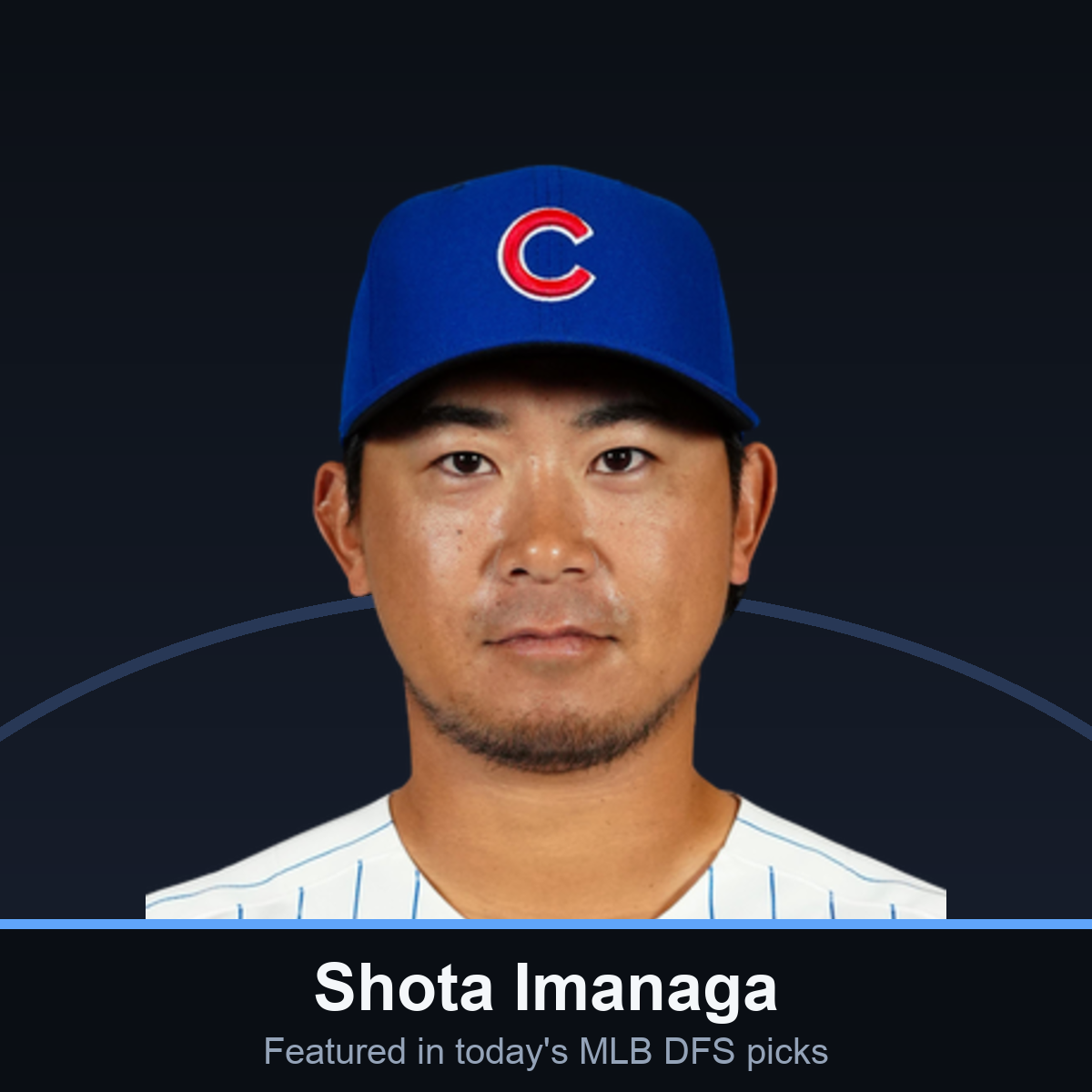
Shota Imanaga — one of the featured players on today's slate.
The Quick Answer
Wednesday's main MLB DFS slate has an unusual problem at pitcher: the three most popular payup arms are Shota Imanaga (CHC) at $8,800, George Kirby (SEA) at $9,000 and Yusei Kikuchi (LAA) at $6,600, and two of them, Kirby and Kikuchi, are starting the exact same game against each other. I'm breaking down why I still prefer Kikuchi's price over Kirby's matchup, why Houston is the stack the field is under-rostering behind San Diego's chalk, and where a four-game early slate with almost no pitcher separation still has one real leverage stack. The full pitcher board and the stack math are below.
Watch The Video
We broke this slate down live on the Stokastic MLB Strategy show. Watch on YouTube.
Three Payups, One Head-To-Head, No Easy Answer
A normal slate gives you three payup pitchers in three different games, and you pick the best matchup. Wednesday doesn't. Imanaga is home against Atlanta at Wrigley. Kirby is on the road in Anaheim. And the pitcher Kirby is facing, Kikuchi, is a payup option in his own right. That's the first thing worth saying out loud: two of the three chalk arms are starting against each other, which means rostering one takes the other fully off the table for that lineup. The second thing worth saying is that none of the three projects for more than 15 fantasy points, the lowest ceiling I've seen at the top of a slate this size in a while. When the payup tier is capped that low, price starts to matter as much as matchup. That tension is the whole pitcher decision today, and it's why Kikuchi, not Kirby, ends up my preferred play even though Kirby's matchup is the best of the three.
The Imanaga Case, And Why I'm Passing
Imanaga's strikeout stuff is genuinely good: a 26% strikeout rate against lefties across roughly 180 plate appearances this season, a 23% rate against righties across about 500, and a swinging-strike rate near 15%. His strikeout prop sits at 5.5 with the market leaning over, and his outs prop is 17.5 with juice to the over, both signs Vegas expects him to cruise. The hard-contact numbers pull the profile back down, though: a .241 ISO against lefties and .192 against righties, both above average, so hitters who connect are doing damage even against solid strikeout stuff.
Atlanta's lineup against lefties this season ranks 24th in wRC+ and 13th in ISO, which sounds bad for the Braves until you notice they're also 21st in strikeout rate and second-to-last in walk rate. That's a lineup that puts the ball in play and doesn't chase, not one built to get overwhelmed. Nothing here screams a clear, obvious smash spot, which is exactly why Imanaga is the arm I'm leaving out of my builds today.
The Kirby Case: The Best Matchup On The Board
If I'm ranking these three purely on matchup, Kirby wins, and it isn't especially close. His strikeout profile trails Imanaga's, an 18% rate against lefties and 22% against righties across roughly 350 plate appearances, but his power-suppression numbers are the best of the group: a neutral 150 xISO and an xwOBA in line with what actually happened, meaning nothing about his season is getting saved by luck. The Angels are the payoff. They rank 28th in wRC+ against righties, 27th in ISO, and they're the No. 1 strikeout team in the league against right-handers. Kirby's lone start against the Angels this season produced seven strikeouts in eight innings, and his 5.5 strikeout prop carries a little juice to the under while his 17.5 outs prop is juiced heavily to the over. That's a Vegas number telling you the same thing our stat line is: this pitcher should cruise.
His home-road splits, for what it's worth, don't move me either direction. Over the past two seasons at home he's run a 24% strikeout rate and a 6% walk rate; on the road, the strikeout rate dips slightly and the walk rate ticks up, with some batted-ball luck working against him. It's noise inside a matchup this good, not a real flag.
Kikuchi: The Same Strikeout Prop At $2,000 Less
Here's the number that decides this for me. Kikuchi's strikeout prop is 5.5, the same as Imanaga's and Kirby's. His skill profile supports it: a 26% strikeout rate against lefties in a small 58-batter sample, 22% against righties across roughly 180 plate appearances, a .200 xISO and .350 xwOBA allowed to right-handed hitters, both signs of real swing-and-miss stuff. Seattle, his opponent, ranks 10th in wRC+ against lefties but 25th in ISO and 14th in strikeout rate; there isn't much power in that lineup, even if they do work counts and draw walks.
None of that alone would separate him from the other two. The price does. At $6,600, Kikuchi is $2,400 cheaper than Kirby and $2,200 cheaper than Imanaga, while carrying an identical strikeout number to both of them. If he were priced at $8,600 today, his profile would read exactly like theirs. He isn't, and that gap between what the market thinks he's worth and what his outs and strikeout props actually say is the single biggest outlier on this pitcher board. My top three, in order: Kikuchi first because of price, Kirby second on the strength of the Angels matchup, Imanaga third.
| Pitcher | Team | Price | Opponent | K Prop | The Read |
|---|---|---|---|---|---|
| Yusei Kikuchi | LAA | $6,600 | vs. Mariners | 5.5, juiced | Same strikeout number as the two payups above him, for $2,200+ less |
| George Kirby | SEA | $9,000 | at Angels | 5.5, juiced under | 7 Ks in 8 IP last look at the Angels; No. 1 strikeout-heavy matchup on the slate |
| Shota Imanaga | CHC | $8,800 | vs. Braves | 5.5, juiced over | Good strikeout stuff, but nothing in the Atlanta split jumps off the page |
| MacKenzie Gore | TEX | — | vs. Red Sox | — | Sitting around 15% owned in our early builds |
| Cristian Javier | HOU | $6,000 | vs. Royals | — | Righties have hit him hard (.230 xISO, .370 xwOBA against); we're 2x'ing him anyway off price |
| Robert Stock | NYM | $5,300 | vs. Orioles | — | Nothing redeeming here beyond a cheap price and a Baltimore lineup that strikes out |
The Robert Stock row is worth narrating, because it's the clearest example of price-chasing gone too far. Our Sims initially had him in 45% of top lineups purely off his $5,300 tag and Baltimore's strikeout tendencies against right-handed pitching, and that's not a real edge, just a cheap arm in a shootout. I knocked that down to 27% ownership, still double the field's roughly 13%, and moved that salary toward Kirby and away from Javier. Javier is a similar story with a better excuse: Kansas City is a mid-pack strikeout team against righties, and while opposing right-handed hitters have posted a strong .230 xISO and .370 xwOBA against him this year, he's still $6,000 and projects as the No. 2 arm in the field's ownership. I'd rather lean Kirby than chase either of these cheap arms into the ground.
Stacks: San Diego Is The Chalk, Houston Is The Value
San Diego is the top stack in the DataHub, 25% to be the slate's best team, roughly 19% owned, and it isn't a surprise; Fernando Tatis Jr. and this lineup have been the chalk offense for weeks. But San Diego being both the most likely top stack and the most owned team means there's very little differentiation in playing them. That's where Houston comes in. The Astros rank third overall in stack score, just behind San Diego and Colorado, and they're tied for the No. 1 value score in the entire field at roughly 13% versus 12.9% for the next team. Their aggregate ownership is actually lower than their top-stack odds, which almost never happens for a legitimately good team; usually a stack that sharp gets bid up in ownership past what it deserves. Houston is the one team on this slate where the numbers and the field disagree, and the numbers are right.
The individual exposures back it up without going overboard. Jeremy Peña, Isaac Paredes and Jose Altuve all sit in the mid-30% range for us, Yordan Alvarez and Christian Walker both around 25%, a balanced spread rather than one or two names carrying the whole stack. That's exactly what you want to see before committing real exposure to a team: the love isn't concentrated in a single boom-or-bust name.
| Team | Stack Rank | Value Rank | Ownership | The Read |
|---|---|---|---|---|
| San Diego | 1st (25%) | — | ~19% | The chalk; correctly popular, but not much leverage left |
| Colorado | 2nd (9%) | — | — | Second-best top-stack odds; second-most fantasy points yesterday |
| Houston | 3rd | Tied 1st (~13%) | Below its stack odds | Under-owned relative to both marks; the real value play |
A Worked Example: 20 Entries, Built Around The Price Gap
Here's what the Kikuchi call actually looks like across a 20-entry build. If Kikuchi anchors somewhere around 60% of those lineups on price alone, that's roughly 12 entries saving $2,000-plus in salary versus the Kirby-or-Imanaga builds, salary that flows straight into the Houston bats: Peña, Paredes and Altuve at their mid-30% exposures fit naturally into those cheaper-pitcher lineups without forcing a min-priced bat somewhere else on the roster. The remaining entries split between Kirby, for the truest shot at the Angels matchup, and a smaller slice of Imanaga as the pure hedge if the Kikuchi-Kirby game turns into a slugfest instead of the pitchers' duel the props suggest. That's the construction logic in one sentence: let the price gap at pitcher fund the stack you actually believe in, rather than paying up at both spots and thinning out the bats to compensate.
Yesterday's Lesson On Why Stack Shape Matters
Tuesday reinforced a point worth carrying into tonight's build: a team scoring a lot of fantasy points doesn't automatically mean the five-man stack was the right construction. Colorado (COL) finished with the second-most fantasy points of any team, but a five-man Rockies stack wasn't actually the play; the two-man combination of Cole Carrigg (COL) and Troy Johnston (COL), who went a combined stellar day at the plate, was the more efficient way to have been there. Compare that to the Yankees (NYY), where a five-man stack of Cody Bellinger, Aaron Judge, George Lombard Jr., Heliot Ramos and Anthony Volpe made more sense given how the lineup produced top to bottom. Same idea with a two-man San Francisco (SF) combination of Bryce Eldridge and Turner Hill. The lesson translates directly to Houston tonight: because the exposure is balanced across five hitters rather than stacked on one or two stars, it's a build where going deeper into the lineup is the correct read, not a trap.
A couple of other notes from Tuesday's slate worth flagging. Spencer Torkelson (DET) went 2-for-4 with a homer, a double, three runs, three RBI, a walk and, improbably, a stolen base, his first of the season and just the sixth of his career; he hadn't stolen a base at all since 2022. Fernando Tatis Jr. (SD) went 1-for-5 with a homer, more validation for that San Diego chalk. And on the pitching side, Logan Gilbert (SEA) struck out seven but gave up two runs on six hits, Sean Manaea (NYM) turned in a strong 5.1 innings with six strikeouts and no walks for 17.5 DraftKings points, and Kyle Freeland (COL) had a rough outing, all reminders that even good real-life arms don't always translate to fantasy value, and vice versa.
The Early Slate: An Unpleasant Board With One Real Leverage Stack
The four-game early slate (White Sox at Guardians, Giants at Cardinals, Yankees at Twins, Tigers at Blue Jays) doesn't have a clean pitcher answer the way the main slate does. Parker Messick (CLE) at $9,900 is the highest-owned arm in our top lineups at 56%, but after him, ownership scatters: Max Scherzer (TOR) at $7,000 is getting boosted to roughly two-and-a-half times the field's exposure, Zebby Matthews (MIN) at $7,700 is close to double the field, and Matthew Liberatore (STL) and Carlos Rodón (NYY) are both sitting near the field's ownership level. Nobody separates, which is why I'm not pounding the table on any single arm here the way I am on Kikuchi's price on the main slate.
The stack picture is more useful. Toronto (TOR) grades out as the top value team on the early slate and is fifth overall in stack odds, currently projected for close to no ownership, which is almost certainly too low once lineups firm up. San Francisco (SF) is the more interesting leverage angle, though: rostering the Giants against Liberatore effectively means building around lineups that skip Liberatore entirely, since he's the pitcher standing between the Giants and a bigger day. If Houston is tonight's version of a value team the field hasn't caught up to, the Giants are the same idea on the early slate, just with the added wrinkle that the pitcher decision and the stack decision are directly connected.
How We're Building It
Everything above comes off a fresh Sims run this morning, both the seven-game main slate and the four-game early. When the payup tier caps out under 15 projected points and two of your three chalk arms are literally facing each other, that's exactly the kind of slate where MLB DFS projections, ownership and stacks in the DataHub earn their keep over a gut-feel build; it's worth a recheck closer to lock. If terms like ownership, leverage and stack score are new to you, start with the MLB DFS glossary and the Sims tutorial; the correlation strategy guide and multi-entry guide cover how to spread exposure across a slate shaped like this one.
The Bottom Line
Start with the number that makes today different: two of the slate's three payup pitchers, Kirby and Kikuchi, are starting the same game, so this isn't a normal three-way matchup debate. Kirby's matchup against the Angels is the best of the three, full stop. But Kikuchi's strikeout prop matches both Kirby and Imanaga while his price sits $2,200 to $2,400 below them, and that gap is bigger than the matchup edge Kirby is giving me. Price him at $8,600 and he looks identical to the other two; he isn't priced there, so he's my arm. Everywhere else, let the field pile onto San Diego and go get the Houston stack it's under-rostering instead.
Check today's MLB DFS picks hub for the rest of the day's slates, or start with how to win at MLB DFS if you're new to building around a split payup tier like this one.
Get The Stokastic MLB Sims
A slate where the two best payup pitchers are facing each other and the field's most-owned team isn't its best value is exactly when the Sims earn their keep: real projections, live ownership, stack scores and the exposure controls that flagged Houston's gap between value rank and ownership. Get 10% off any DFS or Props package with code MLBSTRATEGY.
FAQ
Who is the best MLB DFS pitcher today, September 16? It's close, but I'm on Yusei Kikuchi. He, George Kirby and Shota Imanaga are the three payup arms everyone is looking at, and Kirby is the best pure matchup of the three against the Angels. But Kikuchi's strikeout prop is the same 5.5 as Kirby and Imanaga, and he's priced $2,200 to $2,400 below them at $6,600. That gap is too big to pass on.
What's the best MLB DFS stack today, September 16? San Diego grades out as the No. 1 stack in the DataHub, but they're also the most expensive and most owned team on the slate. Houston is the real value: third overall in stack score, tied for the top value score, and sitting under-owned relative to both marks. Jose Altuve, Yordan Alvarez, Christian Walker and Jeremy Peña all land in the mid-20% to mid-30% exposure range for us.
Are George Kirby and Yusei Kikuchi really pitching against each other today? Yes. Kirby and Seattle are on the road against Kikuchi and the Angels, so two of the slate's three most popular payup pitchers are starting the same game. That's part of why the salary decision at the position is so unusual today: you can't play both, and the matchup, price and strikeout math all point in slightly different directions.
How much salary are the Sims leaving on the table at pitcher on the early slate? A lot. Parker Messick at $9,900 is the highest-owned arm in our early builds at 56%, but after him, exposure is scattered across cheap options like Robert Stock at $5,300, and nobody separates. It's an unpleasant four-game pitching slate, which is exactly why the Giants' leverage stack against Matthew Liberatore in St. Louis stands out.