
NFL DFS Late Swap: How To Use Late Games To Win GPPs
August 31, 2026
NFL DFS late swap is the edge you still hold after your lineups lock. In the late-swap-enabled NFL DFS contests on DraftKings and FanDuel, the Sunday Main slate does not lock all at once. The 1:00 p.m. ET games lock at kickoff, but your players in the late-afternoon window are still live and still editable. Much of the NFL DFS field sets a lineup Sunday morning and never touches it again. That gap is where late swap lives, and it is one of the last places you can press a real edge after lock.
I treat this as a real decision I still get to make each week, not a panic button. Every player whose game has not kicked off is an open spot I can re-decide with better information than I had at 11:00 a.m. Below are the mechanics on both sites and the four reads I lean on to actually change the outcome: swap flexibility, confirmed news, ownership pivots, and game script. If you want the full pre-lock foundation first, start with our NFL DFS strategy guide and come back for the in-slate layer.
The Quick Answer
NFL DFS late swap is editing your DraftKings or FanDuel lineups after lock but before your remaining players' games kick off, and the staggered Sunday schedule (1:00 p.m., then the 4:05 and 4:25 windows) is what turns it into an edge: by the late kickoffs, many early games are final or close to it, so you re-decide your open spots with real results instead of guesses. Four reads do the work: build swap flexibility into the late windows, react only to confirmed inactives, pivot ownership off the early scores, and let game script decide whether you chase ceiling or protect a lead. Below: the mechanics on both sites, each of the four reads in order, a real $100K late-swap run that shows the whole read working, and the zero-variance trick that keeps the Late Swap tool honest.
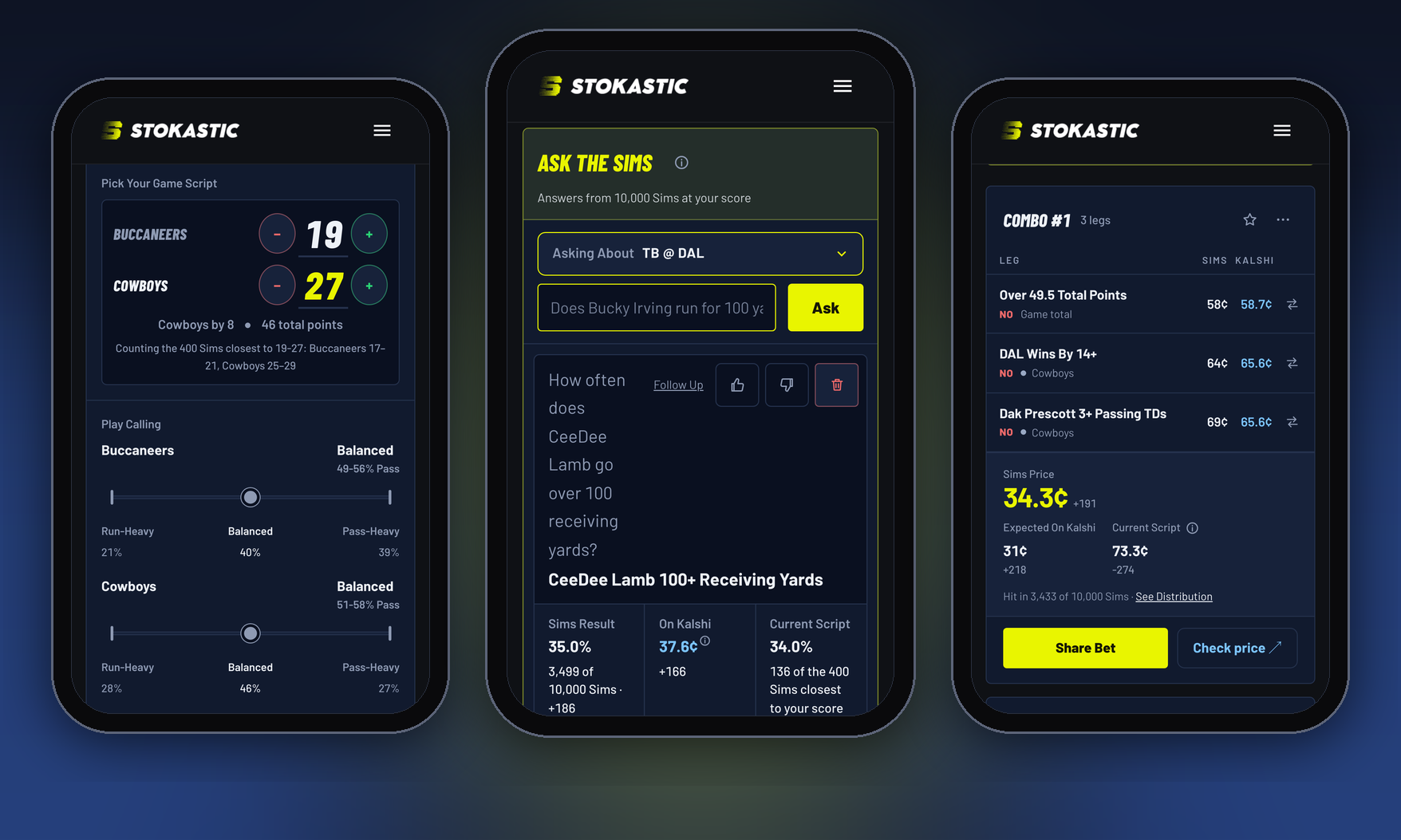 Price the combo before you buy it. The Kalshi Combo Simulator plays this week's NFL game 10,000 times and prices any combo you build next to the price on Kalshi, on your phone, free, no login.
Watch The Video
We walk through the live late-swap workflow in Stokastic's Sims suite here: Watch on YouTube.
What Is Late Swap In NFL DFS?
In NFL DFS, a late swap means changing the players in a lineup after a contest has locked but before your remaining players' games kick off. In late-swap-enabled contests, both DraftKings and FanDuel let you edit any roster spot whose game has not started yet. On DraftKings you open the lineup from your live contest or the My Lineups view and edit the unstarted spots; FanDuel offers the same through its edit-entries flow. Once a player's game kicks off, that spot locks for good.
NFL is the sport where this matters most, and the reason is the schedule. In late-swap-enabled contests, the DraftKings and FanDuel Main slate — home to the flagship large-field Sunday GPPs, such as DraftKings' Millionaire Maker or FanDuel's Sunday Million when those are on the board — locks in stages rather than all at once: your roster spots lock by individual game start time, the early games at 1:00 p.m. ET, then the afternoon games around 4:05 and 4:25. Contests without late swap lock every spot when the first game kicks off, so this whole playbook only applies where late swap is enabled, and Sunday Night Football usually sits on its own separate slate outside that Main-slate window. Between the 1:00 lock and the 4:25 kickoffs you have a stretch of time where part of your lineup is locked and scoring while the rest is still a live decision. That live window is the entire opportunity. If you play a Sunday-only or primetime slate that includes the night game, the same logic just stretches later.
The mechanic itself is not NFL-only. Our sport-agnostic DFS late swap guide covers the universal rules, and the NBA DFS late swap and MLB DFS late swap breakdowns show how different schedules change the read. But football's once-a-week, staggered Sunday is where the edge is fattest, and that is what the rest of this piece is about.
Why The Staggered Sunday Lock Is An Edge
Here is the mechanical reason it works: by the time the 4:25 games kick off, many of the 1:00 p.m. games are final or deep into the fourth quarter. Much of your locked scoring is no longer a projection. You know whether your early-game players boomed or busted, whether you are chasing a top finish or protecting one, and roughly where the field's scores are landing.
That certainty is information nobody had at lineup lock. A pre-lock build has to guess at every one of your players; a late-swap build keeps the results that already happened and only re-decides the spots still open. Just as important, the field's late-game exposure is largely set: because most opponents lock a lineup Sunday morning and never touch it, the projected ownership on your remaining players barely moves once the early games start. You cannot see rival rosters for games that have not kicked off — the sites keep opponents' unstarted players hidden until their games lock — but you are making a smaller, sharper decision with the scoreboard already visible and the field's late chalk essentially committed.
Want to run this across a full portfolio? The Stokastic NFL DFS Late Swap tool re-simulates every lineup you have submitted against the contest pool you load and ranks your swaps by projected ROI in the simulation. New users can try the DFS Sims for free, and code NFLWEEK2 takes 10% off through Monday, September 21 your first Stokastic Data + Sims payment.
Build For Swap Flexibility: Leave Your Decisions In The Late Games
The catch is that you can only swap a spot if its game has not kicked off. A lineup stuffed entirely with 1:00 p.m. players has zero late-swap ability. It locks at 1:00 and you are a spectator for the rest of the day. So if you value in-slate flexibility, build it in on purpose: concentrate the spots you are least sure about in the later windows.
My rough rule: keep at least two or three roster spots — especially the ones I am least sure about — live into the 4:05 and 4:25 windows, so I always have a lever to pull once the early games and the inactive reports break. In practice, when two plays are close, I lean the more uncertain one toward a 4:05 or 4:25 game so I can react to how the early slate breaks. A questionable-tag running back or a boom-bust receiver is a better late-window hold than a 1:00 p.m. lock, because keeping him swappable lets me upgrade off real information instead of committing blind. I am not forcing late-game players into every lineup; I am just refusing to spend all of my flexibility before the first whistle.
React To Confirmed News, Not Rumors
Inactive reports drop about 90 minutes before each game's kickoff, and they are the cleanest late-swap signal there is. A confirmed inactive vacates real opportunity — routes, targets, carries, and red-zone work — and in football those touches are what actually drive fantasy points, more than talent on its own. When a WR1 is ruled out, some of his target share redistributes across the remaining pass catchers; the job is spotting who actually inherits the routes. When a lead back sits, the backup can inherit a true workhorse role and the goal-line touches that come with it. Those redistributed touches are where the sharpest late swaps come from.
The discipline part matters just as much: react to the official inactive report, not to a Sunday-morning rumor or a beat writer's hedge. Chasing speculation is how you swap off a good player an hour before news that never comes.
| Late-Window Inactive | What it usually does | The swap read |
|---|---|---|
| WR1 Ruled Out | Target share shifts to the WR2, slot, and TE | Swap up to the likely beneficiary — confirm the projected role before you lock it |
| Lead RB Sits | Backup inherits volume and goal-line work | Often a low-owned value, but check it is a workhorse, not a committee |
| Starting QB Out | Passing-game floor drops for the whole offense | Fade the pass-catchers; the game total may sink |
| A Defense's Top Corner Out | The opposing WR's ceiling rises | Swap toward the receiver now facing a weaker coverage |
The worked example later in this piece walks through that corner-out read step by step, so you can watch one of these reads become an actual swap instead of a table cell.
Ownership Pivots Off The Early Games
Once the 1:00 p.m. games lock, the field's projected ownership on your late-game players is essentially set — most opponents will not swap those spots, so what the field committed at lineup lock is what it is running. This is your leverage window. In a large-field GPP, your score only matters relative to the field, so if the early games did not break your way, the late spots are where you differentiate. Pivoting a still-open roster spot from a chalky late-afternoon play to a lower-owned option with similar upside is how you get over the field on a slate where you need separation.
This is the $100K run I promised earlier. In our NFL DFS late swap case study, high-volume player Justin Freeman (HeavyChevyJF on DraftKings and FanDuel) walked through managing a 150-entry Milly Maker set across the four-game Divisional Round weekend in January 2021. With two games left he swapped Alvin Kamara off for Travis Kelce, and the pivot helped carry a lineup to 3rd in the Milly Maker and a $100K payday. The same run shows what low-owned pieces already in a build can do once the chalk stalls: Darrel Williams, at just 2% ownership, added 13.4 fantasy points while much of the field sat on the popular plays. Freeman's rule of thumb from that interview was framed around quarterbacks, but it is the shape of every leverage read: if a quarterback is optimal in 30% of simulations and only 20% owned, you should be heavy on him.
The leverage rule of thumb: when your locked spots leave you trailing a big GPP field, treat every still-open late-game spot as a chance to get off the chalk; when you are already live for a top finish, bank the safer play unless a top-heavy payout means first place still needs a unique lineup.
The reverse is true too. If my locked players already have me near the top of a smaller contest, there is no need to gamble the open spots on contrarian dice rolls. Think of it as a two-way lever: chase leverage when you need a ceiling, bank safety when you are protecting a lead. If the mechanics of ownership and leverage are fuzzy, our NFL DFS strategy guide covers the foundation, and our NFL DFS leverage and game theory breakdown goes deeper on winning large-field GPPs.
Chase Or Protect? Let Game Script Decide Your Swaps
Game script is the multiplier on every swap. Start with honest math: add your locked score to a reasonable median projection for your still-open spots, then compare that total to the pace a cash or top-1% finish needs on this slate. If your locked early-game players busted and that total comes up short, you need ceiling from your open spots, so bias your late swaps toward higher-upside, lower-floor plays even if they carry risk. A safe 12-point floor cannot rescue a lineup that already needs 40 from three roster spots.
When my locked players crushed and I am live for a big finish, I invert it. Take the steadier late-window play, cap exposure to boom-bust volatility, and let the score already banked carry the lineup — unless the payout is top-heavy enough that first place specifically still needs a differentiator, in which case I keep one contrarian swing. The point of a late swap is not to swing for the fences every time. It is to point your open spots at whatever outcome your locked spots still need.
A Worked Late-Swap Example
Here is how I actually run the read on a representative Sunday. I have a large-field GPP lineup, and my 1:00 p.m. running back finished with a quiet 6 points against a script that turned into a blowout. I still have two open spots kicking off in the 4:25 window: a wide receiver and a flex. My locked score is now well below where I need to be, so I am chasing ceiling, not protecting a lead.
The order of the read never changes:
- Deficit math: locked points plus a median projection for the open spots, against the pace a top finish needs.
- Late inactives: the 4:05 and 4:25 reports, read separately, roughly 90 minutes before each kickoff.
- Ownership: which open plays the field is heavy on, and who offers a similar ceiling at a fraction of the roster rate.
First I check the late inactives. Those reports drop about 90 minutes before each kickoff, so I read the 4:05 and 4:25 lists separately, and one of them rules out a starting corner in one of the 4:25 games. That lifts the ceiling of the opposing receiver he would have shadowed, so that receiver becomes a live pivot for my flex. Then I look at ownership: my current 4:25 receiver is a popular chalk play — say his projected roster rate sits around 25%, while a similar-ceiling option in the same window is closer to 8% — and since the early games already settled and most of the field will not swap, that projected ownership is essentially set, and I am sitting on the same guy as a big share of the field. Pivoting to the lower-owned option with comparable upside is exactly the leverage a trailing GPP lineup wants. I make both swaps, keep the direction pointed at ceiling, and let it ride. The swaps might not hit, but they give the lineup a real path to a top finish instead of locking in a score I already know is short.
Doing This Across 20 Lineups: The Stokastic NFL Late Swap Tool
Reading one lineup this way is doable in your head. Re-evaluating 20 of them while three games are live is not. That is the exact job the Stokastic NFL DFS Late Swap tool does: it re-simulates your already-submitted lineups against the contest pool you select, and the tool surfaces the swaps projected to improve your ROI, folding in the projected ownership of every player and updating as the slate unfolds.
One setting that does real work here is the variance control. Every player carries a variance setting that gives them a realistic range of outcomes across simulations. The pro move is to drop variance to zero on any player whose game is already over. If a 1:00 p.m. receiver finished with 18 points, set his projection to 18 and his variance to 0, so every simulation treats that result as the known fact it is. Do that across your completed games and the tool grades your open swaps against results that already happened, which makes the ROI on the spots you have left far more accurate. The workflow mirrors the NFL Sims you already use pre-lock: pick your site and slate, upload your entries, choose the live contest pool, run the simulation, then favorite and export the best swaps back to DraftKings or FanDuel.
The zero-variance tip in one line: lock every finished game at variance 0 so the Sims stop guessing at scores you already have, then let the tool rank your remaining swaps by simulated ROI. It is the simplest way to keep the sim from re-rolling outcomes you already know.
NFL DFS Late Swap Strategy: Tips For Sharper Decisions
- Leave Your Uncertain Spots In The Late Windows. A lineup that locks entirely at 1:00 p.m. has no late-swap ability at all.
- Swap On Confirmed Inactives, Not Rumors. Wait for the official report roughly 90 minutes before kickoff, then attack the vacated opportunity.
- Load The Contest Pool so your swaps are graded against the field's projected ownership and the results you have already locked, not a pre-lock guess.
- Zero Out Variance On Every Finished Game so the Sims treat known scores as known instead of re-simulating them.
- Let Game Script Pick Your Direction. Chase ceiling when your locked spots busted; protect the floor when you are already live for a top finish.
- Change As Many Spots As The Deficit Demands, No More. A small gap to the pace you need is a one-swap problem; only a lineup that is badly behind should flip every open spot to ceiling and eat the added volatility.
- Check the NFL DataHub for updated projections and ownership before you commit a swap.
The Bottom Line
For my money, late swap is one of the cleaner structural edges the NFL schedule hands you. The staggered Sunday lock hands you real information the field mostly ignores, and every open roster spot is a chance to turn that information into a better lineup. Before the 4:05 and 4:25 kickoffs I want three things settled: where my locked score sits versus the pace I need, which of my late players just gained volume from a confirmed inactive, and which chalk I can still pivot off. If I am behind, the open spots exist to build a different lineup than the field is on; if I am ahead, I refuse any swap that only adds volatility without improving my first-place equity. Build in the flexibility, react only to confirmed news, pivot your ownership off the early results, and let game script decide whether you are chasing or protecting. It will not rescue every lineup, but skipping it passes up a real chance to improve one after the news breaks. I run the read on every slate I enter.
Remember that Freeman's $100K Kamara-to-Kelce pivot only existed because he still had spots live when the news and the scoreboard turned; that is the whole discipline in one swap. Do it across a full portfolio and the Stokastic NFL Late Swap tool does the heavy lifting, re-simulating your lineups against the live field so you swap on projected ROI. Use code NFLWEEK2 for 10% off your first Stokastic Data + Sims payment and start swapping on projected ROI instead of a hunch.
More on this: NFL DFS Hub: Every Live Stokastic NFL Page · NFL DFS Late Swap Case Study: Inside A $100K Milly Maker Run · DFS Late Swap Strategy: How To Swap Lineups And Win More · NBA DFS Late Swap: How To Win With Late Swap Tools · NBA DFS Without Late Swap: How To Win When You Can't Swap Lineups