
Stokastic Review 2026: Worth It For NFL Tournament Players
By Jake Hari
August 23, 2026 · Updated October 6, 2026
The Quick Answer
The short version of this Stokastic review: Stokastic is worth it for NFL DFS if you play tournaments, enter more than a handful of lineups, and will actually adjust the model each week instead of copy-pasting whatever it spits out. It is not worth it if you play cash games only, fire one lineup on Sunday morning, or want a tool that thinks for you. The September 1 price increase has hit the monthly rates, so NFL Core now runs $149.95 a month, but as of this update the annual plans still carry their Early Bird numbers, $549.95 for a year of Core, which makes the annual the obvious math. Max is $229.95 a month, and there is a free way in before you pay a dollar. What the Sims actually do, the honest list of who should skip them, and the $1,000,000 win that was built on them are all below.
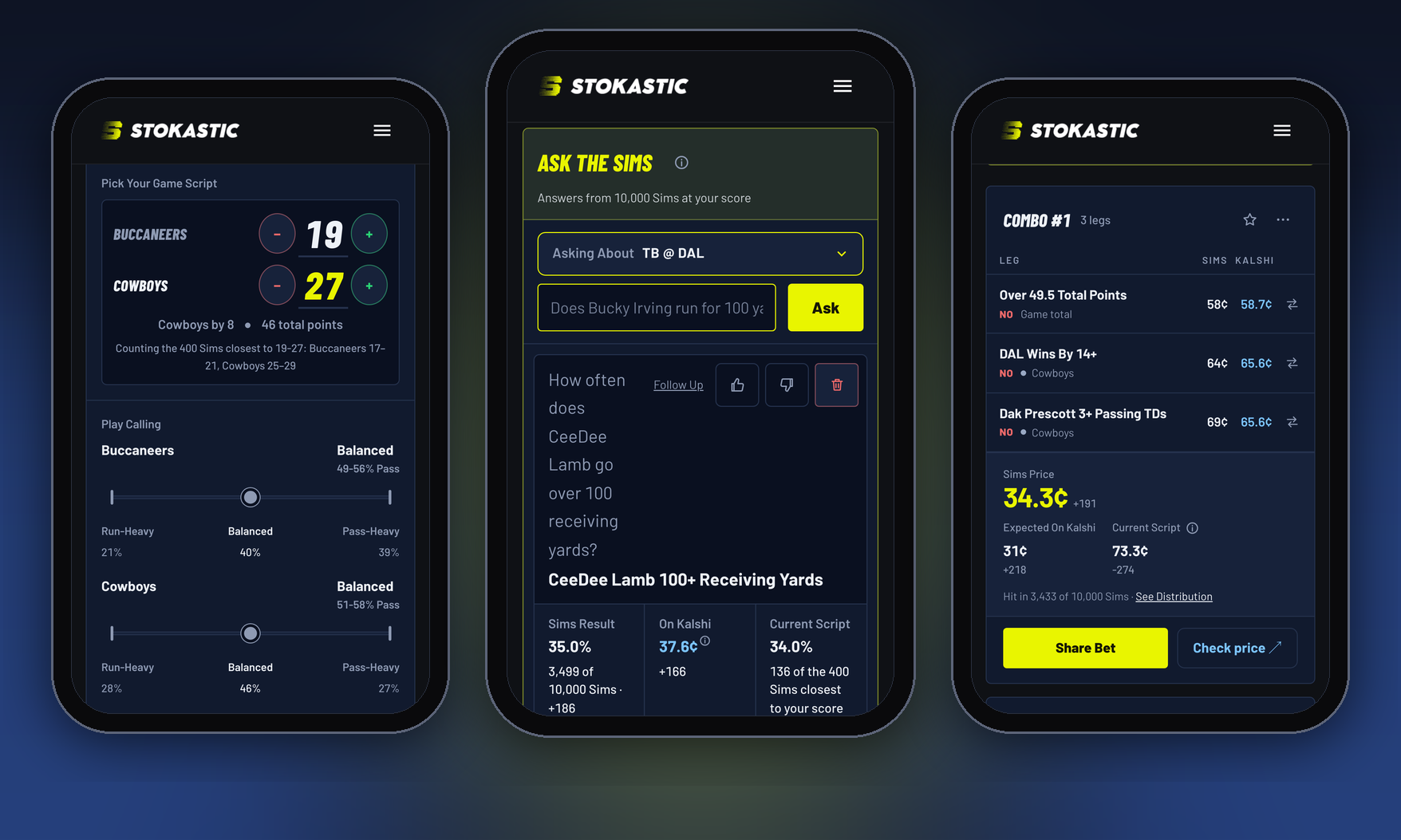 Price the combo before you buy it. The Kalshi Combo Simulator plays this week's NFL game 10,000 times and prices any combo you build next to the price on Kalshi, on your phone, free, no login.
Watch The Video
A Review Written By The Company. Here Is Why You Should Read It Anyway
I work at Stokastic. I am not going to pretend this is a neutral third-party review, because it isn't, and the search result you clicked deserves better than a fake one. What I can do is something the affiliate review sites can't: tell you exactly what the NFL Sims are built to do, exactly what they cost, and, most usefully, exactly which kind of DFS player wastes money on them. Those are the subscribers who cancel fastest anyway. Better to tell you up front.
So the thesis of this review is simple: Stokastic is a tournament tool that pays off in proportion to how much work you put into it. Everything below, from the mechanics to the pricing to the winners, is a test of that one claim. I'll come back to it at the end and tell you where it actually breaks.
What The Stokastic NFL Sims Actually Do
Most DFS tools are optimizers. You feed in projections, the optimizer solves for the highest-projected lineup under the salary cap, and you get the median answer to a question that tournaments never ask. A Milly Maker does not pay the median lineup. It pays the lineup that beats a field of hundreds of thousands once.
The Stokastic NFL Sims attack that problem differently. Instead of solving for one lineup, the Sims simulate the contest itself tens of thousands of times: every player's outcome varies sim to sim, correlations hold (a QB's big game drags his receivers up with him), and projected ownership determines how many entrants you are sharing each player with. Every lineup that comes out is then ranked by simulated ROI against the real payout structure of the contest you tell it you are entering. That last part matters more than people expect. As we walk through in the How To Use Stokastic NFL Sims video embedded above, the "percent to first" setting changes how the Sims value ceiling: a $400,000 contest paying $100,000 to first is 25% to first, and the Sims build differently for that than for a flat double-up.
Here is what you are actually paying for with an NFL subscription:
| What You Get | What it does for your NFL build |
|---|---|
| NFL Projections And Ownership | Median projection plus projected ownership for every player on the slate, the raw material the Sims run on |
| Contest Sims | Simulates the slate tens of thousands of times and ranks lineups by simulated ROI for your contest type and payout |
| Stack And Correlation Handling | Builds QB plus pass-catcher stacks and bring-backs naturally, because the sims reward correlation instead of needing a rule for it |
| Custom Projections And Ownership | Upload a CSV with player name, projection and ownership, or edit single players by hand, and the Sims re-run on your numbers |
| Late Swap | Re-rank your live lineups after the early games lock, which is where a lot of the real money gets made |
| DataHub | NFL DFS projections, ownership and stacks in the DataHub in one place for the "why" behind every build |
The row I'd point a new subscriber at is the custom-projections one. The Sims are not an oracle; they are a machine for turning your read on the slate into lineups that are shaped correctly for a tournament. When you think a back is getting 22 touches and the projection says 16, you type in your number and the whole field of lineups re-shapes around it. Run the contest sim again after an edit like that and the tool surfaces the handful of builds, out of the thousands it simulated, whose simulated ROI actually clears the field for your contest's payout curve. Players who never touch that feature are the ones who usually cancel, which is the forward promise I made above and will pay off in the "who should not subscribe" section.
What Stokastic Costs For NFL In 2026
Three NFL tiers are on offer right now. Prices below are checked against the live billing system as of September 1, 2026. The announced September 1 increase has landed on the weekly and monthly rates; the annual plans were still listed at their Early Bird numbers when we checked.
| Tier | Weekly | Monthly | Annual (still at the Early Bird rate) |
|---|---|---|---|
| NFL Core | $44.95 | $149.95 | $549.95 |
| NFL Max | $64.95 | $229.95 | $749.95 |
| NFL MVP | see pricing page | $349.95 | $1,299.95 |
Core is the projections, ownership, DataHub and Sims access that the in-house players build on. For most people reading a review, Core is the answer. Core builds and simulates up to 2,000 lineups in the Contest Sims, which is more than most players will ever field. Max raises that ceiling to 10,000 lineups on classic slates and 50,000 on showdown, and is built for players entering 20-max and 150-max contests every week. MVP sits above Max as the new top tier for players running the full Thursday-through-Monday weekend on sims; it runs $349.95 a month or $1,299.95 for the year, and the Early Bird guide has the detail on what it adds.
The number that should drive your decision is the gap between those two columns. The monthly rates have already taken their September 1 step up, Core from $129.95 to $149.95 and Max from $179.95 to $229.95, while the annual plans still showed their Early Bird prices as of this update, with announced increases to $649.95 on Core, $899.95 on Max and $1,499.95 on MVP. An annual plan keeps the price you start it at for the full 12 months, playoffs included. I broke down the exact math in the Stokastic NFL Early Bird pricing guide, but the short version is that a five-month season on monthly billing now costs roughly $200 more than a Core annual at the Early Bird number, and about $400 more on Max. If you already know you are playing through January, the annual is the cheaper product, and it only gets worse for monthly billing if the annual increase lands too.
The one number to take away from this section: five months of NFL Core at the now-live $149.95 monthly rate comes to $749.75, while a Core annual at the $549.95 Early Bird rate, still listed as of this update, is $199.80 less for the same five months of football.
Anyone who would rather commit to one month first should read the Stokastic NFL promo code guide, which covers the current monthly discount. Either way, the prices above are the real ones; there is no hidden upsell inside the tool. Every tier is listed side by side on the pricing page.
The Free Path: Try The Sims Before You Pay
This is the part that most reviews of paid DFS tools skip, because the free tier makes the affiliate commission smaller. You can try the Sims free before subscribing: build a pool, run a contest sim, and watch how simulated ROI reorders lineups that an optimizer would rank by raw projection. If the re-ordering doesn't make sense to you, or you look at the output and think "I'd never play that," you have your answer for $0 and we have saved each other a refund email.
The honest caveat: the free path shows you the mechanics, not the full-season edge. The edge comes from the Late Swap, the custom projections and the week-over-week habit, and those are the paid features. Treat the free Sims as a test drive of whether you like how the car steers, not as a substitute for the car.
Who Should NOT Subscribe To Stokastic
I promised this section at the top. Four kinds of players should keep their money:
- Cash-game-only players, if the Sims are the reason you're buying. Double-ups and 50/50s reward a high-floor lineup built straight off projections. Simulated ROI, leverage and percent-to-first are tournament ideas. Core can still make sense for a cash player who wants the projections, ownership and DataHub in one place, and we cover that narrower workflow in how to use the Sims for cash games, but contest simulation is not what you'd be paying for.
- Single-entry Sunday-morning players. If you fire one or two lineups a week, the Sims' biggest advantages, shaping 20 to 150 lineups so they are differentiated from each other and from the field, barely apply. You would be paying $149.95 a month for the projections tab.
- Players who will never adjust the model. This is the forward promise from the Sims table. Someone who downloads the default output every week and never edits a projection, never touches percent to first, never runs Late Swap is using a $149.95 tool as a $20 projection sheet. They cancel by October and they are right to.
- Pick'em players. If your action is PrizePicks, Underdog or Sleeper style pick'em boards rather than DraftKings and FanDuel tournaments, the separate Stokastic Props packages are built for exactly that, and a Sims package is the wrong product for what you are doing.
One more limitation that isn't about the player: the Sims are a contest-and-lineup engine, not an advanced-stats research tool. You will not find route participation or EPA tables inside the product. That research is on you, in the DataHub and wherever else you read, and you feed the conclusions in through custom projections. If you expected a tool that does the film study, this isn't it.
A Worked Example: $1,000,000 On Conference Championship Sunday
Every DFS tool on the market claims its users win. Here is what we can actually point to, with names and numbers, rather than a testimonial widget.
Steve "dacoltz" Buzzard, a Stokastic pro, took down a DraftKings NFL Milly Maker on a Conference Championship Sunday for the full $1,000,000, and he wrote up the exact process in how the Sims won me a million. Three details from that piece are the whole argument for this product in miniature. He set the largest pool size his package allowed (10,000 on Max; the base package capped at 500 at the time, and Core now runs to 2,000) and pushed percent to first to 30%, the tournament-shaping settings from the table above. He boosted Travis Kelce's simulated ROI by hand, which raised Kelce's share of his own lineup pool; Kelce ended up at 24.5% ownership, meaningfully owned but not chalk, and was his highest scorer, which is the custom-adjustment feature doing its job. And the winning lineup had no Christian McCaffrey, who landed in over 60% of the field's lineups, even though Buzzard kept McCaffrey heavily in the rest of his pool rather than banning him. No McCaffrey plus the odd construction is why he didn't have to split the million. Two tight ends and a 1-3 stack with a three-man bring-back is not a lineup an optimizer spits out. It is a lineup a simulator builds when ownership and correlation are part of the model.
That win is not the only one. Alex "Awesemo" Baker, whose handle was the company's original name before the Stokastic rebrand, is a Milly Maker winner himself and spent years ranked as the No. 1 DFS player in the world. One of the more instructive smaller ones is not a Stokastic win at all, and I'm including it for that reason: high-volume player Justin Freeman, HeavyChevyJF on DraftKings, walked through on our High Stakes show how he triaged 150 Divisional Round Milly Maker lineups into three tiers between kickoffs and swapped his way to a $100K finish. We documented it in the NFL DFS Late Swap case study because that triage framework is exactly what the Late Swap tool is built to execute for you. Notice the callback: both wins came from a human overriding a default, Buzzard before lock and Freeman after it.
The caveat I'm obligated to give and would give anyway: these are the top of a very wide distribution. No tool changes what happens on the field, nobody can promise you a profit, and most subscribers in a given week lose, because most entrants in a given Milly Maker lose. What the Sims change is the shape of your lineups, so that when your read on the slate is right, you are holding a ticket that actually cashes at the top instead of a ticket 40,000 other people also built.
How Stokastic Compares To Other NFL DFS Tools
The honest competitive picture, since "is Stokastic worth it" usually means "versus what": SaberSim is the other real contest simulator and the closest head-to-head; FantasyLabs has a simulation layer but is built around a different workflow; RotoGrinders and the optimizer-only products are cheaper and solve a different (median) problem. We ranked the whole field in best DFS tools for 2026, went deep on Stokastic vs FantasyLabs for NFL, and put Stokastic, SaberSim and RotoGrinders side by side. The short version: SaberSim automates more of the simulation and asks you to live inside its projections. Stokastic hands you the levers this review keeps coming back to: the percent-to-first dial, the hand-boost that put Buzzard's Kelce exposure exactly where he wanted it, and Late Swap re-ranking the same pool after the early games lock. RotoGrinders and the optimizer-only tools are the budget choice for a median lineup, not the same kind of product. The free path above is the cheapest way to settle it for yourself.
SO, Is Stokastic Worth It?
Back to the thesis: the Stokastic NFL DFS package is a tournament tool that pays off in proportion to the work you put in. After walking through the mechanics, the pricing and the winners, here is where it holds and where it breaks.
It holds for the multi-entry tournament player who treats Sunday like a process: read the slate, set percent to first for the contest, push their own projections in, run the Sims, and re-rank at 4:05 with Late Swap. The $1,000,000 win came down to one hand-entered read; the $100,000 run came down to a triage between kickoffs. That is the work this tool rewards. For that player, $149.95 a month for NFL Core is cheap relative to the entry fees it's shaping, and the annual is cheaper still while it holds its Early Bird price.
It breaks for the cash player, the single-entry player, and the player who wants the defaults to do the thinking. Those players should use the free Sims, read the guide to using NFL DFS Sims and Sims vs optimizers, and decide honestly which group they're in before paying.
For the first group, the money question is a calendar question. The monthly rates already took their September 1 step up; as of this update the annual plans still carry their Early Bird numbers, and the annual math wins either way, $549.95 against $749.75 on Core today, and still $649.95 against $749.75 if the announced annual increase lands.
More on this: NFL DFS Hub: Every Live Stokastic NFL Page · Stokastic Vs FantasyLabs: Which NFL DFS Tool Wins In 2026? · How A Stokastic DFS Winner Turned The Sims Into $1500 · Stokastic NFL Core Vs Max Vs MVP: Which Do You Need? (2026) · Stokastic NFL Early Bird Pricing: Lock In Before September 1