
Florida Governor Primary Odds
By Jake Hari
August 10, 2026 · Updated August 23, 2026
The Quick Answer
The Florida governor primary odds question is settled: Byron Donalds won the August 18 Republican nomination, and Kalshi finalized his contract at $1 the next day, with every rival, including the 1.5-cent James Fishback line that out-traded him four to one, settling at zero. The number still worth your attention is the one this page flagged before the vote: of the 22.3 million contracts traded in this event by August 10, 14 million traded on the name least likely to win. Why the action concentrated there, what a tournament DFS player would recognize in that instantly, and where the live Florida governor market trades now, is below.
The Market
Update, August 23, 2026: the primary is decided and this market is closed. Kalshi finalized every contract in the event on August 19, 2026: Donalds resolved Yes at $1, and all eight other listed names resolved No at $0. David Jolly won the Democratic nomination the same night, and his contract settled at $1 as well. The live Florida governor market now is the general-election board, priced at 81 cents on the Republican side against 21 on the Democratic side as of August 23, and the eight-model panel's full read on that race is at Florida Governor Odds: Donalds Vs Jolly. The market description, prices, and analysis below are preserved as written on the morning of August 10, eight days before the vote; the board's Result column shows how each contract settled.
Kalshi's Florida Republican nominee event asks one question per candidate: will this person win the party's nomination for the 2026 Florida governorship? Each contract resolves Yes once its candidate officially wins the nomination, which in practice means the August 18 primary decides it. The listed expiration is November 3, but the rules allow the market to close early once the official result is in, so the practical hold is about a week to the primary plus however long the official reporting takes.
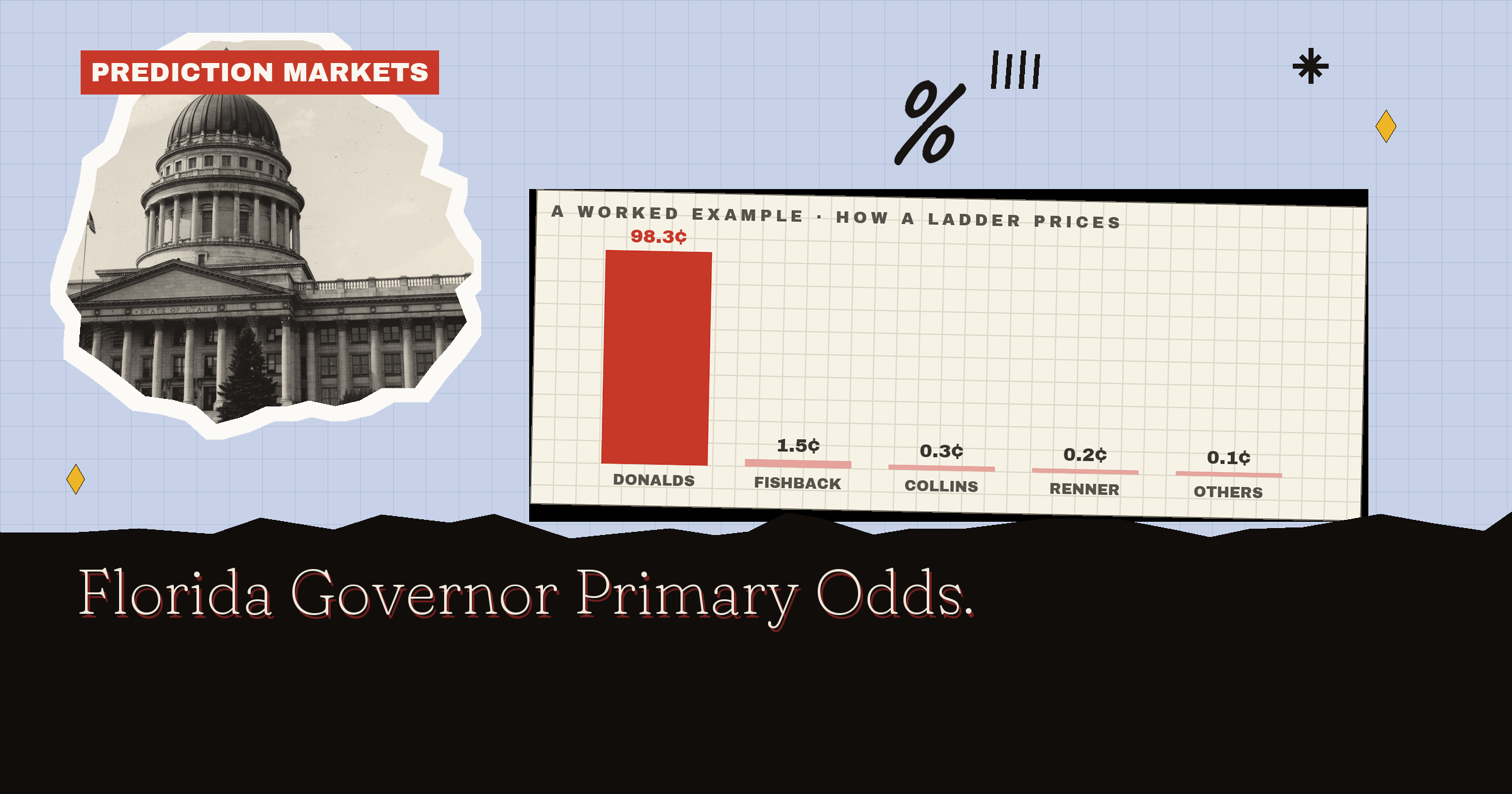
The timing matters more than usual. Florida's mandatory statewide early-voting window opened August 8, some counties started earlier, and vote-by-mail ballots have been going out since mid-July, so ballots are already being cast while these prices print. Prices below are the last-trade numbers as of the morning of August 10, 2026, and Donalds held a one-tenth-of-a-cent spread, 98.3 bid against 98.4 ask. The book is liquid and lopsided, not thin.
The Kalshi Board
| Name | Kalshi Price (Aug 10) | Implied Probability | Contracts Traded | Result |
|---|---|---|---|---|
| Byron Donalds | 98.3¢ | 98.3% | 3,151,725 | Won — settled at $1 |
| James Fishback | 1.5¢ | 1.5% | 14,089,816 | Settled at $0 |
| Jay Collins | 0.3¢ | 0.3% | 3,038,365 | Settled at $0 |
| Paul Renner | 0.2¢ | 0.2% | 1,230,153 | Settled at $0 |
| Five Others (Incl. Casey DeSantis And Matt Gaetz, Listed By Kalshi But Not On The Ballot) | 0.1¢ each | 0.5% combined | 830,507 | Settled at $0 |
Source: Kalshi trade API, event KXGOVFLNOMR-26. Prices and volumes fetched the morning of August 10, 2026; settlement results fetched August 23, 2026, after Kalshi finalized the event on August 19.
One field-fidelity note before reading it: this is Kalshi's set of listed outcomes, not the official ballot. Eleven Republicans qualified with the Florida Division of Elections. The exchange prices four of them, skips seven minor qualifiers entirely, and still carries five names, Casey DeSantis and Matt Gaetz among them, who never filed at all. A market's listing decisions are themselves a bet on who matters.
More live election boards: 2028 Republican nominee odds · 2028 Democratic nominee odds · Texas Senate odds · the full markets hub
The row I keep coming back to is the second one. Fishback's contract has traded 14 million times, roughly 63% of every contract in this event, more than four times the volume on the favorite, and it pays 1.5 cents. Hold that number; it is the whole story of this market, and we will come back to what it means after the favorite's side of the board is dealt with.
Vote Share Is A Projection, Win Probability Is A Sims Number
Public polling through the summer has put Donalds anywhere from the high 30s to the mid 50s in the primary field, with recent averages around the low-to-mid 40s; most summer surveys put his nearest rival 30 or more points back, though the size of the gap varies poll to poll. He announced in February 2025 and took President Trump's endorsement the same month, and no candidate has meaningfully closed since. So how does a candidate polling well short of a majority trade at 98%?
Because vote share and win probability are different units, and this market pays out on the second one. Any Stokastic reader who has compared a median projection to a sims win rate has already done this math. A hitter's median projection is not his chance of leading the slate; sim the night ten thousand times and small, persistent edges in the median column turn into outsized shares of the first-place finishes. The nomination is winner-take-all, so a 30-plus-point lead with eight days left does not convert to a 30-point edge in price. It converts to nearly all of the probability mass, because the paths where the second-place candidate makes up that ground in a week, with mail ballots banked since mid-July and early voting underway, are tail scenarios. It is the same compression you see when you run MLB DFS projections, ownership and stacks in the DataHub through a simulation: comfortable leads in the median column become lopsided win percentages, because winning is a threshold, not an average.
That framing is the honest way to read every price on this board. Collins at 0.3¢ says nothing about his quality as a candidate; in a winner-take-all format, second place 30-plus points back and first place that far clear simply get priced like different sports.
Where The Volume Went: 14 Million Contracts On A 1.5-Cent Candidate
James Fishback is an investment-firm founder and political newcomer who launched his campaign in November 2025, and his contract is the most-traded instrument in this event by a factor of four. He has never led the market. What he generated was argument, and argument is what trades.
Two episodes did most of the work. In June, rival candidate Jay Collins, Florida's lieutenant governor, sued to knock Fishback off the ballot over the state constitution's seven-year residency requirement; a Leon County judge ruled on July 27 that Fishback stays on. Then on August 6, Fishback claimed Donalds was under a federal investigation, a claim the Justice Department called false within two days and the Donalds campaign dismissed as baseless. Each is the kind of binary sub-event that pulls trading into a contract from both directions, and the price history shows it: roughly 665,000 Fishback contracts changed hands in the 24 hours before this snapshot, the most of any name on the board, while Donalds ticked up from 98.0 to 98.3 cents. The market heard the loudest story of the race and raised the favorite. More than 9 million Fishback contracts sit as open interest in the snapshot, and every one of them has a Yes holder and a No holder; what that number measures is disagreement still on the books, not belief in an upset.
A GPP player has a name for this shape: ownership without equity. In large-field tournaments, the field's entries pile onto the story of the week while the sims quietly show the play's win rate never justified the attention, and the discipline that wins long-term is telling those two signals apart. Volume tells you where the argument is. Price tells you who won it. One caution before the analogy runs away: contract counts are not dollars. At 1.5 cents a dollar buys about 65 times more contracts than it does at 98.3, so cheap contracts always post inflated counts, and in dollars the picture inverts. Using current prices as a rough proxy for traded prices, Fishback's 63% of the contracts works out to roughly 6% of the event's traded money, while Donalds's 14% of the contracts is more than nine dollars of every ten. The signal in Fishback's line is not that the money believed in him; it is that the event's argument concentrated on his name. The sharpest version of the point: the polling between Collins and Fishback has been mixed all summer, each leading the other in different surveys, yet Fishback's contract trades at five times the price and more than four times the contract volume. Attention, not polling position, decides where a market's action goes. Fishback's board line, 63% of the contracts at 1.5% of the probability, is a 42-to-1 ratio of attention to equity. If you want to see how concentrated a real contest's equity gets, run a free Sims contest sim and compare the win-rate column to the ownership column; this market is that table with candidates in place of hitters.
A Worked Example: What 98.4 Cents Actually Pays
A Kalshi contract pays $1 if it resolves Yes, so price equals implied probability: the 98.4¢ you would actually pay at the ask for Donalds means 98.4%. Sum this board and you get about 100.8%, a small overround that is normal on multi-candidate events, which is why the implied numbers here run a hair above true market consensus.
Fees are the second adjustment, and at this price they bite harder than usual. Kalshi's standard taker fee is 0.07 times price times one minus price, which works out to about 0.11 cents per contract on a 98.4-cent buy. That sounds like nothing until you notice the trade's maximum gross profit is 1.6 cents. Buy Donalds at the ask and you are risking 98.4 cents to win about 1.49 after fees, effectively laying 66-to-1 on odds that started at 61.5-to-1. Two wrinkles before anyone likes that trade too much. The per-contract fee figure holds at size, but Kalshi rounds fees up to the next cent per order, so a small ticket can surrender close to a full cent of its 1.6-cent ceiling. And the capital is locked until the market settles: the return looks attractive over an eight-day window, but if official reporting drags, the hold stretches with it. In bankroll terms, that is a cash-game decision, not a tournament one: a high floor, a capped ceiling, and a rake that eats a real share of the edge. The market being right is not the same thing as the market being worth buying.
What Could Move The Price Before August 18
The residual 1.7% is not really about polls. With early voting open and a 30-plus-point gap, a routine preference survey is unlikely to reprice this board on its own; what remains is mechanics, the tail scenarios every heavy favorite carries into a settlement window: a withdrawal or health event, an appellate turn in the ballot litigation that reshapes the field, or a settlement delay if the apparent result and the official one take time to converge. And a slice of any 98-cent price this close to settlement is simply time value, capital parked until official reporting rather than live upset risk. The board's graveyard rows tell you how this market handles dead storylines: Casey DeSantis's contract traded 347,000 times on speculation about a run that never became a filing, and Matt Gaetz, Wilton Simpson and Jimmy Patronis all sit at a tenth of a cent, names the market once argued about and has since settled to zero. Fishback's 1.5 cents is the one line still carrying real open interest against the favorite, not because the July ruling left his path open but because his contract is where this primary's argument has lived all summer.
Donalds moved on to the November 3 general in a state Trump carried by 13 points in 2024, against David Jolly, who won the Democratic nomination the same night. That race has its own market, and the same field-pricing lens is on it now: Kalshi's general-election board, event GOVPARTYFL-26, trades at 81 cents on the Republican side against 21 on the Democratic side as of August 23, 2026, on about 330,000 contracts across the pair.
Settlement Timeline
- August 8-15, 2026: the mandatory statewide early-voting window for the Florida primary (counties added days on either end).
- August 18, 2026: primary day; Donalds won the Republican nomination and Jolly won the Democratic one.
- August 19, 2026: Kalshi finalized every contract in the event — Donalds resolved Yes at $1, all rivals No at $0.
- November 3, 2026: general election day in Florida; the live general-election board runs to that date.
- Prices in the board above are as of August 10, 2026; the market settled August 19. This page was updated August 23, 2026, and the panel's verdicts on the general are graded on the same public scoreboard as every panel call.
These prices reflect real traders' money, not a prediction of fact, and nothing here is financial or trading advice.
The Bottom Line
Two numbers described the Florida governor primary odds better than any writeup: 98.3 and 63. The first was the market pricing the Republican nomination as all but decided, with the same field-concentration math that turns a projection lead into a lopsided sims win rate, and the board graded it out: Donalds won, and his contract paid $1. The second says nearly two of every three contracts in this event traded on the argument rather than the favorite, the way tournament fields pile onto the story of the week even when the equity never justified it. Reading the two against each other is the skill, here and on a Saturday slate, and the full markets hub carries the boards still trading, with Florida's story now living on the general-election line at 81 cents.
More on this: Wisconsin Governor Primary Odds: Hong At 95% As Wisconsin Votes · California Governor Odds: Becerra 96¢ Vs Hilton Lead The Field · College Football Playoff Odds: Kalshi's 50-Team Board · House Control Odds: Implied Probability Vs. Election Models · iPhone 18 Release Date Odds: September Is Priced At Just 5%