iPhone 18 Release Date Odds: September Is Priced At Just 5%
By Jake Hari
August 13, 2026

iPhone 18 Release Date Odds: September Is Priced At Just 5%
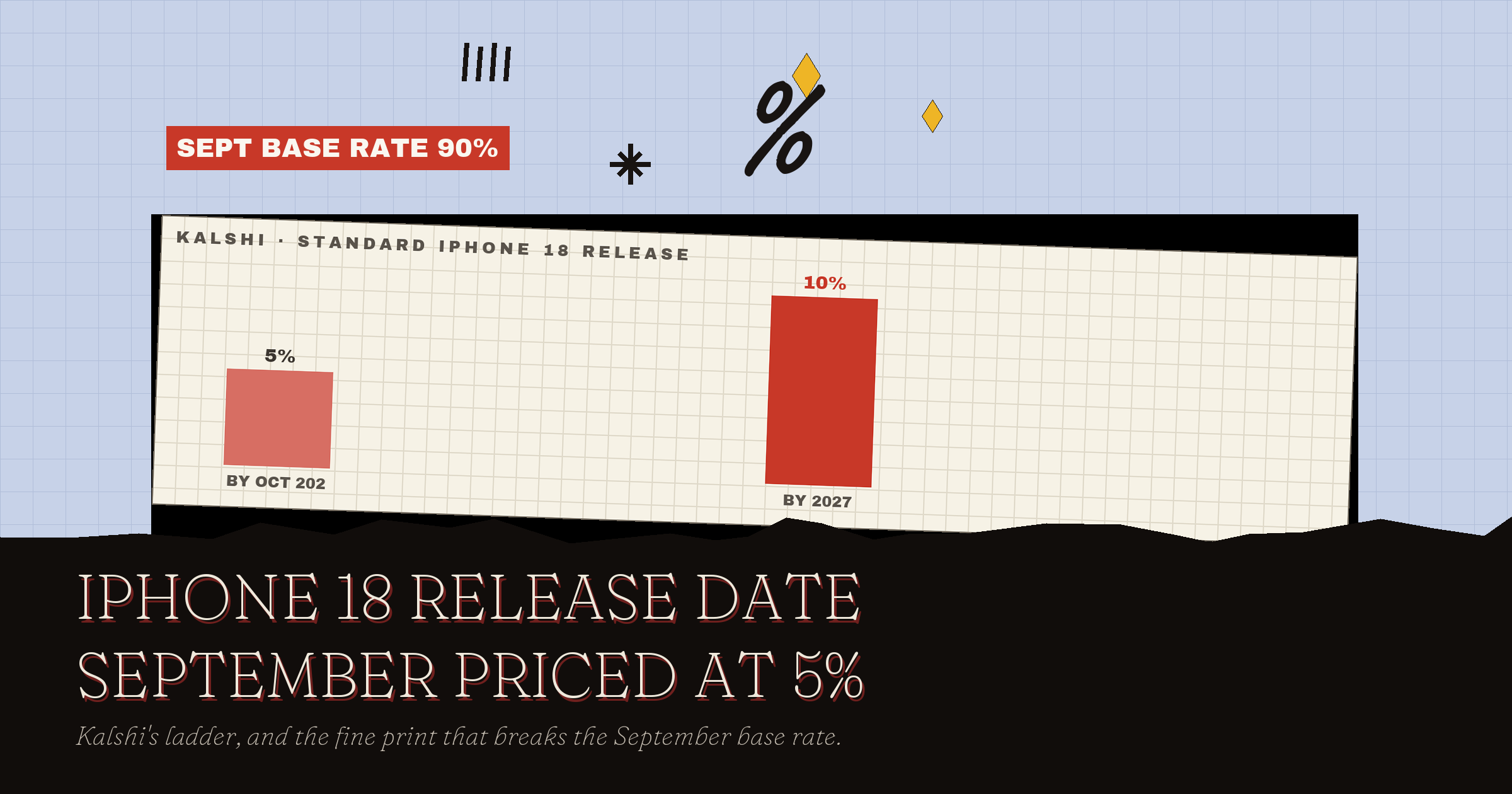
The iPhone 18 release date should be the easiest forecast on any board. Apple has put its new flagship iPhones on sale in September in 13 of the last 14 years, and the lone miss, the pandemic-delayed iPhone 12 in October 2020, barely slipped a month. So when Kalshi's market on the standard iPhone 18 prices a public release before October 1, 2026 at 4 to 5 cents, about a 5% implied probability, the base-rate instinct screams mispriced. This page is about why that instinct is wrong here, and how to tell the difference, because the gap between a tail worth buying and a market that knows something is the single most expensive lesson in event contracts. On this board, the market knows two things the base rate does not: the news, and the fine print. I will show you both, and by the end the nickel will stop looking like a discount and start looking like the market pricing a scratch.
The Quick Answer
Kalshi prices the standard iPhone 18 at 4 to 5 cents (roughly 5%) to reach the public before October 1, 2026, and just 10 to 12 cents (last trade 10 cents, roughly 10-12%) to be released to the public before 2027. The market is not fading Apple's September event; reporting says the iPhone 18 Pro and Apple's first foldable still launch this fall, while the standard iPhone 18 slips to spring 2027, and this contract resolves on the standard model only. The full price ladder, the 13-of-14 September record, and the checklist for separating a real bargain from a trap are below.
The Market At A Glance
| Venue | Kalshi, a CFTC-regulated event-contract exchange (18+) |
| The Contract | "When will Apple release the iPhone 18?" (KXIPHONERELEASE-IPHONE18), cumulative yes/no rungs. Rule, verbatim: "If Apple Inc. releases iPhone 18 to the public before [date], then the market resolves to Yes" |
| The Fine Print | Kalshi's clarification: resolution is based on "the baseline iPhone 18 model. Releases of alternative models, such as the iPhone 18 Pro or Pro Max shall not be considered in the resolution of this market" |
| The Clock | The before-July 2026 rung has already settled NO |
| Lifetime Volume & Depth | Roughly 1.45 million contracts traded across the event lifetime; the October rung alone holds about 360,000 contracts of open interest on a penny-wide book |
| Timestamps | All prices pulled from the live Kalshi order book on August 12, 2026 |
That fine-print row is the whole article, and I promised you a scratch report. First, look at the ladder those rules produce.
The Timing Ladder Points At Spring, Not September
| Contract: Standard iPhone 18 Released Before... | Yes Bid-Ask | Last Trade | Implied Probability |
|---|---|---|---|
| July 1, 2026 | settled | settled NO | resolved |
| October 1, 2026 | 4-5 cents | 5 cents | ~5% |
| January 1, 2027 ("Before 2027") | 10-12 cents | 10 cents | ~10-12% |
Live Kalshi order book, August 12, 2026. Rungs are cumulative thresholds; read the differences, never the sum.
The row that matters most is January, not October. Even giving Apple three extra months past its traditional window, through the entire holiday quarter, the crowd still only gets to 10-12%. Read it plainly: the market treats the standard iPhone 18 as a 2027 product, roughly nine times out of ten. Subtract the rungs, as cumulative ladders demand, and the entire fourth quarter of 2026 carries maybe 5 to 8 points of probability; the crowd sees September or spring, with almost nothing in between. And the conviction is growing: when our sister site OddsShopper read this same board on August 3, the October rung traded at 10 cents and the before-2027 rung at 19. Nine days later, both have been cut roughly in half as launch-window reporting hardened. A crowd that gets more certain as an event approaches is usually a crowd receiving information.
The Base Rate Says September Every Time
Here is the case for the other side, stated as strongly as the history allows. From 2012 through 2025, every new flagship iPhone went on sale in September except one, and the exception needed a global pandemic to slip all the way to October. No flagship iPhone has ever waited for spring; that has been the budget line's territory, which is exactly the seam Apple is reportedly widening. Model that streak the way our Sims model a hitter's season, and a naive projection puts a September 2026 iPhone somewhere north of 90%. Against that prior, a 5-cent YES looks like the fattest edge on the exchange: buy for a nickel, collect a dollar when Tim Cook does the thing he has done every autumn since 2012.
If that logic feels airtight, good. It is exactly the trap this board sets, and it fails on the two updates the base rate cannot see.
Why The Market Says No: The News And The Fine Print
The first update is the news. Reporting from Bloomberg's Mark Gurman and supply-chain sources, consistent from a May 2025 MacRumors report through the continuously updated iPhone 18 roundup, says Apple is splitting the iPhone 18 generation in two. Its iPhone 18 Pro, Pro Max, and first foldable keep the September 2026 slot. The standard iPhone 18 and the cheaper 18e reportedly move to spring 2027, most often narrowed to March or April. The stated reasons are manufacturing complexity around the foldable and a new 2nm-class chip, plus a revenue motive: let the high-margin Pro models own the holiday quarter without a cheaper sibling on the shelf. Apple has confirmed none of this, which is precisely why the October rung trades at 5 cents instead of zero.
The second update is the fine print, and it is the one casual money misses. This market resolves on the baseline iPhone 18 only; per Kalshi's own clarification, a September iPhone 18 Pro launch "shall not be considered." So there will almost certainly be a September Apple event, a September keynote, and September iPhones on shelves, and this contract can still settle NO. There is a quieter third reason the nickel is no gift: the contract's verb is "releases to the public," and Apple typically puts phones on shelves about ten days after it announces them. The pandemic-year iPhone 12 was announced October 13 and went on sale October 23, 2020, so even a surprise unified September keynote could push the standard model's shelf date past October 1 and settle this rung NO anyway. The 13-of-14 September pattern was built by a lineup structure Apple is reportedly changing. The base rate is not wrong; it is priced on a phone that, per the reporting, no longer exists in that window.
The DFS Translation: Chalk Is Chalk Because The Field Read The News
Stokastic readers already own this skill. A season-long projection is a base rate; a 4 p.m. scratch report is an update; the number you act on is neither one alone. As we broke down on How to Shift Projections in the Stokastic Prop Tool, the weighting even shifts with freshness: 50-50 between the Stokastic and market-based numbers by default, closer to 80-20 in favor of the Stokastic projection once it has been freshly updated near lock. Buying the 5-cent September YES on base rate alone is rostering a player because his ownership is low, without noticing his ownership is low because he was scratched an hour ago. That is not leverage; that is a donation. The ownership and leverage math on Kalshi works exactly like the version in the MLB DFS projections, ownership and stacks in the DataHub: being contrarian only pays when the crowd is wrong, not merely when it is crowded.
So when is a cheap tail actually worth buying? Run the same three checks a sims player runs before trusting an ownership number. Is the book thin? Here, no: the October rung is penny-wide with roughly 360,000 contracts of open interest, which means real money holds these positions. Is the price stale? No: it moved this month, in the direction of the reporting. Is there information the crowd plausibly lacks? Against the most-covered consumer product on earth, almost never. A tail is worth attacking when at least one of those checks fails, the situation covered in where the sharp side of these markets lives. When all three pass, the nickel is a nickel because it should be, a read that separates GPP thinking from cash-game thinking on exchanges just as it does on DraftKings.
A Worked Example: From Cents To Probability
Price is probability on an exchange: a contract pays $1 on YES, so a 5-cent YES is the crowd pricing about a 5% chance. Now run this board's actual trade. Buying 100 October-rung contracts at the 5-cent ask stakes $5, and Kalshi's published trading fee formula, 0.07 times contracts times price times one minus price, adds about $0.33, moving your true break-even from 5.0% to roughly 5.3%. The bigger tax is the spread: the book is 4 bid, 5 ask, so crossing it and changing your mind later costs about a fifth of the position before the forecast even matters. That is the expected-value arithmetic that decides whether a +EV prop is worth the hold, and here it means the September case has to clear the fine print, the reporting, and a friction toll that runs from about 7% if you hold to settlement to 20% if you later change your mind. If you ever act on prices like these, size in fractions of a bankroll unit; cheap contracts invite oversized counts, and the math does not care how small the ticket looks.
FAQ
Does A September iPhone 18 Pro Launch Settle This Market YES?
No. Kalshi's resolution clarification is explicit that the market settles on the baseline iPhone 18 model and that alternative models "such as the iPhone 18 Pro or Pro Max shall not be considered." A normal September event with Pro models on shelves still leaves the October rung a NO.
What Would Move These Odds Fast?
An Apple announcement or event invitation that dates the standard iPhone 18, or a hard supply-chain signal of the base model entering mass production. Confirmation of the reported spring 2027 window would push the October rung toward zero; any sign of a unified September launch would repaint the whole ladder in an afternoon.
The Bottom Line
Apple's iPhone 18 release date market is the cleanest live answer to a question every forecaster faces: when is a cheap tail mispriced, and when does the market know something? Here the crowd read a resolution rule the base rate never met, on a deep, tight book that has repriced toward the reporting all month. The pattern that made September feel automatic was a lineup decision, and lineups change. The practical rule for this board follows directly: no October YES deserves a bankroll unit until a report names the baseline iPhone 18 for a September shelf date, and Pro or foldable headlines do not count. This page runs on live market prices and public reporting; our price-blind AI model panel adds its verdicts on a future refresh of this page, with every verdict graded against real settlements. For more boards read this way, start at our sports prediction markets hub, then watch the same base-rate-versus-news collision play out on the GPT-6 release date odds and the PlayStation 6 announcement odds. Prices move; the reading habit is the durable part.
NONE (deliberate) — PM pilot measures organic traffic; funnel via DataHub + free Sims links
Get Started