
Sports Prediction Markets: Live Odds, Model Edges & Picks
By Jake Hari
August 10, 2026
The Quick Answer
Sports prediction markets are exchanges where you trade Yes/No contracts on real outcomes, and every price doubles as a probability: a 12¢ Heisman contract is the market saying 12%. That makes them the closest thing sports has to a public, tradable projection system, which is exactly why a DFS or fantasy player should care. This page is the hub: what the prices mean, how our AI panel grades every board against its own settled record, and the live board of all ten races we track, current prices included, is below.
What A Prediction Market Price Actually Tells You
On a CFTC-regulated exchange like Kalshi, every market is a contract that settles at $1 if the outcome happens and $0 if it does not. The price, quoted in cents, is the market's live probability. CJ Carr to win the Heisman trades with a 12¢ bid and a 13¢ ask as of August 9, 2026, so the market is calling the Notre Dame quarterback roughly a 12.5% shot. No odds conversion, no juice calculation, no minus signs. The number on the screen is the number.
If you spend your Sundays reading projections, this format should feel familiar, because it is a projection. It just happens to be one built by traders' money instead of a model. The full 29-name Heisman field currently sums to about 101%, which means the board carries almost no overround; sportsbook futures menus for the same award routinely price to far more than that. When a market is this close to fair, the comparison between its implied probability and your own number is clean: find the contracts where a well-built projection disagrees with the crowd, and you have found the same thing a DFS player hunts every slate, leverage.
Two honest caveats before the board. First, these are real exchanges with real fees, and fees scale with the contract price. Second, some of these books are thin, and a thin book means wide spreads and prices that can flicker without a single trade printing. Both matter, and both get their own section further down.
The Live Board: Every Race We Track
Prices below are the midpoint of the live bid and ask, fetched as of August 9, 2026. Each race links to its dedicated Stokastic deep-dive page; the full set posts through August 10, so any link that has not populated yet will resolve within 24 hours. This hub re-scores as prices move.
| Race | Front-Runner Right Now | Price | Open Contracts | Deep Dive |
|---|---|---|---|---|
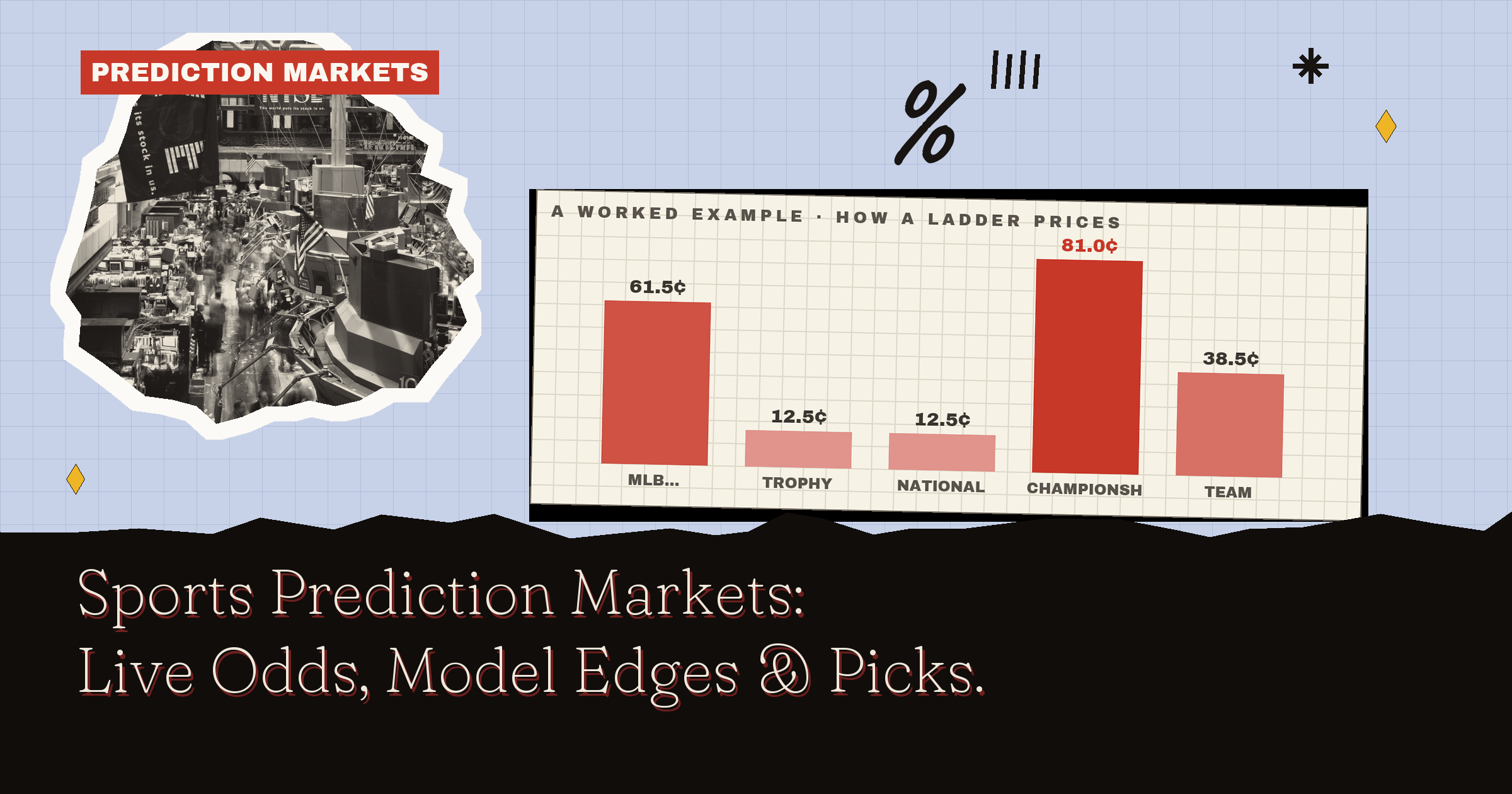
| MLB Rookie of the Year (both leagues) | NL: JJ Wetherholt · AL: Kevin McGonigle | 61.5¢ / 82¢ | 60 | ROTY odds page |
| Heisman Trophy | CJ Carr, Notre Dame | 12.5¢ | 29 | Heisman odds page |
| College Football National Championship | Ohio State and Notre Dame, tied | 12.5¢ | 50 | CFB title page |
| Wyndham Championship (settles tonight) | Michael Brennan | 81¢ | 81 | Wyndham page |
| Tyreek Hill's Next Team | Stays with Miami or retires | 38.5¢ | 32 | Landing-spot page |
The same desk covers the marquee races beyond sports, because the mechanics are identical and the volumes are enormous:
| Race | Front-Runner Right Now | Price | Open Contracts | Deep Dive |
|---|---|---|---|---|
| 2028 Republican Nominee | J.D. Vance | 41.5¢ | 38 | GOP nominee page |
| 2028 Democratic Nominee | Gavin Newsom | 16.5¢ | 47 | Dem nominee page |
| Texas Senate 2026 | James Talarico and Ken Paxton, dead heat | 50.5¢ each | 2 | Texas Senate page |
| Oscars Best Picture | The Odyssey | 48.5¢ | 38 | Best Picture page |
A few reads jump straight off the table. Kevin McGonigle at 82¢ is a race the market considers nearly decided, while the NL side still prices real doubt between JJ Wetherholt at 61.5¢ and Sal Stewart at 28.5¢. The Texas Senate market is the single most balanced high-volume race on the exchange, two contracts sitting at 50.5¢ apiece. And the college football title board is as flat a field as this exchange lists: Ohio State and Notre Dame share the top at 12.5¢, with Texas at 11.5¢, Oregon at 10.5¢, and Georgia at 9.5¢ all within a field goal of the lead.
A Worked Example: Reading The Heisman Board Like A Projection
Take the Heisman market, because it shows every step. Kalshi lists 29 active candidate contracts. Each one carries the same rule shape, quoted from the Will Hammond contract: "If Will Hammond wins the College Football Heisman Trophy in the 2026-2027 college football season, then the market resolves to Yes." Binary outcome, one winner, and every contract on the board settles on the ceremony result. Contracts resolve Yes or No, nothing in between.
Hammond, the Texas Tech quarterback, is bid at 2¢ and asked at 3¢. Convert that to probability and the market is saying somewhere between 2% and 3%. Now the projection question: if your college football numbers, your film read, or your devy rankings make Hammond something like a 6% Heisman candidate, the market is offering him at less than half your number, and the 1¢ spread barely dents that gap. If your number is 2%, there is no edge and you move on. That is the entire discipline. You are not asked to be right about the whole field, only to find the handful of names where your process and the market's price cannot both be true.
The same arithmetic runs everywhere on this page. A 61.5¢ Wetherholt is a 61.5% claim you can test against rest-of-season playing time. A 12.5¢ Ohio State is a 12.5% claim you can test against a power rating and a playoff path. Cents in, probabilities out, disagreements ranked by size. Our deep-dive pages do this work board by board; this hub is the ledger that keeps the current prices in one place.
How The AI Panel Grades Every Board
Every dedicated race page on this hub gets the full Stokastic Model Verdict treatment. A panel of frontier AI models receives a fetched, price-blind data card, current stats, rosters, polls, settlement rules, never the market price, and each seat commits to a probability for every outcome. Then the panel runs a revision round: each model reads the others' anonymized reasoning and may revise with a stated reason. The blended round-two numbers are what we publish next to the market price, and the gap between them is the edge ledger.
The part that makes this more than an opinion column is the grading. Every number every seat produces is stored and scored against the real settlement once the market closes, and the running records are public.
Every seat on this panel is graded against real market settlements — records to date: GPT 83% on 3,225 graded calls · Claude Fable 82% on 450 graded calls · Claude Opus 84% on 514 graded calls · Claude Sonnet 82% on 498 graded calls · GLM 81% on 2,307 graded calls · Kimi 83% on 2,285 graded calls · DeepSeek 80% on 2,332 graded calls. Recomputed daily; the full scoreboard is public.
Models are frequently wrong; the market price reflects real traders' money.*
Panel size varies with seat availability; each race page discloses how many of the panel's eight seats ran its board. Every published number gets graded either way, which is the point: the scoreboard is the reason to trust or fade the panel, not the prose.
What A DFS Player Does With An Event Contract
The reason this hub lives on Stokastic and not a trading site is that award and futures markets leak information a lineup builder can use.
Rookie of the Year markets are a playing-time indicator. An 82¢ McGonigle is the market asserting his job security and his at-bats for the stretch run, weeks before season-long salary systems fully price it. A 28.5¢ Sal Stewart against a 61.5¢ favorite says the market still sees a real two-man race, which means it expects both to play every day. When a rookie's award price moves sharply, the underlying cause is almost always a role change, and role changes are where DFS value comes from before pricing catches up. Our MLB DFS projections and Sims are the natural cross-check: sim a slate, then see whether the award market agrees with the playing-time assumptions baked into it.
The Heisman board doubles as a CFB DFS and devy cheat sheet. The names clustered at the top, Carr at 12.5¢, Arch Manning at 11.5¢, Darian Mensah at 7.5¢, Julian Sayin and Trinidad Chambliss at 6.5¢, are the market's shortlist of which quarterbacks will carry slate-breaking volume this fall. Next-team markets work the same way for fantasy: the Tyreek Hill board pricing "stays or retires" at just 38.5¢ means the market makes a trade or signing elsewhere the likelier outcome, and every landing spot on that board implies a different target tree.
Golf runs in the other direction. On a Sunday afternoon the Wyndham winner market is a live probability feed on a tournament in progress, Michael Brennan at 81¢ with Beau Hossler at 11¢ and Tom Kim at 5.9¢ chasing, which is a sharper leaderboard read than strokes-back alone.
Settlement, Fees, And The Fine Print
Everything above obeys the same fine print. Each Kalshi contract settles by its own written rules, so read the specific market's rules before trading it, not the title. Trading fees scale with the contract price. Book depth varies enormously: the Republican nominee board has traded over 56 million contracts and the Democratic board over 175 million, while the Tyreek Hill board sits near 343,000, and on a book that thin the spread is part of the price. A quote moving without volume behind it is a market maker adjusting, not news. Prices on this page were fetched August 9, 2026, and the page re-scores as boards move and as each deep-dive page lands.
The Bottom Line
Sports prediction markets hand a projections player something sportsbooks never have: near-fair prices that read directly as probabilities, on award races, futures, and roster questions that connect straight back to fantasy value. The method on every page linked above is the same one this site applies to a DFS slate. Build a number independent of the market, compare it to the price, size the disagreement, and keep score in public. Our fantasy futures boards, led by the fantasy QB1 verdict, run on the identical machinery, and the ten boards on this hub now give that machinery a full calendar of races to grade itself against.
More on this: DFS Vs Sports Betting: How To Win At Both · DFS Variance Vs Sports Betting Variance: Manage The Swings · NBA Eastern Conference Odds 2027: LeBron's 76ers Lead At 23\u00a2 · NHL Western Conference Odds 2027: Avalanche Favored At 21\u00a2 · Fantasy RB1 Odds 2026: Gibbs Leads, Bijan Is The Value