
How To Build NFL DFS Lineups For Large-Field GPPs
July 19, 2026
If you play NFL DFS on DraftKings 🎁, the first thing you probably do when you sit down to build is generate the highest-projected lineups you can and fire them into a tournament. It feels right, and it's exactly wrong. That instinct is a cash-game move, and it quietly caps your ceiling in a large-field GPP. This is how to build NFL DFS lineups the way high-volume tournament players actually do it: not by chasing one big projected score, but by shaping a whole portfolio around correlation and leverage, then letting the Sims do the heavy lifting across every lineup at once. Get the order right (caps first, correlation rules second, leverage last) and the whole thing becomes repeatable slate to slate.
In Summary
- The Top-Projected Lineup Set Is A Trap For Tournaments. Building the highest-projected 150 lineups gives you a set that's over-exposed to two or three players, barely correlated, and identical to everyone else's chalk. It has a floor and no ceiling.
- Cash And GPPs Want Opposite Builds. In cash you do want the top-projected, highest-floor lineup. In a large-field GPP you want ceiling and differentiation, which means correlation and leverage, not raw projection.
- Set Exposure Caps On QB And DST First, not on everyone. Capping quarterback and defense (around 20% each) diversifies the two spots that most need it. A universal cap on every player degrades your lineups fast.
- Build Correlation With Stacking Rules: a quarterback with two pass-catchers as the base, a bring-back from the opposing team for shootouts, and smart exceptions for pass-catching backs and dual-threat rushing quarterbacks.
- Tune The Set With Leverage, Not Gut Feel. Read the Boom/Bust Tool and Top Stacks Tool: when a player's optimal rate beats his projected ownership, get above the field on him.
- The Stokastic Sims Apply All Of It At Once, building and diversifying your full portfolio by win probability across thousands of simulated contests, which is something no human can do by hand across 150 lineups.
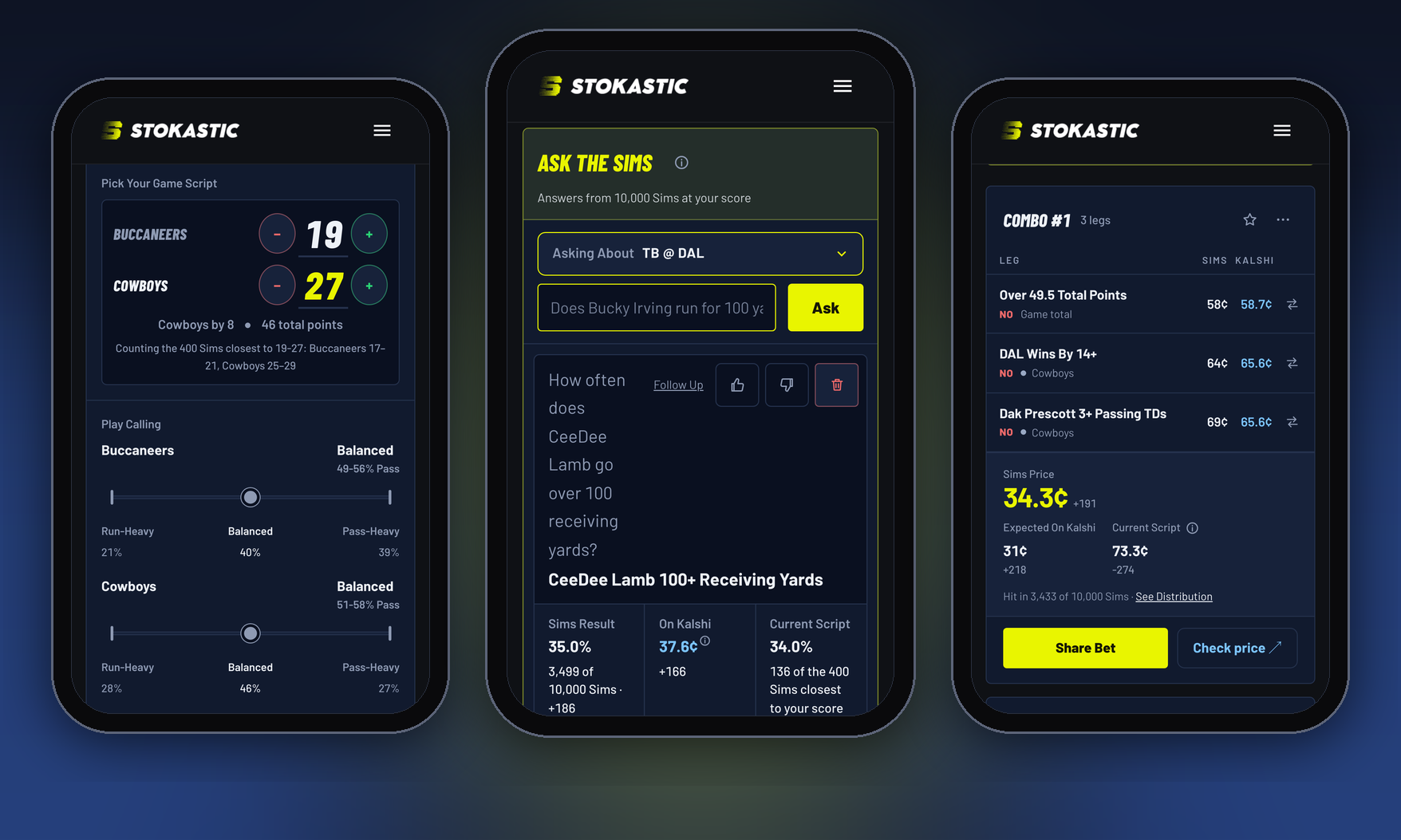 Price the combo before you buy it. The Kalshi Combo Simulator plays this week's NFL game 10,000 times and prices any combo you build next to the price on Kalshi, on your phone, free, no login.
Watch: How We Build NFL DFS Lineups
Here's the full walkthrough this guide is built from. The on-screen tools have evolved since we recorded it, but the build process (exposure caps, correlation rules, leverage reads) is exactly what carries over, and it's what the Stokastic Sims run today. The slate changes; the process doesn't. (watch on YouTube)
Why The Top-Projected Lineup Set Is A Trap In Tournaments
Start where everyone starts: build the 150 best-projected lineups and look at what you got. The problem jumps off the screen. You'll be in one running back in 90%-plus of your lineups, a second one nearly as often, and one quarterback in 80% of the set. That is not a portfolio; it's the same handful of players wearing 150 different jerseys. If any one of those over-exposed players lays an egg, a whole section of your lineups dies with him, and in football, any given player busts on any given Sunday.
There's a second, quieter problem: correlation. Chase pure projection and you'll routinely get a quarterback with no pass-catcher next to him. A naked quarterback who throws for three scores banks you only his points, while the receiver those scores went to sits on someone else's roster. Without intentional correlation you're building lineups that can min-cash but can't explode, and a large-field tournament is won by explosions, not by nine independently fine games.
And even when the projections are clean, they lean chalky. The highest-projected players are the ones the field is piling onto too, so a top-projected set overlaps heavily with everyone else's, even if a few lower-owned values sneak in. You can post a strong score and still split the prize with thousands of near-identical tickets.
This is the fork that decides everything else. In a cash game, the top-projected, highest-floor lineup is what you want; you only need to beat about half the field, so consistency wins and you can skip most of what follows. A tournament rewards the opposite: ceiling and looking different on purpose. (If that distinction is new, our NFL DFS strategy guide lays out the full cash-versus-GPP split.) Everything below is the GPP build.
| Build Decision | Cash games (50/50s, double-ups) | Large-field GPPs |
|---|---|---|
| What You're Optimizing | Highest projected floor | Highest ceiling + win probability |
| Correlation / Stacking | Optional, often none | Required: QB + 2 pass-catchers + bring-back |
| Exposure Caps | One lineup, so N/A | Cap QB and DST ~20%; steer the rest |
| Ownership / Leverage | Doesn't matter | Central: get above the field on the sims' plays |
| Target Ownership On Your Studs | Whatever projects best | Below the field where the sims agree |
The row that matters most is the middle one: correlation is optional in cash and mandatory in a GPP, and that single difference is why you can't just recycle your cash lineup into the milly maker.
Step 1: Set Exposure Caps On Quarterback And Defense First
The fastest fix for that over-exposure problem is a cap, but only in the right two places. Cap your quarterback exposure around 20% so you're spread across several signal-callers instead of stapled to one, and do the same for DST, where 10-20% keeps a single defense from creeping into a third of your lineups. Those are the two positions where over-concentration hurts most and diversification is cheapest.
The tempting next move is to cap every player the same way, and it's a mistake. When you force a hard cap across the whole pool, the Sims can't reuse your best plays, so each successive lineup has to reach further down the projection board. Turn on a blanket 30% cap and you can watch lineup quality fall off: the first build is strong, the second can't repeat any of the first's players, the third is starving, and by the middle of the set you're rostering plays you'd never choose on their own. You solved concentration by manufacturing bad lineups.
So cap the two spots that need it and leave running back, receiver, and tight end at full exposure. You'll still steer those positions, just with a scalpel instead of a hammer, which is what the last step is for.
Step 2: Build Correlation With Stacking Rules
Correlation is the engine of the whole build. Instead of hoping projection accidentally pairs the right players, you write correlation rules once and let every lineup inherit them.
- Base Rule: Stack The Quarterback With Two Pass-Catchers (wide receivers or tight ends) from his own team. When he throws for 350 and three scores, you want to own where those yards went, twice over.
- Bring-back: add at least one pass-catcher from the opposing team. You're betting the game turns into a shootout, so you want a piece of both sides; when the trailing offense has to throw, your bring-back catches up. Receivers and tight ends correlate cleanest here, though a pass-catching back can work too.
- Positional Limit: Cap Running Backs, Receivers, And Tight Ends From One Team At Two Players Unless The Quarterback Is In The Stack. If a team is spilling enough fantasy points to want three skill players, the quarterback is almost certainly having a big day anyway, so tie the concentration to him.
- Two Unique Players Per Lineup, Four Players Max From Any One Team. The unique-player rule keeps builds from cloning each other; the team cap keeps a single game from swallowing a lineup.
The same rule set, as a slate-day reference:
| Rule | Setting | Why |
|---|---|---|
| Base Stack | QB + 2 pass-catchers (WR/TE) | One big passing day pays your lineup twice |
| Bring-Back | + 1 opposing pass-catcher | Buys a piece of both sides of a shootout |
| Team Skill Cap | 2 RB/WR/TE per team unless QB is stacked | Ties concentration to a big-day quarterback |
| Uniqueness | 2 unique players per lineup | Stops builds from cloning each other |
| Team Ceiling | 4 players max from one team | Keeps one game from swallowing a lineup |
The bring-back row is the one most new builders skip, and it's the difference between a team stack and a game stack; game stacks are how the milly maker gets won.
Two exceptions keep those rules honest. For teams whose running back is heavily involved in the passing game, let that back count toward the stack instead of forcing two wideouts, because his receptions correlate with the quarterback just like a slot receiver's do. And for dual-threat rushing quarterbacks, require only one pass-catcher: a quarterback who banks a chunk of his points on the ground doesn't need two receivers to hit his ceiling, so forcing a second just over-restricts the build.
And here's the payoff on the forward promise from up top: once these rules are in, your set diversifies itself. Each quarterback drags his own required pass-catchers and bring-back into his lineups, so a lineup anchored by one quarterback can't help but look different from a lineup anchored by another. That's why heavy correlation and light diversification settings get along: you rarely have to police duplicate lineups by hand, because the stacking rules already spread the set out for you.
Step 3: Tune The Set With Leverage, Not Gut Feel
Caps and correlation give you a structured set. Leverage is what makes it a winning one. Your score in a large-field GPP only matters relative to the field, so the question for every player isn't "is he good," it's "am I getting more or less of him than everyone else, and do I want to be."
Answer it with the tools, not your gut. The Boom/Bust Tool and Top Stacks Tool show each player's projected ownership next to how often he lands in an optimal lineup across our simulations. When a player's optimal rate clears his projected ownership, that's positive leverage: the field is under-rostering a player the sims love, and getting above the field on him is exactly how you separate. When ownership towers over optimal rate, that's chalk you want to be underweight. Value here is leverage, not the raw projection and definitely not the shortest-priced favorite.
You have two ways to act on it. If you're newer, nudge a player up or down with a small thumbs-up or thumbs-down style boost and re-run; it's the safe lever. If you've got reps, you can adjust the projection itself, but do it in small steps: with this much correlation baked in, a big bump to one receiver can flood your set with his quarterback and both of their stack partners. Small nudges, re-crunch, read the exposures, repeat, until the set holds the players you want at the weights you want.
A Sample NFL DFS Build, Step By Step
Say the raw set hands you your top dual-threat quarterback at 81% exposure. Cap him at 20% and re-run. Now check the tools: he's projected for 11.5% ownership but shows up as a top stack 21.5% of the time. That gap is positive leverage pointing the other way, so you raise his cap to 30% and get above the field on the player the sims like and the room is under-rostering.
Run the same read at running back. Your set is forcing 63% of one chalk back, but the Boom/Bust Tool has a cheaper back at roughly 2% ownership and a 7.7% optimal rate. That's a player the field has left for dead and the sims keep putting in winning lineups. Thumb the chalk back down, boost the cheap one up a step at a time, and re-crunch until you're above the field on the leverage play instead of buried in the chalk. That single read, repeated position by position with small boosts, projection nudges, or the occasional individual cap, is the core of the tuning pass.
One more setting ties it together: run about 30% randomness on a main slate. It's enough to keep the build from stamping out near-identical lineups without letting projections drift into noise.
Let The Sims Build The Portfolio
Notice what actually happened across those three steps. You capped two positions, wrote your correlation rules once, and made a handful of leverage reads. You did not hand-pick 150 lineups. That's the point: the Stokastic Sims take your player pool, correlation rules, and exposure targets and simulate the tournament tens of thousands of times, surfacing the highest-win-probability builds with the bring-backs and diversification already handled. Roster construction, stacking, and ownership leverage all get applied across your entire portfolio at once. Your job shrinks to the read you already know how to make: nudge, re-crunch, read the exposures, repeat, until the set holds the players you want at the weights you want.
That's also where you'll spend real prep time before a slate: pull your NFL DFS projections, ownership and stacks in the DataHub, then build and diversify the set in the Sims. Want to see it before you subscribe? You can try the Sims free and run a set start to finish.
Build the process, not one lineup. Stokastic's NFL Data + Sims package gives you the Contest Sims, Ownership Projections, Boom/Bust Tool and Top Stacks Tool that turn caps, correlation, and leverage into a few clicks: a full portfolio built and graded by win probability across thousands of simulated contests. New to Stokastic? Use code NFLWEEK2 for 10% off through Monday, September 21 your first NFL payment.
start building smarter NFL lineups
Putting It All Together
Building NFL DFS lineups for a large-field GPP is a sequence, not a single click. Skip the instinct to fire the top-projected set, because that's a cash build wearing a tournament costume. Cap quarterback and defense near 20% so a single dud can't crater your portfolio, write correlation rules (QB + 2 pass-catchers + a bring-back) so every lineup diversifies itself, run about 30% randomness, then read the Boom/Bust and Top Stacks Tools to get above the field on the leverage plays the room is sleeping on. Do that in order, let the Sims apply it across every lineup, and judge yourself on the process over a season, not on any one Sunday. For the deeper cuts, our NFL DFS stacking guide, leverage and game theory breakdown, and Milly Maker Sims guide each go one level further than this build.
How To Build NFL DFS Lineups FAQ
How Do I Build NFL DFS Lineups For Tournaments?
Build the whole set, not one lineup. Cap your quarterback and defense exposure (around 20% each), write correlation rules so most lineups stack a quarterback with two pass-catchers plus a bring-back from the opposing team (with exceptions for pass-catching backs and dual-threat rushing quarterbacks), then use the Boom/Bust and Top Stacks Tools to get above the field on players whose optimal rate beats their projected ownership. Let the Stokastic Sims apply all of it across your full portfolio by win probability.
Why Shouldn't I Just Play The Highest-Projected Lineups In A GPP?
Because a top-projected set is over-exposed to two or three players (you'll often be in one running back in 90%-plus of your lineups and one quarterback around 80%), barely correlated, and identical to the chalk everyone else is on. It has a solid floor and almost no ceiling, so it can min-cash but rarely wins. The highest-projected lineup is a cash-game build; tournaments reward ceiling and differentiation instead.
Should I Set An Exposure Cap On Every Player?
No. Cap only quarterback and defense, the two spots where over-concentration hurts most. A universal cap on every player forces each successive lineup to reach further down the projection board, and lineup quality drops off quickly. Steer running backs, receivers, and tight ends with leverage nudges instead of hard caps.
How Many Players Should I Stack When Building NFL DFS Lineups?
The base is a quarterback plus two of his own pass-catchers, plus one bring-back from the opposing team for a full game stack. Two exceptions: let a pass-catching running back count toward the stack, and require only one pass-catcher for a dual-threat rushing quarterback who scores heavily on the ground.
What Is Leverage In NFL DFS, And How Do I Use It?
Leverage is getting underweight the chalk and overweight the comparable players the field is ignoring. Read the Boom/Bust and Top Stacks Tools: when a player's optimal rate (how often he lands in a winning simulated lineup) beats his projected ownership, that's positive leverage. A back at roughly 2% ownership but a 7.7% optimal rate is a player the field left for dead and the sims keep using, and getting above the field on him is how you avoid splitting prizes when he hits.
How Much Randomness Should I Use To Build NFL DFS Lineups?
Around 30% on a main slate. That's enough to keep the Sims from producing near-identical lineups without letting the randomness drift so far that you're ignoring the projections. Pair it with your correlation rules, which already diversify the set on their own.
What Stokastic Tools Help Build NFL DFS Lineups?
Stokastic's NFL Data + Sims package includes the Contest Sims (which simulate the tournament tens of thousands of times and build your full portfolio by win probability), NFL projections and Ownership Projections for leverage, the Boom/Bust Tool for each player's range of outcomes, and the Top Stacks Tool for correlated builds. The Sims build the lineups, so there's no separate optimizer to learn. New to NFL DFS? Start with the NFL DFS primer.
More on this: NFL DFS Hub: Every Live Stokastic NFL Page · How To Build Winning MLB DFS Lineups (DraftKings & FanDuel) · How To Build PGA DFS Lineups: The Tournament Process That Controls Ownership · How To Build Winning DFS Lineups In Stokastic Sims · How To Build NHL DFS Lineups: Stacks, Uniques & Randomness
Code NFLWEEK2 takes 10% off your first payment on any Stokastic NFL or All Access package through Monday, September 21. Week 2 projections and ownership are live in the Sims.
Use code NFLWEEK2
Get Started