
NFL Week 1 DFS Values
By Jake Hari
August 23, 2026
Week 1 is the only NFL DFS slate of the year that gets priced before anyone has seen a meaningful snap. DraftKings posted its Week 1 board in late July, and when we re-pulled the full 12-game main slate on August 18, the shape was familiar: Jahmyr Gibbs still on top at $8,000, and a huge bin of cheap players underneath. In the weeks between those two dates, training camps quietly settled a batch of jobs that the salaries never reacted to. Finding those rows is what I actually mean when I say Week 1 is the softest slate of the season, and the cleanest example on the whole board is a Jets wide receiver priced at $3,000 who beat out a first-round pick listed $1,100 above him. We will get to that row, but first the process that finds it, because the process is the part that keeps working after DraftKings finally reprices everyone.
The Quick Answer
NFL Week 1 DFS values come from the gap between salaries DraftKings posted in late July and the roles training camp settled in August. Comparing each salary against a projected role, instead of last season's box score, is how I find them by hand and how the Sims find them at scale. The four-step workflow, the real Week 1 rows where camp moved and the board did not, and the traps that only look like values are all below.
Week 2 offer. Code NFLWEEK2 takes 10% off your first payment on any Stokastic NFL or All Access package through Monday, September 21. Get 10% off the Sims with code NFLWEEK2.
Why Week 1 Salaries Go Soft
DraftKings set these prices roughly six weeks before kickoff. The pricing team can adjust any salary between now and September 13, and it does, but repricing tends to chase the loudest headlines. The quieter stuff, a rookie moving up to the first team, a WR3 job changing hands, a tight end becoming the two-minute target, mostly sits where it was priced. Cleveland moved rookie Denzel Boston into the starting lineup on August 11, and a week later the board we pulled still listed him at $4,400, a depth-receiver tag attached to a starting job. Our first look at the full DraftKings Week 1 board covers the overall shape of the pricing; this piece is about the workflow that turns that board into a value list.
The second half of the edge is the field. In Week 1 there are no in-season stats, so most entrants fall back on what they remember from last December. Players who earned new roles in August get rostered like the depth pieces they used to be. The early chalk and leverage reads follow from exactly that behavior: ownership concentrates on last year's names, and the camp winners go overlooked. A salary can be soft on points alone, but a salary that is soft on points and ignored by the field is what wins tournaments. If the salary-cap math underneath any of this feels new, start with the NFL DFS primer and come back.
The Workflow: Salary Vs. Sim Value In Four Steps
Here is the actual process, the same one the Sims run at scale once the season data flips on.
Step 1: freeze the board. Pull every salary on the main slate and date the snapshot. Ours is August 18. A value only exists relative to a specific board, and DraftKings will reprice some of these rows, so you need to know which price you evaluated.
Step 2: project the role, volume first. Opportunity drives NFL scoring, so the question for every player is who actually gets the ball: projected routes and target share for receivers, touches and red-zone work for backs. In August, camp reporting and depth charts answer that question far better than last season's stat page does. A player's history matters only as evidence of what he does with the volume; the volume itself is set by the job he holds right now.
Step 3: convert to value. Divide projected DK points by salary in thousands. The cheap player does not need a big game to be the better roster decision; he needs a real role at a stale price. Rate stats like this are exactly what NFL DFS projections, ownership and stacks in the DataHub are built to sort the moment the season feeds go live.
A Worked Example With Illustrative Numbers
Real Week 1 projections do not exist yet, so the numbers here are round illustrative examples rather than our forecasts. The rate math is the lesson:
| Profile | Salary | Illustrative Projection | Points Per $1,000 |
|---|---|---|---|
| Camp Winner Priced Before His Promotion | $3,000 | 9.0 DK points | 3.00 |
| Mid-Tier Veteran Priced On Reputation | $5,700 | 14.0 DK points | 2.46 |
The veteran outscores the camp winner by five points and still loses the value column, because he would need about 17 DK points to match a 3.0x rate. Salary buys ceiling, role buys rate, and a winning tournament lineup needs both from somewhere. In Week 1, the cheap end of the board is where rate lives.
Step 4: re-run when news lands. A projection from August 10 died on August 18 if the depth chart moved. The Sims advantage is mechanical rather than clever: the inputs update and everything downstream recalculates, while the salary column stays frozen. Late in Week 1 prep you layer ownership on top, and the soft salaries the field ignored become leverage. The full walkthrough of that engine is in how to use NFL DFS Sims.
One timing note that matters more than any single row below: Stokastic NFL annual prices go up on September 1. The Early Bird pricing breakdown runs the exact numbers, and locking an annual in August means the full Week 1 value boards, ownership and Contest Sims are already yours when this workflow goes live for real.
Where Camp Moved And The Board Did Not
Now the fun part. These rows are on the August 18 board at prices that predate the camp news attached to them.
| Player | Pos | Team | DK Salary | What Changed In Camp |
|---|---|---|---|---|
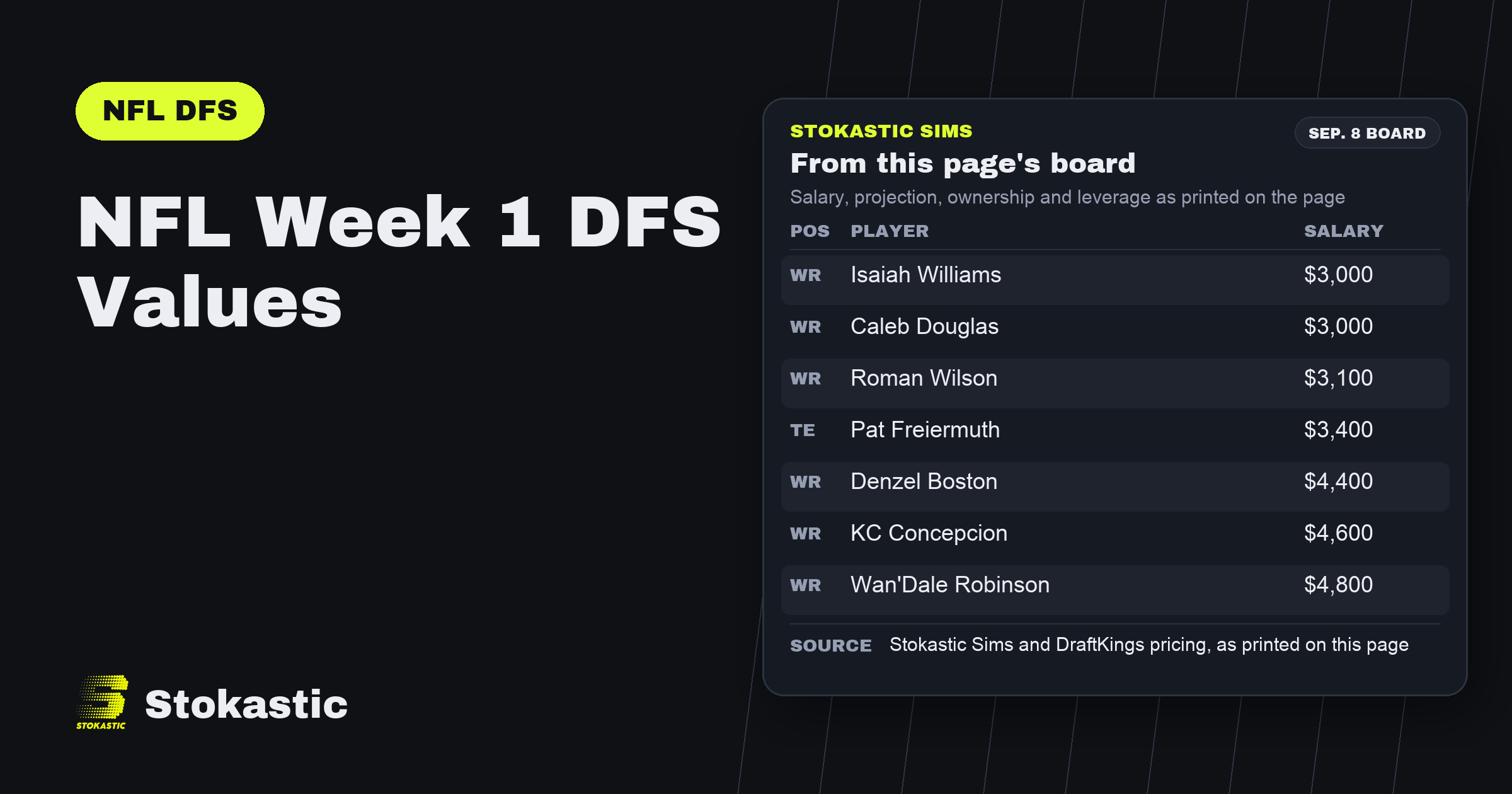
| Isaiah Williams | WR | NYJ | $3,000 | Passed first-round pick Omar Cooper Jr. ($4,100) for the WR3 job |
| Caleb Douglas | WR | MIA | $3,000 | Listed starter, called one of camp's most consistent players |
| Roman Wilson | WR | PIT | $3,100 | Beat reporting calls him firmly the slot WR3 |
| Pat Freiermuth | TE | PIT | $3,400 | Go-to target in two-minute work, bigger planned role |
| Denzel Boston | WR | CLE | $4,400 | Promoted to the first team on August 11 |
| KC Concepcion | WR | CLE | $4,600 | Listed starting WR on the Browns' first depth chart |
| Wan'Dale Robinson | WR | TEN | $4,800 | Led Titans camp receptions, 26 through August 10 |
The Jets row is the one I promised, and it is the purest version of the pattern. Omar Cooper Jr. was priced at $4,100 on draft capital, the way first-round receivers always are. Then camp happened: Isaiah Williams caught a 36-yard touchdown off a deflection in the team scrimmage, strung together what the Jets beat called a terrific camp, and by mid-August the first-rounder was running with the second team while Williams held the WR3 job. The board still charges $1,100 more for the player who lost the competition. A role-based projection flips those two the moment the depth chart does, while a salary-only read keeps paying extra for the loser of the battle.
Cleveland is the same story with a louder soundtrack. Rookies Denzel Boston ($4,400) and KC Concepcion ($4,600) were both in the starting lineup by mid-August alongside Jerry Jeudy ($4,100), and ESPN's camp reporting relayed a team source comparing Boston to Drake London. Starting outside receivers priced in the mid-$4,000s, down where punt-priced roster spots usually live, is precisely the kind of line a reprice eventually comes for. Miami's Caleb Douglas ($3,000) fits the same mold: a third-round rookie listed as a starter and described by his own head coach as one of the most consistent players in camp. And in Tennessee, Wan'Dale Robinson ($4,800) leading the entire camp with 26 receptions is a volume signal hiding behind a mid-tier price.
None of these are season-long calls. They are gaps between an August 18 price and an August 18 role, and gaps close. The play is knowing they exist before the field prices them in; the final calls, once depth charts firm up in September, will live in our Week 1 DraftKings picks and strategy breakdown.
The Salaries That Only Look Soft
The same workflow that surfaces value also kills traps, because Step 2 cuts in both directions. Three rows on this board look like discounts until you project the role.
| Player | Pos | Team | DK Salary | Why It Only Looks Soft |
|---|---|---|---|---|
| Alec Pierce | WR | IND | $5,700 | Has not practiced all summer; Keenan Allen just arrived |
| Kaleb Johnson | RB | PIT | $4,400 | Sixth in Pittsburgh's mid-August carry line |
| Breece Hall | RB | NYJ | $6,200 | August 18 groin strain, called minor; wait for the re-run |
Alec Pierce ($5,700) is the big one. The salary reflects a receiver Indianapolis just paid $114 million, but Pierce has not practiced all summer after offseason ankle surgery, took a second PRP injection in August, and his head coach said he did not expect him back for joint practices with four weeks to the opener. Then on August 18, the same day we pulled this board, the Colts agreed to sign Keenan Allen, who was not on the board at all yet and who walks into a target share. Josh Downs ($5,200) sitting out an August practice with a groin injury rounds out a receiver room where every mid-tier price carries volume risk the salaries never priced in.
Kaleb Johnson ($4,400) shows the other trap: a name-brand young back whose camp evidence points down. He took the sixth spot in Pittsburgh's running back carry line in mid-August, behind Rico Dowdle, Jaylen Warren and three depth backs, and played zero first-half offensive snaps in the preseason opener. His teammate Pat Freiermuth made the value table above; Johnson is the reminder that a familiar name at a modest price is not a role.
Breece Hall ($6,200) is the name that teaches patience. He strained his groin on August 18, the team called it minor, and backup Braelon Allen ($4,700) is coming off a 31-yard preseason touchdown run. The headline says pivot; the process says wait. If Hall is limited or out, Allen at $4,700 becomes one of the best rate plays on the slate, and if Hall is fine, nothing changed. You do not have to guess, because the projections re-run when the answer arrives. The discipline of waiting for the re-run instead of chasing the headline is most of what separates a value list from a rumor list.
From A Watchlist To Full Boards
Everything above is the workflow at hand-tool scale: one board, a dozen rows, camp reports as the role input. When the season data goes live, the Sims run the identical loop across every player on the slate, thousands of times per contest, with ownership layered on top, and the output is a full value board instead of a watchlist. You can see the machinery yourself and try the Sims free before Week 1, and if you want to know what the tournament field does with all this once real money is on the line, the Week 1 Milly Maker strategy guide picks up where this piece stops.
Get There Before The Reprice
The board will catch up. DraftKings will move some of these salaries before September 13, the field will read the same depth charts eventually, and the gap between an August price and an August role will narrow by the day. The whole Week 1 edge is a race against that correction, and a sim-driven process wins it because it reprices players every time the news does. Between now and kickoff, the cheapest way into that process is also on a clock of its own: Stokastic NFL annual pricing increases on September 1, so the Early Bird window closes before the slate even locks. Lock in the season now and the full value boards, ownership projections and Contest Sims are live in your account the moment Week 1 data drops.
More on this: NFL DFS Hub: Every Live Stokastic NFL Page · NFL Week 1 DFS Injury Updates: Jeanty, Kamara & The Raiders Chalk Question · DraftKings NFL DFS Cheat Sheet: Week 1 Picks And Stacks · FanDuel NFL DFS Cheat Sheet: Week 1 Picks And Stacks · NFL DFS Late Swap: How To Use Late Games To Win GPPs
Code NFLWEEK2 takes 10% off your first payment on any Stokastic NFL or All Access package through Monday, September 21. Week 2 projections and ownership are live in the Sims.
Use code NFLWEEK2
Get Started