
Heisman Trophy Odds: The Favorite Our Models Ranked Fourth
By Jake Hari
August 10, 2026
The Quick Answer
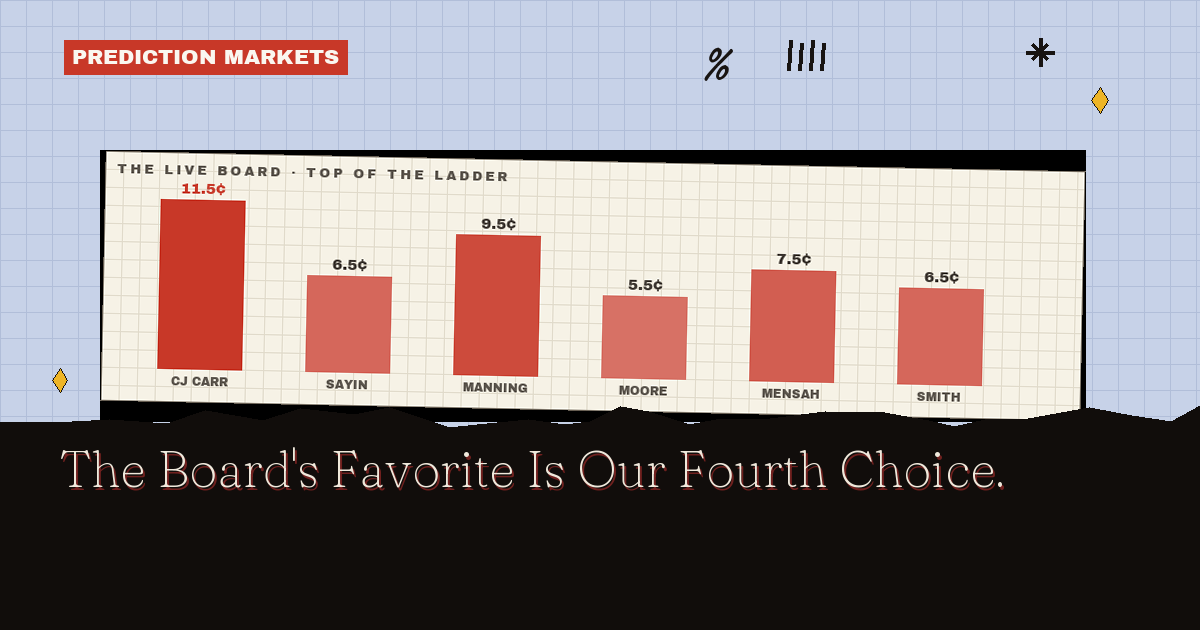
Kalshi's Heisman board goes into Week 1 with Notre Dame's CJ Carr as its most expensive name at 11.5 cents, Arch Manning behind him at 9.5, and 29 more names underneath. We asked eight AI models to price the same race without ever showing them the market, then let them read each other's reasoning and revise. Every single one of them put Ohio State's Julian Sayin first, and the market has Sayin at a little over half of Carr's price. Carr came out fourth. The full 31-name board, the name the market has moved hardest on in the last two weeks, and what a devy manager should actually take from it are below.
The Market
Kalshi's Heisman market is a set of 31 separate yes-or-no contracts, one per player, and each of them settles on a single sentence. Quoted verbatim from the Julian Sayin contract: "If Julian Sayin wins the College Football Heisman Trophy in the 2026-2027 college football season, then the market resolves to Yes." Nothing else counts. The award's own calendar, from heisman.com, has the finalists announced December 7 and the trophy handed out December 12; the contracts carry a listed expiration of January 1, 2027.
Two things shape every number below. No 2026 snap has been played, so each price is a prior rather than a read on form, and about 7.7 million contracts have changed hands across the 31 listings since they opened, which makes this one of the busiest sports boards Kalshi runs.
The second is that there is still no field contract. If the winner is a player who is not one of these 31, every one of them resolves No: nobody holding a Yes ticket collects, and everyone holding the No side does. The missing field contract matters more than it sounds, because the board's own arithmetic is loose in both directions: the 31 midpoints add up to 98.5 cents, while buying all 31 at the offer would cost 114 cents to chase a dollar that only pays if the winner is listed. Twenty-four of the 31 have a real two-sided quote; the other seven sit at zero bid and one cent ask, which is a displayed market rather than a price anyone is currently standing behind.
Timestamps: the panel's verdicts were generated the morning of August 24, 2026, without sight of any price; the prices here are bid-ask midpoints as of August 24, 2026. This page re-scores when the story moves.
The Board
Prices below are Kalshi midpoints: the halfway point between the best price someone will buy at and the best price someone will sell at, so a contract quoted 6 to 7 shows as 6.5. A contract pays a dollar if that player wins and nothing if he does not, which is why the cent figure reads as a percentage. The blend is the median of the eight models' revised estimates, which is why it does not sum to exactly 100 either.
| Outcome | Kalshi | Our Blend |
|---|---|---|
| Anyone Not Listed At All | no contract | 13.8% |
| CJ Carr (Notre Dame) | 11.5¢ | 5.6% |
| Julian Sayin (Ohio State) | 6.5¢ | 11.7% |
| Arch Manning (Texas) | 9.5¢ | 7.5% |
| Dante Moore (Oregon) | 5.5¢ | 9.0% |
| Darian Mensah (Miami) | 7.5¢ | 5.5% |
| Jeremiah Smith (Ohio State) | 6.5¢ | 3.5% |
| Trinidad Chambliss (Ole Miss) | 6.5¢ | 4.0% |
| Gunner Stockton (Georgia) | 3.5¢ | 5.5% |
| Josh Hoover (Indiana) | 4.5¢ | 4.5% |
| Keelon Russell (Alabama) | 3.5¢ | 3.4% |
| Marcel Reed (Texas A&M) | 3.5¢ | 3.5% |
| Sam Leavitt (LSU) | 3.5¢ | 2.5% |
| John Mateer (Oklahoma) | 3.5¢ | 2.5% |
| Jayden Maiava (USC) | 3.5¢ | 2.5% |
| Malachi Toney (Miami) | 2.5¢ | 0.6% |
| Bryce Underwood (Michigan) | 1.5¢ | 2.0% |
| Demond Williams Jr. (Washington) | 1.5¢ | 1.9% |
| Rocco Becht (Penn State) | 1.5¢ | 1.3% |
| Kevin Jennings (SMU) | 1.5¢ | 1.0% |
| Byrum Brown (Auburn) | 1.5¢ | 0.8% |
| Will Hammond (Texas Tech) | 1.5¢ | 0.8% |
| LaNorris Sellers (South Carolina) | 1.5¢ | 0.7% |
| Drew Mestemaker (Oklahoma State) | 1.5¢ | 0.5% |
| Jaron-Keawe Sagapolutele (California) | 1.5¢ | 0.4% |
| Kewan Lacy (Ole Miss) | 0.5¢ | 0.9% |
| Bo Jackson (Ohio State) | 0.5¢ | 0.8% |
| Ahmad Hardy (Missouri) | 0.5¢ | 0.5% |
| Jadan Baugh (Florida) | 0.5¢ | 0.4% |
| Kamario Taylor (Mississippi State) | 0.5¢ | 0.3% |
| Austin Mack (Alabama) | 0.5¢ | 0.1% |
| Brendan Sorsby (listed under Texas Tech) | 0.5¢ | 0.0% |
More live boards from the same panel: College Football Playoff odds (Notre Dame 83¢ to make the field) · College football national championship odds (Ohio State 12.5¢) · Conference championship boards. Prices fetched August 24, 2026.
The row that decides how you read everything else is the top one. Our models were asked to price the whole race in one pass, including the chance that the winner is nobody on the list, and their median answer to that question is 13.8 percent. There is no way to buy it.
Julian Sayin, Ohio State: The Name Every Model Put First
Sayin is the one player on this board that all eight seats agreed about. Not "roughly agreed" in the way panels usually converge on a favorite: he was the highest-rated player on all eight revised boards, in a range from 10 to 14 percent, against a market midpoint of 6.5 cents. Only the unlisted-winner row outranks him, and on most seats it does.
The case is short. Sayin threw for 3,610 yards with 32 touchdowns against 8 interceptions last season and completed 77.0 percent of his passes, the best accuracy figure anywhere on this board by a distance. He does it for the team that sits first in both the AP poll and the coaches' poll, and Ohio State collected 40 of the AP's first-place votes. Voters have handed this trophy to a quarterback in 21 of the last 26 seasons, and almost always to one whose team was playing for something in December.
"Sayin is the cleanest profile on the card (77.0% completion, 32-8, unanimous No. 1 team, six ranked games), but Ohio State's own balance caps him: Jeremiah Smith and Bo Jackson eat snaps and votes." (Claude Opus)
[Editor's note: Ohio State is first in both polls but not a unanimous No. 1. It took 40 of the AP first-place votes and 38 of the coaches'. The quote is reproduced as the model wrote it.]
That caveat is the one thing keeping his number in the low teens rather than higher, and it showed up unprompted in six of the eight write-ups. Ohio State is deep enough to make two or three Heisman cases and can only really finish one. The date that resolves it early: Ohio State goes to Texas on September 12, the second week of the season, which puts Sayin and Arch Manning on the same field before most of the country has formed an opinion about either.
CJ Carr And Arch Manning: What The Board Is Paying Up For
Carr is the most expensive name in this market at 11.5 cents and the panel's fourth choice at 5.6 percent, which is the widest disagreement anywhere on the board. No seat put him above 6 percent.
Nothing in the models' reasoning is dismissive of him. Carr completed 66.6 percent for 24 touchdowns against 6 interceptions as a redshirt freshman, Notre Dame is fourth in the AP poll, and his schedule hands him a national stage twice, opening against Wisconsin on September 6 and hosting Miami on November 7. What the seats kept flagging is that his slate is thin above him. Notre Dame's only preseason-ranked opponents are BYU, Miami and SMU, so a quarterback who is asked to out-produce the Big Ten and SEC front-runners gets three chances to do it on a comparable stage. The schedule read is a real handicapping argument rather than a knock on the player, and the market is under no obligation to accept it.
Manning is the closer call. At 9.5 cents against a 7.5 percent blend he is the second-most-expensive contract here, and the models are consistent about why they will not go higher: his completion rate.
"Manning is live but a little overrated by name; 61.4% completion and a brutal Texas schedule create downside as well as spotlight." (ChatGPT (GPT-5.5))
Seven ranked opponents is the most brutal slate anyone on this board carries. Texas plays Ohio State, Tennessee, Oklahoma, Ole Miss, Missouri, LSU and Texas A&M. Every one of those is a chance to win the trophy in an afternoon and a chance to lose it in one.
Dante Moore is the quieter version of the Sayin gap. Oregon's quarterback threw for 3,565 yards and 30 touchdowns at 71.8 percent last season for the team ranked second in both polls, he is the second-highest player on all eight boards, and he trades at 5.5 cents against a 9.0 percent blend. Several seats made the point that he is the only member of the top tier with no internal competition for votes at all.
Jeremiah Smith: The Name The Market Moved On, And The Panel Didn't
When we last scored this board two weeks ago, Smith traded at 3.5 cents. He is at 6.5 now, close to double, and no other contract here has moved as far since. The panel's number went the other way and sits at 3.5 percent.
The disagreement is about how rare his path is rather than how good he is. Smith caught 87 passes for 1,243 yards and 12 touchdowns last season and is, by consensus, the best receiver in college football. But five of the last 26 winners were not quarterbacks, and every one of those five put up a historic individual season for a title contender: Reggie Bush in 2005, Mark Ingram II in 2009, Derrick Henry in 2015, DeVonta Smith in 2020, Travis Hunter in 2024. The seats tested Smith against that specific bar rather than against a general "can a receiver win" question, and split on it.
"1,243 yards and 12 TD is excellent but well short of DeVonta Smith's 1,856/23 exception standard, and he splits with his own QB; 3.8 is the honest exception price." (Claude Opus)
Claude Sonnet, which had Smith at the very top of its first board, was the one seat that kept arguing the other side, calling his volume already sufficient to clear the exception bar. Both of those reads are defensible. The market has picked one of them in the last fortnight and the panel has picked the other, which is exactly the sort of split this page exists to show you.
Where The Panel Changed Its Mind
The revision round moved almost nothing at the top and a great deal at the bottom. Every seat kept Sayin first among the listed players and Moore second. What collapsed was the disagreement over the unlisted-winner number, which entered the round spread from 5 percent to 35.6 percent and left it spread from 10.4 to 22.9.
Claude Sonnet made the largest move on the board, from 5.0 percent to 18.2, and said why:
"Field sits at 18.2%, between the extremes in this round. It has to cover Tennessee, Clemson, BYU, Utah, Louisville, ranked with no listed candidate, plus a true first-year breakout, but shouldn't dominate given how concentrated the top-10 programs already are among named QBs." (Claude Sonnet)
DeepSeek came down from the other end, from 35.6 to 22.9. GLM made the sharpest reversal of any seat. It entered the round with Arch Manning as its outright favorite at 12 percent, on platform and name recognition, and left it with Manning cut to 7.5 for the same completion rate everyone else had flagged.
Claude Opus barely moved at all, from 13.2 to 12.2, and used its revision to add something no other seat had noticed: the card showed Lane Kiffin now coaching LSU, which means Trinidad Chambliss is running Ole Miss without the coach who built the offense that made him a candidate. Opus cut Chambliss from 4.5 to 3.5 on it. One model read a coaching change out of the roster data and repriced a contract on it, which is the whole reason the revision round exists.
The Devy Read: What This Board Is Actually For
If you play devy, dynasty or college DFS, this is a priced shortlist of who will carry slate-breaking volume this fall, assembled by people with money at risk. The shape tells you where the touches concentrate. Of the 30 listings we could check against a current roster, 24 are quarterbacks and six are not: Jeremiah Smith, Malachi Toney, Bo Jackson, Kewan Lacy, Ahmad Hardy and Jadan Baugh. Two of those six carry a real two-sided quote and the other four sit at zero bid. The 31st listing is Brendan Sorsby, who is on no 2026 roster at all.
The transfers are where your league mates are most likely to be behind. Darian Mensah brought a 3,973-yard, 34-touchdown season with him to Miami. Josh Hoover walked into the Indiana offense that produced last year's winner in Fernando Mendoza, on a team the coaches' poll gave 14 first-place votes. Sam Leavitt is installed as LSU's starter for Lane Kiffin's first season there, and Rocco Becht followed Matt Campbell from Iowa State to Penn State. Our odds desk scored the same market name by name in its own read of this board; this page is the projections-side companion. Once the season starts, these are the names headlining CFB DFS slates, and the Stokastic Sims are where the weekly version of this exercise lives.
Dark Horses The Panel Won't Dismiss
- Gunner Stockton (Georgia, 3.5¢, blend 5.5%): the largest upgrade outside the top tier, two points of blend above his price. Stockton returns for a fifth year having thrown for 2,894 yards and 24 touchdowns at 69.7 percent, added 462 yards and 10 scores on the ground, and plays for the AP's third-ranked team. Every seat had him above his price tier.
- Bryce Underwood (Michigan, 1.5¢, blend 2.0%): a second-year starter at a top-16 program whose 2025 line (60.3 percent, 11 touchdowns to 9 interceptions) is the whole argument against him and the whole reason the upside is priced this cheap.
- Demond Williams Jr. (Washington, 1.5¢, blend 1.9%): 3,065 passing yards at 69.5 percent plus 611 rushing yards, the most complete dual-threat profile outside the top tier.
- Kewan Lacy (Ole Miss, 0.5¢, blend 0.9%): 1,567 rushing yards and 24 touchdowns last season. At half a cent, he is the least expensive running back the board lists against a bias that has broken five times in 26 years.
One contract deserves a warning rather than a write-up. Brendan Sorsby is still listed at 0.5 cents under Texas Tech. He is not on Texas Tech's 2026 roster. ESPN reported on June 8 that the NCAA had declared him permanently ineligible over roughly $90,000 of wagers on pro and college sports across four years, including 40 bets on Indiana football while he played there, and that a Texas judge then granted a temporary injunction that would have let him play in 2026. NBC Sports reported on June 17 that his own voluntary-dismissal filing states Texas Tech informed him on June 15 it would not permit him to play in 2026-27 notwithstanding the injunction; he dropped the suit and applied for the NFL supplemental draft. Nothing in the contract terms provides for voiding that market. It stays listed, and it settles like any other contract here: Yes only if he wins the trophy.
What Would Change The Panel's Mind
- Ohio State at Texas, September 12. The board's two most-argued quarterbacks meet in week two. One statement performance re-prices the top of this market before October.
- An injury or benching at Ohio State or Oregon. Seven of the eight seats named this as the single development that would most reshape their board, because so much of the probability sits on two teams.
- Jeremiah Smith's September volume. The exception bar is a historic receiving season, not a very good one. Three weeks of target share will tell you whether the market's re-pricing or the panel's fade was right.
- A quarterback from a ranked team with no contract here. Tennessee, Clemson, BYU, Utah and Louisville are all ranked and none of them has a listed candidate. The panel's 13.8 percent covers every unlisted player, not just those five rooms, and every September breakout either shrinks that number or vindicates it.
Every Seat's Number
The top of the eight revised boards, after each model read the others' reasoning. It shows the unlisted-winner row plus the 16 highest-blend players; the remaining 15 contracts all sit under 2 percent on every seat and are in the full board above. Cells are rounded to whole percentage points for width, so ranges quoted in the prose above (which use the unrounded, normalised numbers) can sit a few tenths outside what you see here. On a phone this table scrolls sideways; the board above carries the headline numbers.
| Outcome | Claude Fable | Claude Opus | Claude Sonnet | ChatGPT (GPT-5.5) | Gemini 3 Pro | GLM 5.2 | Kimi K3 | DeepSeek V4 |
|---|---|---|---|---|---|---|---|---|
| Anyone Not Listed At All | 15% | 12% | 18% | 12% | 13% | 10% | 20% | 23% |
| Julian Sayin | 12% | 11% | 10% | 12% | 12% | 14% | 10% | 12% |
| Dante Moore | 9% | 9% | 9% | 9% | 10% | 11% | 8% | 10% |
| Arch Manning | 8% | 7% | 7% | 8% | 8% | 7% | 7% | 9% |
| CJ Carr | 6% | 5% | 6% | 6% | 6% | 6% | 6% | 5% |
| Gunner Stockton | 6% | 5% | 5% | 6% | 6% | 4% | 5% | 6% |
| Darian Mensah | 6% | 5% | 6% | 6% | 6% | 5% | 5% | 5% |
| Josh Hoover | 4% | 4% | 4% | 4% | 5% | 5% | 5% | 4% |
| Trinidad Chambliss | 4% | 3% | 4% | 4% | 4% | 3% | 4% | 4% |
| Jeremiah Smith | 4% | 4% | 4% | 3% | 3% | 5% | 4% | 2% |
| Marcel Reed | 4% | 3% | 4% | 4% | 4% | 3% | 4% | 3% |
| Keelon Russell | 3% | 3% | 3% | 4% | 4% | 2% | 4% | 3% |
| Sam Leavitt | 2% | 3% | 2% | 3% | 2% | 2% | 2% | 2% |
| John Mateer | 2% | 2% | 2% | 3% | 2% | 3% | 2% | 2% |
| Jayden Maiava | 2% | 3% | 2% | 2% | 2% | 3% | 2% | 2% |
| Bryce Underwood | 2% | 3% | 2% | 2% | 2% | 2% | 2% | 2% |
Every seat on this panel is graded against real market settlements — records to date: Gemini 86% on 4,746 graded calls · GPT 84% on 6,039 graded calls · Claude Opus 84% on 777 graded calls · Claude Fable 84% on 707 graded calls · Claude Sonnet 82% on 755 graded calls · Kimi 83% on 2,494 graded calls · GLM 81% on 2,504 graded calls · DeepSeek 80% on 2,542 graded calls. Recomputed daily; the full scoreboard is public.
Models are frequently wrong; the market price reflects real traders' money.*
Every number on this page gets graded in public when the trophy is handed out, on the same full graded scoreboard as every other call the panel has made.
Settlement Timeline
| Date | What happens |
|---|---|
| August 29, 2026 | First game involving anyone on this board (USC's Jayden Maiava vs San José State) |
| September 5, 2026 | Most of the board opens, including Sayin, Manning, Moore and Stockton |
| September 12, 2026 | Ohio State at Texas: Sayin against Manning in week two |
| November 7, 2026 | Oregon at Ohio State: Moore against Sayin |
| December 7, 2026 | Heisman finalists announced |
| December 12, 2026 | Ceremony; every contract resolves Yes or No |
| January 1, 2027 | Listed contract expiration on Kalshi |
This page re-scores when the story moves. Prices above are as of August 24, 2026.
Hottest Prediction Markets Right Now
- 2028 Democratic presidential nominee · $190M traded
- 2027 Pro Football Champion · $71M traded
- 2028 U.S. Presidential Election winner? · $62M traded
- 2028 Republican presidential nominee · $60M traded
- Pro Baseball Champion · $59M traded
- Bitcoin price at the end of 2026 · $33M traded
Every market above links to our full AI model verdict; browse them all on the Stokastic prediction markets hub, and see how every settled call actually scored on the full graded scoreboard.
The Bottom Line
The market and the panel agree on almost everything about this race except who is winning it. Both have the same eight or nine names at the top, both discount the same longshots, and both treat the trophy as a quarterback award decided by team success. They part company on one question: whether the most valuable name is the one from the fourth-ranked team with the friendliest schedule, or the one from the first-ranked team with the best accuracy figure in the sport and three teammates competing for the same headlines. The board says Carr. All eight of our models say Sayin, at a price that is currently a little over half of Carr's.
Underneath that sits the thing neither side can trade: a 13.8 percent chance, by the panel's median, that the 2026 Heisman goes to somebody these 31 contracts have never heard of. On a board that already costs 114 cents to buy in full, that is the quiet cost carried inside every Yes ticket here. The markets hub tracks this board's live prices alongside every other race we cover, and we will re-score this one the moment September gives it something to chew on.
More on this: College Football Playoff Odds: Kalshi's 50-Team Board · House Control Odds: Implied Probability Vs. Election Models · iPhone 18 Release Date Odds: September Is Priced At Just 5% · LeBron James Retirement Odds: The Market Says 2% · Who Leaves The Trump Administration Next? Odds Say 7 More