
Republican Presidential Nominee Odds: Vance 41¢, Panel Says 53%
By Jake Hari
August 10, 2026
The Quick Answer
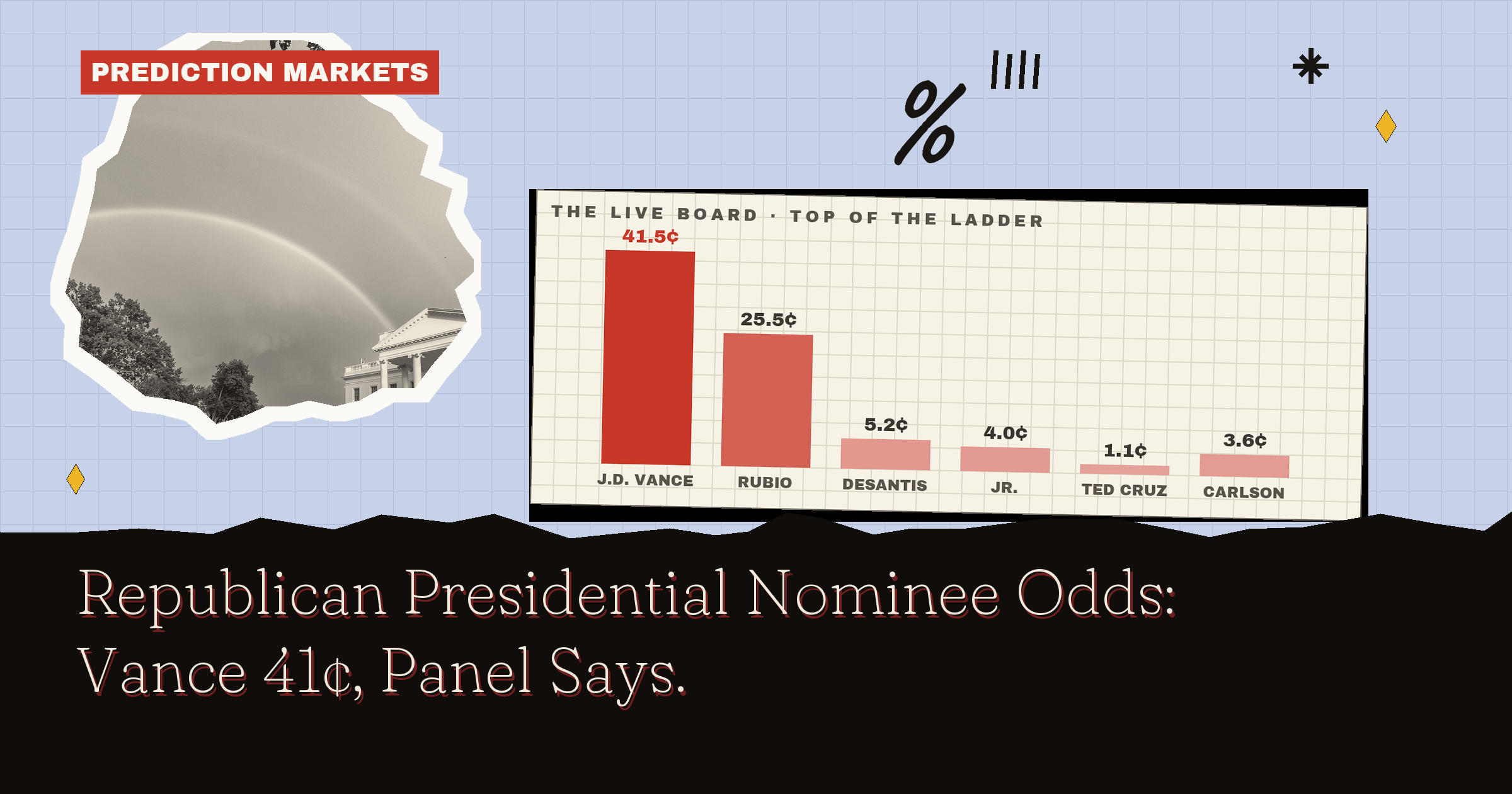
The Republican presidential nominee odds on Kalshi make J.D. Vance a 41.5¢ favorite for 2028, with Marco Rubio at 25.5¢. Our seven-model AI panel, reading 26 recent polls price-blind, thinks the market is underpricing the front-runner: its blended number on Vance is 53.2%, nearly 12 points above the contract, driven by one of the strongest base rates in presidential politics. The full 38-contract board, the per-model split, and the one endorsement that could reshape everything are below.
The Market
This is one of the deepest political markets on the exchange: about 56 million contracts traded across 38 active candidate markets. The settlement rule is stricter than it looks, quoted verbatim: "If [person] wins and accepts the nomination for the Presidency for the Republican party in 2028, then the market resolves to Yes." Winning delegates is not enough; the nominee has to accept. Prices below are live bid-ask midpoints fetched as of August 9, 2026, and the top of the board is tight enough that Vance's spread was a single cent. Panel verdicts were generated the same evening, price-blind.
One note for readers used to sports boards: the full field of listed mid-prices sums to roughly 98¢, so this market carries essentially no overround at the top. The prices really are probabilities here.
The Board
| Outcome | Kalshi | AI Blend (After Revision) |
|---|---|---|
| J.D. Vance | 41.5¢ | 53.2% |
| Marco Rubio | 25.5¢ | 19.5% |
| Any Other Listed Candidate | n/a | 7.4% |
| Ron DeSantis | 5.2¢ | 5.1% |
| Donald Trump Jr. | 4¢ | 4.7% |
| Anyone Not Listed (The Field) | n/a | 4.4% |
| Ted Cruz | 1.1¢ | 1.4% |
| Tucker Carlson | 3.6¢ | 1.2% |
| Glenn Youngkin | 1.1¢ | 0.9% |
| Josh Hawley | 0.9¢ | 0.7% |
| Thomas Massie | 1.3¢ | 0.5% |
| Donald Trump | 2.7¢ | 0.4% |
| Marjorie Taylor Greene | 0.9¢ | 0.4% |
| Ivanka Trump | 1.2¢ | 0.2% |
More live boards from the same panel: 2028 Democratic nominee odds (Gavin Newsom 16.5¢) · Texas Senate odds (a 50.5¢ dead heat) · The full markets hub
The Fundamentals Read: Why The Panel Sits Above The Market
Treat a probability like a projection and the question becomes mechanical: what does the reference class say? The panel's answer is that two base rates apply to Vance, and the market's price only reflects one of them. A generic polling front-runner 18 months before the primaries converts at something like a coin flip, and 41.5¢ is a coin flip with a haircut. But a sitting vice president who seeks his party's nomination has won it in every modern case: Nixon in 1960, Humphrey in 1968, Bush in 1988, Gore in 2000, Harris in 2024. The panel blended the two classes rather than choosing.
"The right reference class blends 'sitting VP seeking the nomination' (historically ~85% conversion: Nixon, Humphrey, Bush, Gore, Harris) with 'plurality front-runner 18 months out' (~50%); Vance leads every national poll in the window (29-51%, median ~39%) plus New Hampshire and Minnesota, so I land between those rates." (Claude Fable)
The polling side of the card supports the front-runner half of that blend. Vance led all 26 national primary polls fetched in the 90-day window, with a median share near 39%, and led the University of New Hampshire and Minnesota statewide surveys. Every seat also named the same discount: his lead is a plurality, not a majority, he has made no formal announcement, and his standing is partly inherited, which makes it contingent on an endorsement no one can schedule.
Marco Rubio: A Strong Second, Priced Like A Stronger One
The market gives Rubio 25.5¢; the panel blends him at 19.5%. Nobody disputes the resume of his polling: a consistent second nationally, 38% in one July survey that put him within a point of Vance, and a 42-24 lead over Vance in his home-state Florida poll. The panel's discount is structural rather than dismissive: second place in a race where the leader holds the institutional lane is usually a bet on the leader stumbling, and the seats priced the stumble, not the resume.
"Rubio at 20% is the serious challenger: he consistently polls second." (DeepSeek V4, which still put Vance three times higher)
The Long Tail, Where Panel And Market Actually Agree
Below the top two, the disagreements shrink to noise almost everywhere. Ron DeSantis trades at 5.2¢ against a 5.1% blend, as clean an agreement as this format produces. Donald Trump Jr. at 4¢ drew 4.7% from the panel. The two exceptions are instructive. Tucker Carlson trades at 3.6¢, but the panel blends him at 1.2%, reading his support as media presence rather than a nomination path. And the market keeps 2.7¢ alive on Donald Trump himself; the panel prices that at 0.4%, citing the 22nd Amendment's two-term election limit, and treating the residual cents as speculation about a scenario the Constitution's text forecloses.
Where The Panel Changed Its Mind
Round one produced the widest spread of any recent panel: Vance numbers ranged from 41% to 60%. The revision round, where each seat reads the others' anonymized reasoning, squeezed that entire range to 52-55.
"I split the difference between panel extremes: the pure VP-succession rate (~85%) overstates his lock because his lead is plurality-not-majority and depends on Trump's endorsement." (Kimi K3, which raised its Vance number from 41% to 52%, and cut its fat "other candidates" tail from 16% to 6%)
"I give substantial weight to the sitting-VP succession base rate: when a vice president seeks the nomination of his party, elite coordination and voter familiarity usually matter more than generic early-primary volatility." (ChatGPT, up from 44% to 54%)
The seats that started high came down for the same stated reason the low seats came up: the base rate deserves weight, but not full weight, 30 months from a convention.
Dark Horses The Panel Won't Dismiss
- Ron DeSantis (5.2¢, blend 5.1%): the one candidate with a national campaign already run; ChatGPT held him at 10% in round one as the natural consolidation vehicle if the front-runner falters.
- Donald Trump Jr. (4¢, blend 4.7%): several seats kept him mid-single-digits on name inheritance and the July Harvard Harris poll that put him at 18%.
- Glenn Youngkin (1.1¢, blend 0.9%): named as the establishment's late option in multiple rationales, polling near 1% but structurally positioned for a collapse scenario.
- The unlisted field (blend 4.4%): 38 contracts is a wide net, but the panel kept real weight on a late entrant; primary fields two years out have a history of surprise names.
What Would Change The Panel's Mind
- A Trump endorsement, either direction. The single most-cited trigger across all seven seats: an explicit endorsement of Vance collapses this race toward the VP base rate, and an endorsement of anyone else breaks the panel's whole framework.
- A formal Vance announcement. Converts inherited standing into a campaign; several seats said their number rises on the news alone.
- Rubio consolidating the non-Vance lane. A second Emerson-style poll with the race inside five points would move the blend materially.
- Early-state polling reversals. The panel leaned on New Hampshire; a lead change there matters more than another national survey.
Every Seat's Round-1 Number
The per-model split before the revision round. On a phone this table scrolls sideways; the board above carries the headline numbers, which average all seven seats' revised round-two estimates. Seven of the panel's eight seats ran this board.
| Outcome | Claude Fable | Claude Opus | Claude Sonnet | ChatGPT (GPT-5.5) | Kimi K3 | GLM 5.2 | DeepSeek V4 |
|---|---|---|---|---|---|---|---|
| J.D. Vance | 57% | 58% | 60% | 44% | 41% | 48% | 60% |
| Marco Rubio | 18% | 17% | 17% | 22% | 18% | 22% | 22% |
| Any Other Listed Candidate | 4% | 9% | 5% | 7% | 16% | 8% | 5% |
| Ron DeSantis | 4% | 3% | 4% | 10% | 6% | 6% | 4% |
| Donald Trump Jr. | 5% | 4% | 6% | 6% | 6% | 4% | 3% |
| Anyone Not Listed (The Field) | 6% | 4% | 2% | 3% | 8% | 5% | 3% |
| Ted Cruz | 1% | 1% | 1% | 2% | 2% | 2% | 1% |
| Tucker Carlson | 1% | 1% | 0.8% | 2% | 1% | 2% | 1% |
| Glenn Youngkin | 0.7% | 0.8% | 0.4% | 2% | 0.5% | 1% | 0.5% |
| Josh Hawley | 0.5% | 0.8% | 0.6% | 1% | 0.8% | 0.6% | 0.3% |
| Thomas Massie | 0.2% | 0.2% | 0.3% | 0.8% | 0.8% | 0.5% | 0.2% |
| Donald Trump | 3% | 2% | 2% | 0.3% | 0.2% | 0.1% | 0.1% |
| Marjorie Taylor Greene | 0.3% | 0.4% | 0.4% | 0.5% | 0.4% | 0.3% | 0.2% |
| Ivanka Trump | 0.3% | 0.2% | 0.3% | 0.4% | 0.3% | 0.5% | 0.1% |
Every seat on this panel is graded against real market settlements — records to date: GPT 83% on 3,225 graded calls · Claude Fable 82% on 450 graded calls · Claude Opus 84% on 514 graded calls · Claude Sonnet 82% on 498 graded calls · GLM 81% on 2,307 graded calls · Kimi 83% on 2,285 graded calls · DeepSeek 80% on 2,332 graded calls. Recomputed daily; the full scoreboard is public.
Models are frequently wrong; the market price reflects real traders' money.*
Every number in this piece gets graded in public once the market settles, which for this board means holding the receipt for two years. That is the point of writing it down now.
How A Projections Reader Should Use This Board
This page is deliberately built like a projections product, not a pundit column. The polling median is the input, the base rates are the model, the blend is the projection, and the market price is the field you are trying to beat. When the projection and the price disagree by 12 points on the most liquid contract, one of two things is true: the market knows something the polls do not, or the market is under-weighting a reference class. Both are testable, on a settlement date, in public. It is the same discipline our DFS Sims apply to a slate, pointed at a slower-moving board. For the analytical read on the other party's race, the 2028 Democratic nominee board runs the identical method.
Settlement Timeline
- Early 2028: primary voting begins; early states have historically re-priced nominee boards overnight.
- Summer 2028: the Republican National Convention formally selects the nominee; the "wins and accepts" clause settles here.
- November 7, 2028: listed market expiration on Kalshi.
- This page re-scores when the story moves; prices above are as of August 9, 2026.
The Bottom Line
The market and the panel agree on the shape of this race: a clear front-runner, one serious challenger, and a long tail of single-digit scenarios. The dollar disagreement sits on the favorite, and it reduces to a single analytical question: how much is the vice presidency worth as a nomination platform? History's answer is "nearly everything," the market's answer is 41.5¢, and the panel wrote 53.2% next to its name in public. The scoreboard settles the argument in 2028.
More on this: 2028 Presidential Election Odds: Vance Leads At 19.5 Cents · 2028 Democratic Nominee Odds: The Market's 5-Cent Blind Spot · College Football Playoff Odds: Kalshi's 50-Team Board · House Control Odds: Implied Probability Vs. Election Models · iPhone 18 Release Date Odds: September Is Priced At Just 5%