
College Football Playoff Odds: One LSU Order Now Owns Half The Volume
By Jake Hari
August 13, 2026 · Updated September 3, 2026
Updated September 3, 2026 · by Jake Hari
Three weeks ago this page read Kalshi's college football playoff odds the way a CFB DFS player reads a main slate: the price is the projection, the volume is the ownership, and the title price divided by the make-it price is the ceiling. Since then almost no football has been played, five of the 50 teams on the board have taken a snap, and the board has repriced anyway. The first Thursday of the real season kicks tonight, so this is the last read before the results start doing the repricing for us. Two things are new. The model-panel verdicts we promised in August have landed: nine AI models scored all 50 contracts without seeing a price, and the widest gap they left among the market's contenders is on the team at the very top of the board. And the ownership column has a new main character. In August a 16-cent South Carolina contract had absorbed nearly a third of the event's volume; today one order, placed the same afternoon the August version of this page went up, accounts for more than half of every contract ever traded on the event. We will get to it, and to the team it was placed on.
The Quick Answer
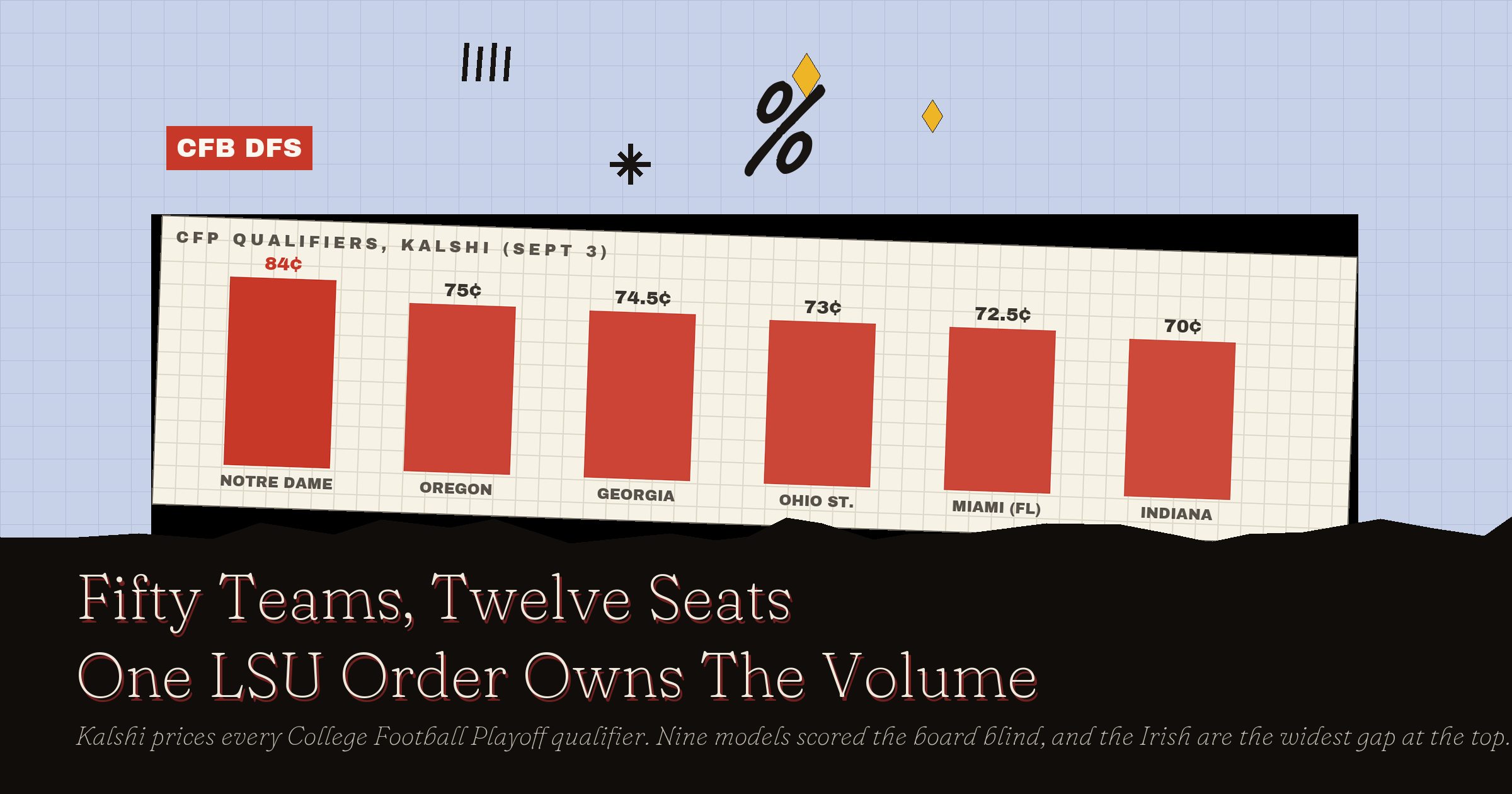
Kalshi's college football playoff odds still make Notre Dame the closest thing to a made team at 83 bid, 85 ask, and a nine-model panel that never saw a price reads the Irish at 65%, the widest disagreement among the teams the market expects to be in (only Florida's 20-point split, on a 23-cent contract, is wider). Since August 13, Auburn is up eight cents to a 19.5 midpoint, on a book nine cents wide, without playing a game. Georgia climbed seven and a half cents to 74.5, and TCU fell to 5.5 after losing to North Carolina in Dublin. The 50 midpoints now add up to about 1,278% against the 1,200 points the 12 seats can pay, up from 1,205 in August. The full board, the one pattern that runs through every big split (the market prices expectations, the panel prices the ledger), the LSU order that now owns the volume column, and the DFS read on this weekend's slates are all below.
Free: The Weekly PM Market Brief — the panel's graded record, the week's biggest market-vs-model gaps, and what's spiking next. One email, Sundays.
New to reading exchange prices from the DFS side? Prediction market expected value for DFS players covers the conversion; this page assumes it and goes straight to the board.
What Moved Since August 13
The market's top nine by price are the same nine names as three weeks ago, and the tenth spot is now a tie: LSU, which shared it with Alabama at 40.5 in August, has slipped to 37, level with Texas A&M, with Oklahoma and Ole Miss half a cent behind. Inside the top nine there is one reshuffle: Georgia jumped from sixth to third, half a cent behind Oregon, and Ohio State, Miami and Indiana each gave back two or three cents to make room. Below that tier the moves are larger and, in most cases, came on no games at all.
- Auburn, 11.5 to 19.5. The biggest midpoint move on any contract that actually trades, and Auburn has not played. The honest part of the move is the bid, 9 to 15; the ask ran to 24 and flatters the midpoint. The price history shows it: about 10,800 contracts lifetime. The Sept. 1 session printed as high as 30 at 6:49 p.m. ET and its last fill, at 8:39 p.m. ET, went off at 18; two fills at 27 went through at 1:50 p.m. ET Thursday, and the book has since gone nine cents wide at 15 bid, 24 ask. The market has decided something about the Tigers before Baylor visits on Saturday afternoon, and the panel, which sees Auburn at 4%, does not agree.
- Georgia, 67 to 74.5. The one move at the top that the panel already agreed with: nine seats blend to 72%, and the Bulldogs open Saturday against Tennessee State.
- Iowa, 11.5 to 19. A real move on a real book: 18 bid, 20 ask with about 620 contracts traded in the last day, which puts it with Georgia and Auburn among the moves the market actually made.
- Houston, 11 to 16.5. The opposite kind of move. The book is 12 bid, 21 ask with about one contract traded in the last day, so the midpoint is doing most of the work.
- Virginia, 9 to 16. The biggest upward mover with a result behind it: the Cavaliers beat NC State 34-8 on August 29. The price history after the game is the interesting part, and we come back to it in the volume section.
- Tulane, 4 to 13.5. The largest midpoint move on the board and the least real one: a 6 bid against a 21 ask, and nobody has traded it in 24 hours. Treat the midpoint as a rumor.
- TCU, 10 to 5.5. The one team that lost, priced accordingly, and the board's cleanest example of a result moving a contract.
- Texas, 63.5 to 60, LSU, 40.5 to 37, Miami, 75.5 to 72.5, Indiana, 73 to 70. Four contenders drifting lower without playing, each of them a team the panel also has below the market.
Put the moves together and the board added 73 points of probability in three weeks with four games played, most of it in the 10-to-25-cent tier where books are widest. That is the tier where a bid-ask midpoint overstates what you can actually sell, and it is the tier the panel disagrees with most.
The College Football Playoff Odds Board: All 50 Teams, Kalshi Vs The Panel
Kalshi prices are the live bid and ask fetched September 3, 2026. The panel column is the median of nine models that scored every contract on September 2 from the season ledger, the selection rules and the preseason polls without seeing a single price; the full per-seat numbers and the panel's own reasoning live on the OddsShopper college football playoff board. Gap is panel minus Kalshi midpoint, so a positive gap means the panel is higher than the market and a negative gap means the market is higher. Move is the midpoint change since August 13.
| Team | Kalshi bid / ask | Panel | Gap | Since Aug 13 |
|---|---|---|---|---|
| Notre Dame | 83 / 85 | 65% | −19.0 | +1.0 |
| Oregon | 74 / 76 | 72% | −3.0 | +0.5 |
| Georgia | 74 / 75 | 72% | −2.5 | +7.5 |
| Ohio State | 72 / 74 | 78% | +5.0 | −2.5 |
| Miami (FL) | 72 / 73 | 60% | −12.5 | −3.0 |
| Indiana | 69 / 71 | 65% | −5.0 | −3.0 |
| Texas Tech | 66 / 68 | 52% | −15.0 | +3.5 |
| Texas | 58 / 62 | 57% | −3.0 | −3.5 |
| Alabama | 40 / 43 | 40% | −1.5 | +1.0 |
| LSU | 36 / 38 | 24% | −13.0 | −3.5 |
| Texas A&M | 36 / 38 | 46% | +9.0 | even |
| Oklahoma | 35 / 38 | 38% | +1.5 | +1.0 |
| Ole Miss | 36 / 37 | 48% | +11.5 | +3.0 |
| USC | 28 / 34 | 26% | −5.0 | +0.5 |
| BYU | 27 / 29 | 25% | −3.0 | +3.5 |
| Michigan | 27 / 28 | 24% | −3.5 | +1.0 |
| Penn State | 27 / 28 | 31% | +3.5 | +2.0 |
| Florida | 22 / 24 | 3% | −20.0 | +2.5 |
| Tennessee | 19 / 25 | 20% | −2.0 | −2.0 |
| SMU | 21 / 23 | 22% | even | +2.0 |
| Auburn | 15 / 24 | 4% | −15.5 | +8.0 |
| Utah | 18 / 20 | 29% | +10.0 | +0.5 |
| Washington | 16 / 22 | 19% | even | +1.0 |
| Iowa | 18 / 20 | 17% | −2.0 | +7.5 |
| Louisville | 16 / 22 | 13% | −6.0 | +1.5 |
| South Carolina | 17 / 19 | 5% | −13.0 | +4.0 |
| Clemson | 15 / 18 | 16% | −0.5 | +4.5 |
| Houston | 12 / 21 | 6% | −10.5 | +5.5 |
| Missouri | 13 / 19 | 12% | −4.0 | +2.0 |
| Virginia | 14 / 18 | 6% | −10.0 | +7.0 |
| Kansas State | 13 / 14 | 6% | −7.5 | +1.5 |
| Tulane | 6 / 21 | 10% | −3.5 | +9.5 |
| Virginia Tech | 9 / 12 | 1% | −9.5 | +1.5 |
| Oklahoma State | 9 / 12 | 0% | −10.5 | +2.0 |
| James Madison | 7 / 13 | 28% | +18.0 | +3.5 |
| Vanderbilt | 5 / 14 | 12% | +2.5 | +3.0 |
| Arizona State | 7 / 12 | 7% | −2.5 | +2.5 |
| Georgia Tech | 8 / 10 | 6% | −3.0 | +2.0 |
| Pittsburgh | 7 / 11 | 4% | −5.0 | −0.5 |
| California | 7 / 10 | 2% | −6.5 | +0.5 |
| Florida State | 5 / 10 | 3% | −4.5 | +2.0 |
| Illinois | 7 / 8 | 7% | −0.5 | +0.5 |
| Kentucky | 2 / 11 | 2% | −4.5 | +1.0 |
| NC State | 5 / 7 | 2% | −4.0 | −0.5 |
| North Texas | 4 / 8 | 8% | +2.0 | +0.5 |
| Arizona | 4 / 7 | 9% | +3.5 | −0.5 |
| TCU | 3 / 8 | 4% | −1.5 | −4.5 |
| Baylor | 2 / 4 | 2% | −1.0 | even |
| Arkansas | 1 / 2 | 2% | +0.5 | −1.5 |
| Miami (OH) | 1 / 2 | 2% | +0.5 | −2.5 |
Kalshi bid and ask in cents as of September 3, 2026, 5:18 PM ET, event KXNCAAFPLAYOFF-26. Each Yes contract pays $1 if that team qualifies for the 12-team College Football Playoff; the field is announced on Selection Day, December 6, and the contracts list a close of December 29, 2026. Panel medians were generated September 2, 2026, price-blind, and are frozen there on purpose so they can be graded.
More live boards from the same panel: the OddsShopper college football playoff board with every seat's number (Notre Dame 83 / 85¢ today), our college football championship projections on the title market (Ohio State 12 / 13¢), and the OddsShopper national champion board (Texas 11 / 12¢).
The row to read first is the one at the top. Notre Dame is 83 bid, 85 ask, and the highest number any of the nine seats produced was 70. That is a 19-point gap on the highest-priced contract on the board, and the panel is not doubting the roster there; it is pricing the path: an independent cannot win a conference, the four power-conference champions and the top-ranked non-power team are in automatically, so the Irish are competing for one of the seven at-large seats with no title-game safety net. The market is paying 84 cents for a schedule it treats as low-variance. The panel is paying 65 for a team with no fallback. Both are describing the same fact from opposite ends.
The Pattern: The Market Prices Expectations, The Panel Prices The Ledger
Line the gaps up and one thing explains most of them. The clearest contracts the panel has well below the market are teams whose price is built on a preseason expectation rather than a banked season: Florida and Auburn from losing records, LSU from a quarterback arriving, Notre Dame from a schedule with no variance, Texas Tech and Miami from preseason expectation and market strength the models discount. The clearest contracts the panel has well above the market are teams whose case is already on the 2025 ledger: Ole Miss and its 13-2 with six ranked opponents still to play, and James Madison and the rule that now hands the one non-power seat to the highest-ranked team rather than a champion. Ohio State is the exception that proves it: the one top-eight row where the brand and the ledger say the same thing, which is why it is the only contract up there the panel pays more for than the market does. The exception is the thin book: Houston sits roughly 10 points above the panel on a 12 bid, 21 ask, a nine-cent spread where the midpoint is a convenience rather than a price. Oklahoma State and Virginia Tech sit the same distance above the panel, but on three-cent books, and Virginia Tech traded about 540 contracts in the last day, more than Notre Dame or Georgia, so those two are real disagreements, not artifacts. The panel was handed the 2025 ledger, the remaining schedules, the selection rules and the preseason polls, but no market prices, so of course it prices what it was shown. The market is made of people, and people price brands, especially in August. The volume column says the same thing: Alabama has traded about 28,400 contracts lifetime and Penn State about 54,000, against about 19,700 for Ole Miss and 12,900 for Utah, two teams priced comparably or lower that the panel likes more. Brand attention shows up in how much a contract trades, not only in where it trades.
That does not make the panel right. When the panel first published fair numbers on all 50 contracts on August 18, 15 of them carried a gap of at least 4.5 points, and over the following 15 days seven moved toward the panel's number, six moved away and two were unchanged, which is a coin flip. The scoreboard that grades every one of these calls at settlement is the graded panel record, and it carries the caveat the OddsShopper board states plainly: across thousands of settled contracts the market has been the better forecaster more often than the panel has. We quote that here so nobody reads a gap on this page as a recommendation. A gap is a disagreement with a date on it. Four of them are big enough to be worth a paragraph each, and three of them, Florida, Auburn and James Madison, play Saturday before Ole Miss plays Sunday.
Florida And Auburn: Twenty Points Apart On No Football
Florida trades 22 bid, 24 ask against a panel median of 3%. Auburn trades 15 bid, 24 ask against 4%. Florida is the widest split on the board at 20 points, Auburn is 15.5 behind a book nine cents wide, and the two SEC rows are the same shape: a 4-8 and a 5-7 team from last season, both unranked in the preseason polls, both facing five ranked opponents the rest of the way, both priced as if they were a coin flip away from the field. No seat had Florida above 5.
Auburn is the one that moved. Its midpoint is up eight cents since August 13, more than any contract on the board that actually trades, on a Saturday afternoon game that has not happened yet. Kalshi makes the Tigers 72 bid, 73 ask to beat Baylor, sits the spread market around Auburn by 7.5 at 48 bid, 49 ask, and prices the total over 57.5 at 54 bid, 55 ask, which reads as an Auburn team total just under 33. For the DFS side of that game, DraftKings priced Auburn quarterback Byrum Brown at $7,800 and running back Jeremiah Cobb at $6,000 on the Saturday main slate, with Baylor's Dawson Pendergrass at $6,500 and DJ Lagway at $6,500 on the other side. A team total near 33 is a fine environment for a QB-plus-RB pairing, the same-team stack NFL habits tell you to avoid because the two compete for a fixed number of scores; in college football the number is not fixed in the same way, a team total in the 30s or higher carries four to five touchdowns to go around, and one offense can feed both players, which is exactly why the field avoids the pairing and why it carries leverage. It is not evidence about a playoff seat. That is the whole point of the gap: the market is pricing the Tigers on what it thinks a new season looks like, and the panel is pricing them on what it was shown.
James Madison And Ole Miss: The Two Places The Panel Pays More
James Madison sits at 7 bid, 13 ask and the panel has it at 28%, the widest gap in the panel's favor. The reason is a rule, not a roster. Under this season's selection rules, the non-power conferences share exactly one automatic bid, and it goes to the highest-ranked team from those leagues whether or not that team won its conference. James Madison finished last season as the highest-rated non-power team in the sport on the ledger the panel was given, and its remaining schedule has zero teams from this 50-team board on it. Every seat landed between 22 and 35. The market has traded exactly nothing on the contract in the last 24 hours, so the 10-cent midpoint is a resting quote, not an argument. The Dukes host Liberty on Saturday, and they are not on the DraftKings main slate, which is its own kind of ownership signal: the market for their playoff contract and the market for their players are both thin.
Ole Miss is the same disagreement at a real price. The Rebels trade 36 bid, 37 ask, up three cents since August, and the panel reads 48%, with eight of nine seats between 45 and 51. Ole Miss went 13-2 and qualified last year, and it faces six currently-ranked opponents, which the models score as résumé rather than only as risk. The first of those games is Sunday at home against Louisville, and Kalshi makes Ole Miss 70 bid, 71 ask to win it, with the spread market around Ole Miss by 6.5 priced at 52 bid, 53 ask and the total over 55.5 at 47 bid, 48 ask. That works out to an Ole Miss team total right around 31. Sunday games are not on the Saturday DFS slates, so this is a board read, not a lineup read, until the Sunday showdown contests post.
The counterweight at the top is Ohio State, 72 bid, 74 ask against a panel median of 78%. It is the only team in the market's top eight the models price above its own contract, and it is the team whose Saturday matchup we come back to in the DFS section, because Kalshi prices a 51-point Ohio State margin as a coin flip, and that does something to a lineup that no playoff contract can.
Where The Money Went: One LSU Order
Now the payoff on the ownership column. In August this page found that South Carolina, a 16-cent contract, had absorbed roughly 31% of every contract traded on the event, and asked what a DFS player should make of a 16%-projection team drawing chalk ownership. The price history has since answered a question we did not ask: that pile was never a crowd either. Three fills on the evening of July 15, two of $40,000 and one of $50,000 in face value, make up about 82% of everything South Carolina has ever traded. The Gamecocks' share of the event is now 10%, and not because they got quieter. It is because of what happened at 3:05 p.m. Eastern on August 13, the same afternoon the August version of this page went up.
At that moment a single Yes order filled on LSU at 41 cents for $837,500 in face value, roughly $343,000 of premium. That single fill is larger than any other trade on the event by a factor of about 17; the next-biggest trade on the LSU contract since then was under $2,000. LSU has traded about $874,000 in face value lifetime, which is 53% of the entire 50-team event, and about $863,000 of that is still open, which is consistent with the position not having been unwound. It has been sitting there while the contract printed as high as 51 on August 29, a single fill of about 19 contracts at 5:13 p.m. ET, touched 46 repeatedly through the weekend before drifting to 43 and 44, broke to a 36 print on September 2 and sits at 36 bid, 38 ask today, and while the panel, which never saw it, scored LSU at 24%.
We do not know who placed it, and the price history is the only evidence this page will use. What the price history does tell you is that the volume column on this board is one decision.
The read: one order is about 51% of every contract ever traded on this event, and the LSU contract it sits on is 53%. The volume column on this board is not ownership anymore. It is one participant's position, and everyone else is trading around it. When we wrote about ownership and leverage in prediction markets, the argument was that volume is information about attention, not about accuracy. That still holds, with one adjustment this tape forces: a volume pile can be broad attention or a few concentrated positions, and only the price history tells you which. On this board it has been the second kind all summer, three blocks on South Carolina in July and now one fill on LSU in August, and the difference between them is scale. The July blocks were 8% of the event. The LSU fill is 51% of it.
The first test of that conviction is Saturday night in Baton Rouge. Clemson visits, and Kalshi makes LSU 77 bid, 78 ask to win, sits the spread market around LSU by 9.5 at 52 bid, 53 ask, and prices the total over 50.5 at 48 bid, 49 ask, which reads as an LSU team total near 30 and a Clemson total near 20. On the DraftKings Saturday night slate LSU quarterback Sam Leavitt is $8,000, running back Dilin Jones is $6,700 and receiver Jayce Brown is $6,100; Clemson quarterback Christopher Vizzina is $6,500. A 41-cent playoff contract does not care about a 10-point win over Clemson. It cares about a loss, which would put the panel's 24% and the market's 37% on the same side of the argument for the first time.
One footnote on Virginia, because it is the price history's other lesson. After the Cavaliers beat NC State, their contract spiked to 32 on August 29, then absorbed about $20,000 of face value across August 31 and September 1, the largest fills at 19 cents on the No side, and settled at 14 bid, 18 ask. A result moved the price, and then the sellers moved it back. That is what a liquid contract is supposed to do, and the LSU tape shows the opposite.
Make-It Price Vs Win-It Price: The Conditional Read, Updated
The ceiling math from August still runs, and the inputs have shifted. Divide a team's price in the national championship market by its playoff qualifier price and you get the market's implied title conversion if the team gets in. The championship event traded about 544,000 contracts in the last 24 hours, so these numbers are fresh.
| Team | Qualify (mid) | Win title (mid) | Implied conversion if in |
|---|---|---|---|
| Texas | 60¢ | 11.5¢ | 19% |
| Ohio State | 73¢ | 12.5¢ | 17% |
| Oregon | 75¢ | 11.5¢ | 15% |
| Notre Dame | 84¢ | 12.5¢ | 15% |
| LSU | 37¢ | 5.5¢ | 15% |
| Indiana | 70¢ | 9.5¢ | 14% |
| Georgia | 74.5¢ | 9.5¢ | 13% |
| Miami (FL) | 72.5¢ | 7.5¢ | 10% |
| Texas Tech | 67¢ | 3.5¢ | 5% |
Bid-ask midpoints, Kalshi events KXNCAAFPLAYOFF-26 and KXNCAAF-27, September 3, 2026, 5:18 PM ET. Conversion is the title midpoint divided by the qualifier midpoint, rounded, before fees; Kalshi's trading fee pushes the real break-even on every row out a little, the math is in Kalshi fees vs DFS rake.
Start with Texas. On the August page's last-trade basis the Longhorns were 65 cents to qualify and 12 to win; on today's midpoints they are 60 and 11.5, so the market lowered the floor and left the ceiling roughly alone: the best conversion among the contenders now sits on a cheaper make-it price than it did three weeks ago. Notre Dame and LSU land on the same 15% from an 84-cent floor and a 37-cent one, and Indiana, the defending champion, is priced as a mid-tier ceiling at 14%.
The panel's read on the same conditional is on our college football championship projections page, and the two boards agree on the shape: the market's favorites to make it are not always the market's favorites to win it. Texas Tech at 67 cents with a 5% ceiling is the cash-game profile. LSU at 37 with a 15% ceiling is the tournament profile.
What This Board Means For CFB DFS This Week
As of the Sims run posted Thursday afternoon, projections at 4:54 p.m. ET and ownership at 4:57 p.m. ET, the only college football slate with projections and ownership posted is Thursday's four-game DraftKings main. The 12-game Saturday main slate and the seven-game night slate have salaries but no ownership yet. Until the Saturday run posts, this 50-contract board is the closest thing to an ownership read on the 16 board teams in those two groups, which is why a DFS player opens it before the projections exist.
Tonight. Two board teams open the week on the DraftKings four-game Thursday main slate, Illinois against UAB and Georgia Tech against Colorado, and the Stokastic CFB Sims are live on it. Georgia Tech is the one worth the space: 8 bid, 10 ask to make the playoff and 68 bid, 69 ask to beat Colorado at 8 p.m. ET. From the Sims, Georgia Tech quarterback Alberto Mendoza projects at 19.0 DraftKings points for $7,200 at 24.0% ownership, running back Justice Haynes projects at 18.1 for $8,100 at 26.3% ownership against 33.2% optimal-lineup exposure, a seven-point leverage gap, and Colorado quarterback Julian Lewis projects at 15.9 for $6,700 at 7.8% ownership against 14.6% optimal exposure, the same seven-point gap at less than a third of the ownership. The widest leverage gap on the whole slate is in this game too: Colorado receiver Danny Scudero projects at 10.2 for $6,000 at 1.9% ownership against 11.0% optimal exposure. Colorado is not listed on the playoff board at all and Georgia Tech is a 9-cent contract, and three of the four widest leverage gaps on the slate come out of this one game, two of them on the Colorado side. The playoff board and the DFS board are asking different questions.
Saturday. The 12-game DraftKings main slate carries 11 board teams: Texas, Alabama, Indiana, Ohio State, Oregon, Auburn, Penn State, Houston, Tulane, Baylor and North Texas. The night slate adds LSU, Clemson, Texas A&M, Michigan and Florida. Notre Dame, Ole Miss, Louisville and Washington play Sunday, SMU and Florida State play Monday, and Georgia's 3 p.m. game against Tennessee State is not on the main slate at all, so the market's top-priced team and its third-priced team are both off the Saturday main slate.
The slate's structural read comes straight off the Kalshi spread markets. Ohio State's contract to beat Ball State by more than 50.5 points trades at 47 bid, 48 ask, a coin flip on a margin north of seven touchdowns, and the total over 56.5 sits at 48 bid, 50 ask, which reads as an Ohio State team total near 53 and a Ball State total near 3. Oregon's contract to beat Boise State by more than 24.5 sits at 49 bid, 50 ask with the total over 51.5 at 49 bid, 50 ask, an Oregon team total near 38. Those are the two mega-stack environments on the slate, and DraftKings priced them as such: Julian Sayin and Jeremiah Smith are $8,600 each, Bo Jackson is $7,500, Dante Moore is $8,200 and Jordon Davison is $7,400, and Arch Manning is the salary ceiling at $9,300 against Texas State, a game Kalshi prices at 98 bid, 99 ask for Texas. What the salaries cannot tell you yet is ownership, because the Saturday Sims run has not posted, and that is the whole Saturday question. The three-man Ohio State stack costs $24,700 of a $50,000 cap before a fourth piece, so the field has to choose between the 53-point offense and the rest of the slate, and the NFL habit of bringing back a piece from the other side is dead money here: a Ball State team total priced near 3 means there is nothing to bring back. Either the field crowds the obvious stack and it becomes chalk you need a different fourth piece to differentiate from, or it spreads out across the 12 games and the seven-touchdown offense goes under-owned relative to its share of the slate's points. The playoff board says Ohio State is the one top-eight team the panel likes more than the market does; the spread and total markets say its Saturday is a seven-touchdown afternoon against an opponent priced for a field goal. Which of those the field prices is the number to check the moment ownership posts. Until it does, Thursday is the template: the widest leverage on that slate was a $6,000 receiver at 1.9% ownership, not the chalk stack.
Ownership on the Saturday slates lands in the CFB DFS projections, ownership and stacks in the DataHub when our Saturday run posts; as of this fetch the Sims carry only the Thursday slates. Compare those ownership numbers against the playoff prices above before treating a brand-name contract as a chalk stack, because this board has already shown that the two can point in opposite directions.
Georgia Tech's 9-cent playoff price and Justice Haynes's leverage number came from the same read: a 9-cent contract and a player fewer people are rostering than should be. That pairing, projection against ownership against ceiling, is what the Sims are built to find.
More on this: College Football National Championship Odds: Brands vs the Ledger · NFL Playoff Odds: Stokastic Sims Vs Kalshi Prices · Fantasy Rookie Rankings 2026: The Market Is Selling The No. 1 Pick · AFC West Odds 2026 · NFL MVP Odds 2026
The Bottom Line
One rule from August needed revising: read a volume pile off the price history before calling it ownership, because on this board it never was. In August the pile was three July blocks on a 16-cent contract. Today it is one order on a 37-cent contract, placed at 41, and everything else on the board is trading around it. The panel, which saw none of that, disagrees with the market hardest on the teams the market knows best, and agrees with it almost everywhere the ledger and the brand say the same thing. Saturday starts settling the argument, one result at a time, and this page re-scores when it does. We track the rest of the season's markets on the Stokastic prediction markets hub, the conference layer on the Big 12 championship odds board, the individual-award angle in the Heisman Trophy odds, and the NFL version of this exact read on our weekly NFL predictions board.
- Eligibility. Kalshi is a CFTC-regulated event-contract exchange; whether its sports contracts are subject to state gambling law is in active litigation, and on August 28 the Ninth Circuit held that Kalshi had not shown federal law likely preempts Nevada's gaming laws as applied to its sports contracts, and upheld the dissolution of Kalshi's injunction there.
- **Not advice. Event contracts involve risk, and you can lose money trading them. Stokastic trades prediction markets, including on Kalshi, holds positions in them, and has no affiliate or commercial relationship with Kalshi.
Prices on this page were fetched from the live Kalshi order book on September 3, 2026, 5:18 PM ET. DraftKings salaries are from the September 3 and September 5 draft groups as posted on September 3. Stokastic Sims projections (posted 4:54 p.m. ET) and ownership (4:57 p.m. ET) are from the September 3 run on the Thursday main slate.
Hero illustration: Stokastic, in the house collage style, built from the September 3 Kalshi board.
No promo code (deliberate, PM pilot); DataHub CFB + free Sims links only
Get Started