
Anthropic Mythos Release Date Odds: Fable 5.1 Paid One Board, Mythos 5.1 Paid Neither
By Jake Hari
August 12, 2026 · Updated September 5, 2026
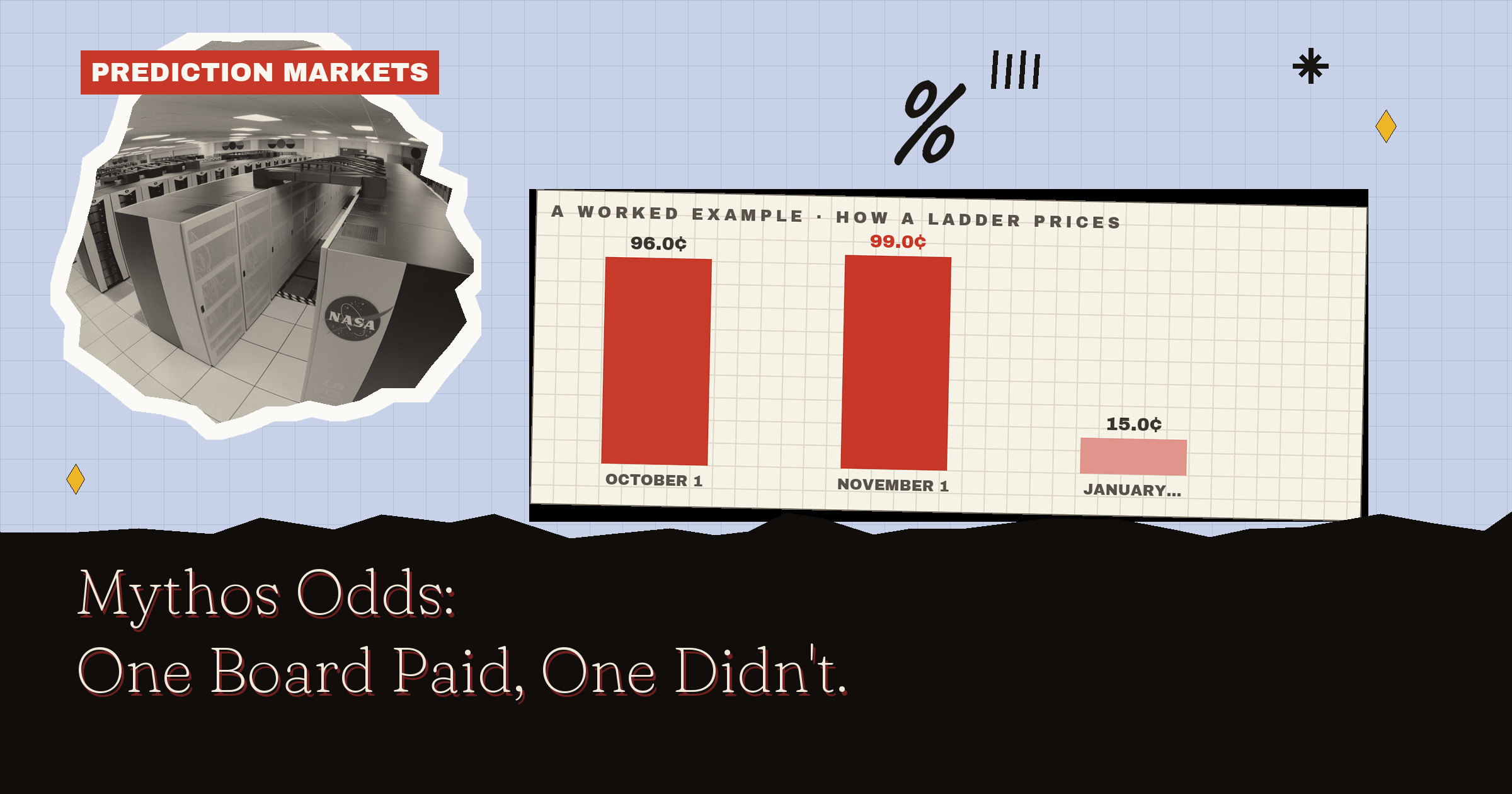
Anthropic announced Claude Mythos 5.1 on September 1, 2026, and Kalshi's two Mythos boards gave two different answers the same afternoon. The board that asks when Anthropic ships its next Mythos-class model closed early and paid Yes. The board that asks when Anthropic releases Mythos to the public did not pay, and its year-end strike barely moved. The whole gap is one clause about who is allowed to use the model, and the traders who bought the headline paid for it.
The Quick Answer
No. Claude Mythos 5.1 did not settle Kalshi's "When will Anthropic release Mythos?" market. Anthropic says access "remains limited to a small set of vetted organizations," and the contract requires a release "to the public, outside of a closed beta." After the announcement the year-end strike, before January 1, 2027, is quoted 15 cents bid, 24 cents ask. It was a 17-cent last trade on August 12.
What Happened On September 1
Anthropic's announcement, "Introducing Claude Fable 5.1 and Claude Mythos 5.1," opened two very different doors. Claude Fable 5.1 "is available to Pro, Max, Team, and Enterprise users" and on the API. Claude Mythos 5.1 "is available to vetted cyberdefenders and life scientists through our trusted access programs," and "currently, we're only able to make it available to a set of US organizations." Anthropic adds that Fable 5.1 "is the same underlying model as Claude Mythos 5.1 with safeguards for cybersecurity and biology."
Kalshi's next-Mythos-class board (KXCLAUDE-NXTMYTH) read that and settled. Its October 1 and November 1 strikes closed early that afternoon and finalized Yes. The November contract had been sitting at 89 cents before the news, so that board was already pricing a near-certain Mythos-tier ship by Halloween, and the announcement simply collected.
The public-release board (KXCLAUDE-MYTH), the one this page has tracked since August, stayed open. Its year-end strike printed a 25-cent trade on the news and then went quiet. Same company, same afternoon, one board settled and one board shrugged.
Why One Board Paid And The Other Did Not
Here is the fine print, verbatim from Kalshi's contract pages as of September 1, 2026.
The public-release board resolves Yes "if Anthropic releases a model called Mythos" before the strike date, and its secondary rule reads: "Release must be to the public, outside of a closed beta, though limiting it to a high-cost subscription tier is acceptable."
The next-Mythos-class board resolves Yes "if Anthropic releases a model under Anthropic's Mythos tier — including models branded 'Mythos' or 'Fable' - excluding Claude Fable 5 (released June 9, 2026)." Its secondary rule is the same public-release sentence.
Read together, the split is mechanical. Claude Fable 5.1 is a Mythos-tier model, it is branded Fable, and it is sold to anyone with a Pro subscription. That alone satisfies the next-Mythos-class board. Claude Mythos 5.1 is a model called Mythos, but it is offered through an "invite-only beta" limited to approved organizations. The carve-out in the rules is for a paid tier the public can buy, not for a vetting program, so the public-release board stays open. "Anthropic released Mythos 5.1" and "Anthropic released a model called Mythos to the public" are different sentences, and only one of them pays. It is the same reason Kalshi and Polymarket can settle the same event two different ways.
The Board
Prices from Kalshi's order book as of September 1, 2026, about 6 p.m. ET, after the announcement had been absorbed. A Yes price in cents reads as the market's implied probability before fees.
| Strike (Public Mythos Release...) | Result / Last Yes | Yes Bid / Ask | Contracts Traded | 24h Volume |
|---|---|---|---|---|
| Before Jun 15, 2026 | Settled No | — | 404,660 | — |
| Before Jul 1, 2026 | Settled No | — | 397,462 | — |
| Before Aug 1, 2026 | Settled No | — | 242,939 | — |
| Before Sep 1, 2026 | Settled No (last 5¢) | — | 173,530 | — |
| Before Oct 1, 2026 | 1¢ | 1¢ / 6¢ | 142,682 | 1,569 |
| Before Nov 1, 2026 | 13¢ | 9¢ / 12¢ | 204,936 | 7,544 |
| Before Dec 1, 2026 | 13¢ | 14¢ / 18¢ | 190,467 | 2,705 |
| Before Jan 1, 2027 | 25¢ | 15¢ / 24¢ | 237,915 | 4,927 |
Four strikes have now settled No, and the fourth closed hours before the announcement. The September 1 strike expired early that morning with a 5-cent last trade, and the Mythos 5.1 news arrived that afternoon. Even open, it would have faced the same access test the year-end strike now faces.
October is the row that shows the naming risk. A 1-cent bid against a 6-cent ask, with a Mythos-numbered model already out, says the market puts almost nothing on a public Mythos in the next thirty days.
November is where the curve actually steepened. Its last trade went from 8 cents on August 12 to 13 cents on September 1, and it was the busiest strike on the board that day. The bulge after the announcement sits in November, not in the year-end strike where the headline print landed.
Why The Year-End Strike Barely Moved
The 25-cent print is the number headlines will quote, and it is the least sturdy number on the board. It is a 38-contract last trade. Within an hour of the news the same strike traded as high as 39 cents and as low as 13, first as buyers chased the headline and then as sellers read the access language. That is a crowd changing its mind twice, not a crowd repricing a thesis.
The read that matters: the quote is 15 bid / 24 ask, the sized book is about 13 / 29, and the honest probability range is 15% to 24%, not "a quarter."
The move was small because the announcement supplied evidence for both sides. The Yes case got a model literally named Mythos 5.1, plus Anthropic's line that the Cyber Verification Program "will include access to Mythos models in the near future." The No case got the more important sentence: Anthropic's own FAQ says "making a model as capable as Mythos 5.1 generally available comes with risks." That is the company describing its product architecture. The capability ships to the public under the Fable name, and the Mythos name stays behind a vetting gate. Traders watched that pattern with Fable 5 in June and Fable 5.1 in September, and the ask side of the book is pricing that it holds a third time.
The Four Strikes That Already Settled No
June 2026 stress-tested both conditions inside three weeks. On June 9 Anthropic released Claude Fable 5 to the public and Claude Mythos 5 to approved organizations only. On June 12 a federal export-control directive took both offline, and when Anthropic restored access on July 1 the public model came back while Mythos 5 went right back behind the gate. The June 15, July 1, August 1 and September 1 strikes all settled No. Anthropic has shipped two Mythos-numbered models since June, and both stayed restricted; the models the public could use were named Fable.
Casual money reads "Mythos announced" and buys Yes; the contract settles on the name and the access. That is the trap across the whole release-date class, and this board has confirmed it four times.
The Base Rate Under The Price
Treat Anthropic's launch cadence as the prior and the price as the update. The Claude 5 generation launched with Fable 5 on June 9, and the 5.1 point release landed twelve weeks later. A market asking only whether Anthropic ships something meaningful in four months would deserve a much fatter Yes, and the next-Mythos-class board proved it by paying.
This board adds three discounts the cadence never sees. Naming risk: the public product keeps the Fable label, which is exactly what happened on September 1. Packaging risk: the vetting gate simply stays in place, which "access remains limited" suggests. Regulatory risk: the June directive kept a willing seller offline for nearly three weeks.
Put rough numbers on it and the range stops looking arbitrary. If a Mythos-tier ship before January 1 is an 85% proposition and the public door carries the Mythos name on one launch in four, the math lands near 21%, right on the sized-book midpoint. Nobody knows the true haircut, which is why the book is quoted 9 cents wide. The same naming problem drives Kalshi's GPT-6 release-date board, where what OpenAI calls its next model does the work the Fable-versus-Mythos label does here.
What Would Flip This Board
The rules accept "a high-cost subscription tier," so the Yes case does not need Anthropic to open Mythos to everyone. It needs a paid plan anyone can buy that carries the Mythos name. If that happens, every live strike past that date closes early and pays Yes, the way the sister board's strikes closed the afternoon of the announcement rather than waiting for their October and November dates.
Three things to watch: the Cyber Verification Program's Mythos access, which Anthropic says is coming "in the near future" but describes as a program for vetted defenders; any change to the "access remains limited" language on Anthropic's Mythos page; and any new paid plan with the Mythos name on it. The No case needs nothing to happen, which is the most comfortable position in any timing market and never a free one.
Bottom Line
The market's answer is a 15% to 24% chance of a public Mythos before January 1, with the tightest defensible read near 20%. The headline print overstates it and the resting bid understates it.
Holding No at the current bid puts about 86 cents at risk to collect 14 after fees. That is roughly 16% over four months with the stake locked the whole way, against a Yes that only has to cash once. We grade calls like this on the Sims vs Kalshi ledger against how the market actually settles.
These are live market prices and public facts read through a projections lens, not a model output. Kalshi is open to U.S. residents 18+.
More on this: Kalshi iPhone 18 Release Date Odds: September or Spring? · GPT-6 Release Date Odds: The Name OpenAI Still Won't Say · Next Claude Opus Released: Opus 5.5 Lands At $4 Per Million · Giants vs Rams Player Props: The Nacua Call Paid · Kalshi NFL Prop Picks Sunday: The Steal Never Ran
NONE — deliberate; PM lane carries no promo codes, funnel is DataHub + free Sims
Get Started