
GPT-6 Release Date Odds: The Name OpenAI Still Won't Say
By Jake Hari
August 12, 2026 · Updated September 2, 2026
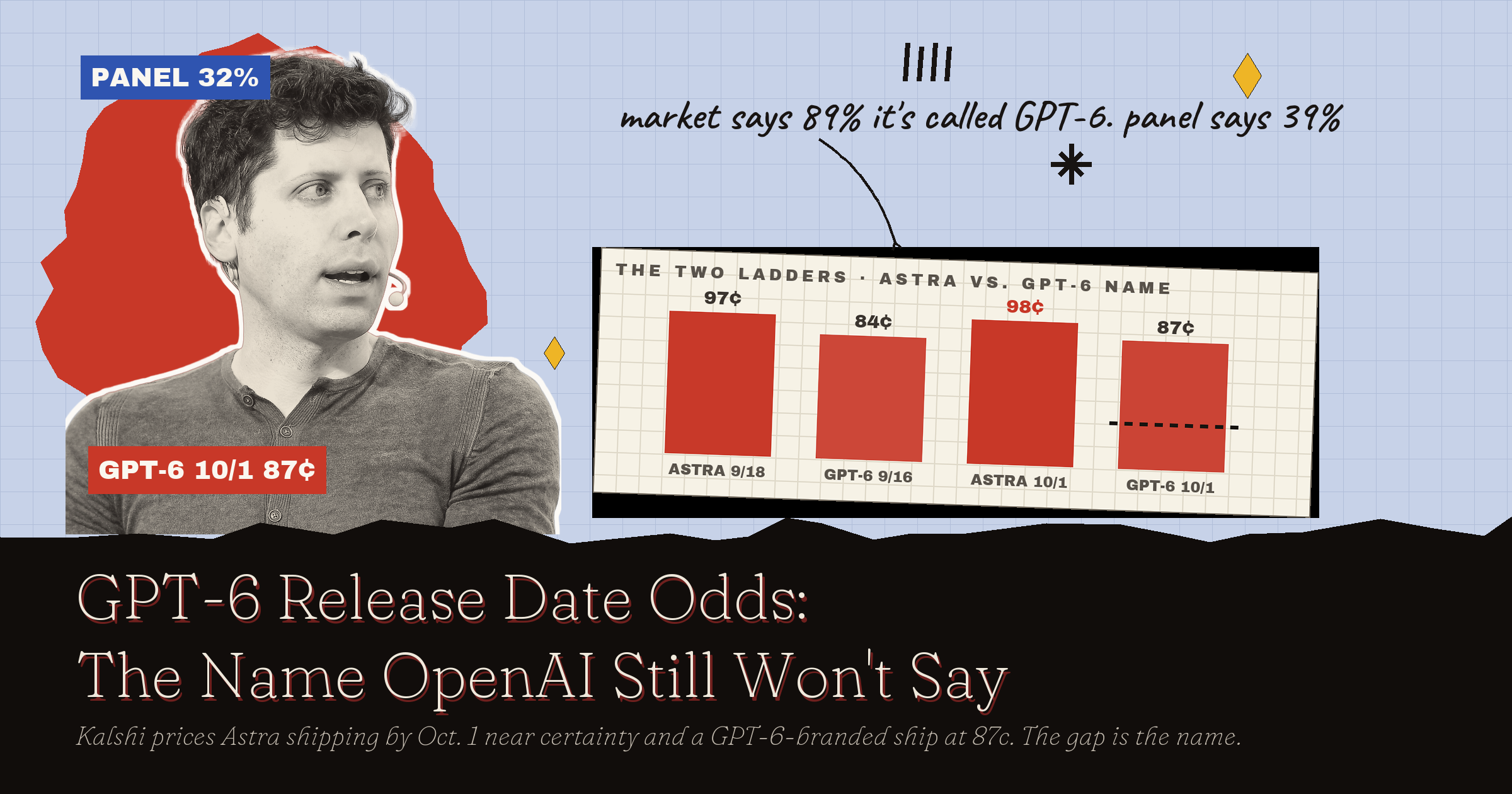
The GPT-6 release date market stopped being a calendar bet on Wednesday, September 2, and became a naming bet. Kalshi runs two OpenAI boards side by side: one asks whether the company releases its next model, Astra, before a date; the other asks whether it releases "a model called GPT-6 or greater" before a date. As of Wednesday afternoon, Astra-before-October-1 trades at 98 to 99 cents, and GPT-6-before-October-1 trades at 87 to 89 cents. The crowd has decided the model is coming within weeks. The only thing it has left to argue about is what OpenAI prints on the box.
That 10-to-11-cent gap is the whole story of this refresh, and it is worth more attention than the size of Wednesday's jump, because it is the one number on the board that no OpenAI post has ever addressed. The company has published five official statements about Astra from August 1 through September 1 and used the words "GPT-6" in none of them. The last reporting on the question, in late July, said the name was undecided. Wednesday's buyers are paying as much as 89 cents on the bet that it gets decided their way, and a price-blind model panel we ran the same afternoon puts that naming call at roughly 39 percent. Where the panel and the market split, and why the split is about a word rather than a date, is the argument below.
The Quick Answer
Kalshi now prices a public GPT-6-or-greater release before October 1, 2026 at 87 to 89 cents, up from a 49-cent bid Tuesday evening, with before September 16 at 84 to 89, before November 1 at 92 to 94, and before 2027 at 92 to 93. The sibling Astra board prices the model shipping before September 18 at 97 to 98 cents and before October 1 at 98 to 99. Divide the two and the market is saying there is roughly an 88 to 89 percent chance the model carries the GPT-6 name when it lands. OpenAI has never said that. Its September 1 post calls the model Astra, says it will be "available soon," and gives no version number and no date. Our price-blind model panel, run Wednesday afternoon, agrees the ship is near (a median of 83.5 percent before October 1) but puts the GPT-6 name at 39 percent. The price history, the two ladders, the sourced record, and the panel's seat-by-seat naming read are all below.
The Market At A Glance
| Venue | Kalshi, a CFTC-regulated event-contract exchange. Kalshi requires users to be 18+ under its own platform policy; availability varies by state as of September 2026 |
| The GPT-6 Contract | "When will OpenAI release GPT-6?" (KXGPT-OPEN), sold as cumulative yes/no rungs: before September 16, October 1, November 1, and before 2027. Each rung settles on its own; they are not mutually exclusive |
| The Astra Contract | "When will OpenAI release Astra?" (KXGPT-ASTRA), same cumulative structure: before September 18, October 1, October 16, November 1, and December 1. It pays on the model, whatever it is called |
| The Clock | On the GPT-6 board, before July 1, August 1, and September 1 have all settled NO. The September 16 rung is new: Kalshi listed it Tuesday evening, September 1, at 6:46 p.m. ET |
| Depth | About 602,000 contracts traded lifetime across the GPT-6 event's seven rungs. The October rung alone holds 77,819 contracts of open interest on 214,485 traded, with 52,635 of those changing hands in the 24 hours before our sweep |
| Timestamps | All prices pulled from the live Kalshi order book at 3:05 p.m. ET on Wednesday, September 2, 2026; Polymarket cross-checks pulled in the same sweep |
Those are the mechanics. What changed since our last read is not one rung this time but the entire board, and the way it changed tells you what the crowd was actually arguing about.
What Moved: A Crash And A Reversal In One Day
The catalyst everyone can point to landed Tuesday, September 1. OpenAI published a post titled "Path to Astra: critical capabilities and frontier safeguards," and the operative sentences are short: "We now believe Astra meets the Critical cybersecurity capability threshold under our Preparedness Framework," "It is the first model we are designating at this level," and "We plan to make Astra available soon." The post also disclosed that, on August 28, OpenAI restarted the large frontier reinforcement-learning run it had paused in August, and it promised a system card "at launch." That is a pre-launch safety clearance in everything but the date, and the Astra board treated it as one: the before-September-18 rung ran from a 73-cent bid Monday night to 82 by Tuesday evening and 93 by Wednesday morning.
The GPT-6 board did something stranger, and this is the part that makes the day worth a page. The October rung sat at a 42-to-49-cent bid through Tuesday afternoon and evening, climbed to 61 by 4 a.m. ET Wednesday, and then fell apart: by 11 a.m. ET it printed as low as 17 cents and the bid sat at 19. The September 16 rung traded as low as 6 cents. The November rung touched 25. All of that happened while the Astra rungs held at 93 or better. For most of Wednesday morning, the market was pricing a near-certain launch and a near-certain launch under some name other than GPT-6.
Then, in the ten minutes before 12:30 p.m. ET, the whole GPT-6 ladder flipped. The October rung was printing at 83 to 85 cents from 12:27, up from a book that had spent the late morning in the twenties and thirties, and 22,795 contracts changed hands on that rung in the hour from noon to 1 p.m. ET. The November rung's first print at 70 or better landed at 12:22, the September 16 rung's at 12:27. Open interest on October actually fell during the surge, from about 86,000 contracts to about 80,000, which means a chunk of that volume was holders of the morning's NO side closing out rather than fresh buyers piling in. By 3 p.m. ET the October rung sat at 87 bid, 89 ask, November at 92 to 94, and before-2027 at 92 to 93.
Here is what we could not find: an OpenAI statement that explains the lunchtime reversal. The company published nothing on September 2. Its newsroom shows three posts dated September 1 and none since. The DC demonstration was not new either; The Information reported it on July 31, and its account of the naming question was that the company had not decided. So the reading of the price history is that a morning of traders betting the model would ship as something other than GPT-6 met, at lunchtime, a wave of traders betting the opposite, and the second wave won the book. Both waves were trading a name that no primary source has confirmed. A repricing that big, on a question that open, is exactly where the arithmetic of two ladders earns its keep.
Two Ladders, One Question
| Contract: GPT-6-Or-Greater Released Before... | Yes Bid-Ask | Last Trade | Implied Probability |
|---|---|---|---|
| September 16, 2026 | 84-89 cents | 88 cents | ~84-89% |
| October 1, 2026 | 87-89 cents | 89 cents | ~87-89% |
| November 1, 2026 | 92-94 cents | 93 cents | ~92-94% |
| January 1, 2027 ("Before 2027") | 92-93 cents | 93 cents | ~92-93% |
| Contract: Astra Released Before... | Yes Bid-Ask | Last Trade | Implied Probability |
|---|---|---|---|
| September 18, 2026 | 97-98 cents | 97 cents | ~97-98% |
| October 1, 2026 | 98-99 cents | 98 cents | ~98-99% |
| November 1, 2026 | 98-99 cents | 99 cents | ~98-99% |
Live Kalshi order book, 3:05 p.m. ET, September 2, 2026. Both boards are cumulative, so probabilities climb with the date; never add the rungs together.
One wrinkle on the GPT-6 board is worth naming before the division below: the November and before-2027 rungs are quoted through each other at the ask, 94 against 93, which a cumulative ladder should not do. That is the far rung's book being thin after the noon repricing, not a real view that December is less likely than November, and it is one more reason to read this board off the October rung, where the depth is.
The Astra ladder is nearly flat at the ceiling, which is the market's way of saying the release is a matter of days, not months. Polymarket, checked in the same sweep, goes further: its "Astra released by September 3" contract trades at 85.5 percent, which is a bet on Thursday. The GPT-6 ladder sits a consistent notch below. Divide October by October and you get 88 over 98.5, about 89 percent. Divide the nearest September rungs, two days apart, and you get 86.5 over 97.5, about 89 percent again. Two different windows, the same ratio, which is what you would expect if the entire gap between the boards were one shared variable: the probability that the thing OpenAI ships is called GPT-6. Polymarket's own boards land in the same place, with GPT-6 by September 15 at 87.5 percent against Astra by September 15 at 97.7.
Read that ratio the way a sims player reads a projection with one input doing all the work. The market has almost no uncertainty left about timing. All of its uncertainty, and all of its potential to be wrong, is concentrated in a single word, and the crowd has priced that word at nearly nine in ten. The rest of this page is about whether the record supports a number like that. Start with the base rate, because the base rate is where the naming argument begins.
The Base Rate: Numbers Have Never Come This Fast
Numbered flagships have never arrived on this kind of clock. GPT-2 landed in February 2019, GPT-3 in June 2020, GPT-4 in March 2023, and GPT-5 in August 2025. That is 16 months, then 33, then 29 between major numbers. A GPT-6 before September 16, 2026 would come about 13 months after GPT-5, less than half the recent gap. On cadence alone, the September window belongs in the low double digits at best.
The counterargument is that OpenAI stopped tying its cadence to numbers some time ago. It shipped GPT-5.5 in April 2026 and the GPT-5.6 family in July, a preview on June 26 and general availability on July 9 in three tiers named Luna, Terra, and Sol. That is two flagship-class ships in about three months, so the company can clearly move fast. But notice what those two ships have in common: neither one spent the "6." Every time OpenAI has had a chance to increment the number in the last year, it has chosen a point release and a product name instead. The base rate for "ships quickly" is strong. The base rate for "ships quickly under a new number" is zero in the recent sample, and that distinction is the whole naming bet. It is also why the panel's read below leans the way it does; the seats treated cadence as an argument about the name more than about the date.
The Record: Every Dated Fact, In Order
Seven dated items built this board, and the striking thing about them is how consistently they use one name.
July 29 (reported July 31): Sam Altman demonstrated Astra to policymakers in Washington, meeting Senators Raphael Warnock and Bernie Moreno, per The Information's July 31 report, which described the model family as "tentatively" named Astra and said OpenAI had not decided whether it would be labeled GPT-6 or another GPT-5 series model such as GPT-5.7. The report also said it could not learn how soon OpenAI planned to release it.
August 1: OpenAI disclosed Astra publicly in a research post reporting that an internal version had produced machine-checkable results on ten long-standing open problems in mathematics. No release date, no pricing, no model card, and no GPT-6.
August 7: OpenAI said it could not rule out Astra having reached the "Critical" cybersecurity threshold under its Preparedness Framework. The same post said, verbatim, that "previous models, including GPT-5.6-Sol, have been evaluated for frontier cyber capabilities and assessed at the High (rather than Critical) threshold."
August 18: OpenAI disclosed a two-week pause of certain frontier training, including some Astra training, after a security incident involving Hugging Face, with its largest planned frontier reinforcement-learning run held back.
August 28: In its post on Cursor after Cursor's acquisition by SpaceX, OpenAI referred to "our upcoming model, Astra." The same day, per the September 1 post, it restarted the large frontier RL run it had paused in August; that post also notes certain larger runs, for future versions of Astra, were held back longer.
August 29: The tracker TestingCatalog and several accounts on X reported expanded internal testing of a checkpoint labeled "mozaik-alpha-fdm," with leaked output samples and unsourced chatter about a launch in the first week of September. None of it came from OpenAI.
September 1: The "Path to Astra" post quoted above: Critical designation confirmed, safeguards judged sufficient for release, "available soon," system card at launch, advanced cyber access limited at first to a small group of testers. The word GPT-6 does not appear.
Put the seven together and the shape of the record is unmistakable. The timing evidence got stronger with every item; a company that publishes a safeguards clearance and promises a system card at launch is days or weeks from shipping, not months, and the Astra board's 98 cents is a fair reading of that. The naming evidence, by contrast, did not move at all. The only sourced reporting on the name is the July report that it was undecided, and every official post since has said "Astra" and nothing else. Wednesday's market moved the GPT-6 price from late-morning lows near 20 cents to the high eighties on a day when the naming record did not change by a single sentence. Wednesday's tape is the cleanest base-rate-versus-news problem this board has produced: a 19-cent book at 11 a.m., an 83-cent book at 12:30, and not one primary-source fact in between. When the update column is empty and the price still moves 60 points, the move is other traders, and the only defensible anchor is the base rate you walked in with. That is the same discipline a DFS player needs when a lineup is suddenly 40 percent owned on a rumor nobody can source; the projections, ownership and stacks in the DataHub exist so the base rate is on the screen before the noise arrives, and the free Sims show what happens when that anchor is blended with real news thousands of times.
The one-line read: every dated fact after the July 31 naming report moved the timing column, and none of them added evidence that Astra will be branded GPT-6. Wednesday's market moved the name column anyway.
The Naming Fine Print, On Both Boards
The rules make the split precise. The GPT-6 market resolves YES only if OpenAI releases "a model called GPT-6 or greater" before the date, publicly and outside a closed beta, with a high-cost subscription tier counting as public. The Astra market's rules, which cite the August 1 disclosure by name, pay on a model publicly named Astra in any variant, and they explicitly list "GPT-6 Astra" as a qualifying name, or on any release that OpenAI or a consensus of credible reporting confirms shares the underlying model from the August 1 disclosure, "regardless of the commercial name."
So the two boards nest. A release called "GPT-6 Astra" pays both. A release called "Astra" alone, or "GPT-5.7," pays the Astra board and leaves the GPT-6 board at NO. Short of a GPT-6 that is not Astra at all, there is no branch where the GPT-6 board pays and the Astra board does not, which is why the GPT-6 rung should not trade above its Astra twin, and why the gap between them is a clean measure of one thing. At Wednesday's prices, the 12 cents of NO on GPT-6-before-October, measured against the 88-cent midpoint, is almost entirely a bet on the christening: the calendar risk and the safety-gate risk that used to live in that NO price have migrated to the Astra board, where they are now worth a penny or two. Recognizing when a price has collapsed down to a single variable is the most transferable skill on this page, and it is the reason we put the question to a panel that had never seen the price.
What A Price-Blind Model Panel Makes Of The Name
On Wednesday afternoon, September 2, we put both ladders to a six-model panel, each seat shown the settlement rules for both boards and the dated record above, and never a market price. The seats priced each ladder in one pass, so their numbers had to be internally coherent, and each was asked for a separate estimate of the naming question: if Astra ships, what is the chance it carries the GPT-6 name? Six seats ran this board; every ladder verdict is stored, to be graded when these contracts settle, and the naming estimate, which no contract settles directly, is stored alongside them as the panel's stated conditional.
The seat medians, with the market's afternoon quote beside each:
| Contract | Panel Median | Seat Range | Kalshi (Bid-Ask) |
|---|---|---|---|
| Astra before September 18 | 66.5% | 47-75% | 97-98 cents |
| Astra before October 1 | 83.5% | 76-90% | 98-99 cents |
| GPT-6 before September 16 | 24% | 16-28% | 84-89 cents |
| GPT-6 before October 1 | 32% | 28-36% | 87-89 cents |
| GPT-6 before November 1 | 39% | 31-49% | 92-94 cents |
| GPT-6 before 2027 | 44.5% | 34-62% | 92-93 cents |
| Name is GPT-6, given a ship | 39% | 33-44% | ~89% (implied) |
Six seats, run September 2, 2026, price-blind. Blend is the seat median. Implied market naming odds are the GPT-6 rung divided by its Astra twin at the nearest comparable window.
Two things stand out. First, on timing, the panel and the market are on the same side of the ledger. Every seat put an Astra release before October 1 at 76 percent or better, and the highest seat said 90; the median of 83.5 is below the market's 98, which reflects a hesitation several seats raised about the timing of a possible federal pre-release review, plus OpenAI's own history of "soon" slipping, but it is not a disagreement about the direction of the story. The September 1 post was the single strongest driver in every rationale.
Second, on the name, the panel and the market are on different planets. The seats ranged from 33 to 44 percent that the model ships as GPT-6, against a market ratio near 89. Their reasons repeat across the seats without ever having seen each other's work: the July report that the decision was unmade, five consecutive official posts that brand the model "Astra" and never "GPT-6," and the recent GPT-5.5 and 5.6 point-release habit; one seat added that the three-tier Luna, Terra, Sol naming suggests OpenAI has moved toward product names over version numbers. The finding is lopsided rather than symmetrical, and that is the point. Five of the six seats reached their number on the same branding record, and the only pro-number argument anyone raised, from a seat at 40 percent, was that the Critical designation is exactly the kind of milestone a company might spend a new number on. The top seat, at 44, still called naming the main discount on its GPT-6 ladder; what separated it was its stated biggest uncertainty, the timing of a possible federal pre-release review. The lowest, at 33, got there on the branding record alone and separately flagged that limited cyber access could push a truly public tier past a date. Nobody had a source for the name, because there is none.
Now hold that against the panel's last read on this board. On August 21, shown the record through that date, a price-blind run put GPT-6-before-October at about 10 percent; when this page last read the market, on August 30, that rung sat near 46. That run priced the two boards separately, rung by rung, so Wednesday's is the first to price both ladders in one pass and put the naming question to the seats directly. Both numbers have since risen: the panel's move, from 10 to 32, is what the September 1 clearance is worth to a reader that still discounts the name by 60 percent, while the market's move, from 46 to 88, is mostly a move on the name. That is the cleanest way to state the disagreement: the panel updated on the news, the market updated on something the news did not say. The panel is not an oracle, and a market drifting toward it is agreement, not proof; on this board the scoring happens when OpenAI ships and the name is on the page. But a base-rate reader that cannot be swept up in a lunchtime print is exactly the second opinion a 60-point day calls for.
A Worked Example: What 88 Cents Has To Be Right About
An 88-cent contract is the crowd pricing roughly an 88 percent chance of a $1 payout, and at that price the fee math and the naming math line up in an instructive way. Kalshi's published trading fee formula is 0.07 times contracts times price times one minus price, which peaks at 50 cents and shrinks toward the edges: 0.07 x 100 x 0.88 x 0.12 is about $0.74 on 100 contracts, against roughly $1.74 for the same fill back when this rung traded at 46. The fee is small now, but the margin is smaller. Break-even for a buyer at 88 cents sits within a point of the price itself; there is no cushion. And because the Astra rung is at 98.5, essentially all of the dozen cents of upside is a bet on one word. If the crowd is right about the name, a YES buyer here collects about a dozen cents, a bit over 11 after the fee. If the crowd is wrong, the buyer loses 88 of them.
Wednesday also rewrote this board's standing lesson about reading the price history. Last edition the rule was "read the live book, not the last trade," because a 64-cent spike print was sitting on a 46-cent book. This week the book itself was wrong twice in one day: 19 cents at 11 a.m., 84 cents at 12:30, on the same rung, with no new primary-source fact in between. The upgrade to the rule is that a price is only as good as the fact it is attached to, and when a 60-point move arrives without a statement to pin it to, the size of the move tells you about the crowd's conviction, not about the world. On a board where the entire remaining question is one word in a future press release, that is worth remembering before either side of the trade looks obvious.
More live boards from the same panel: the Anthropic Mythos release date board, where before-2027 trades at 13 to 14 cents, and the iPhone 18 release date board, where before-October trades at 1 to 3 cents, both as of September 2, 2026.
Kalshi requires users to be 18+ under its own platform policy, availability varies by state as of September 2026, and one OpenAI launch post can settle this entire board, and its name, in an afternoon.
Hero illustration: OddsShopper, in the house collage style. Sam Altman photo by TechCrunch, licensed CC BY 2.0; photos cropped, toned, and composited.
The Bottom Line
The GPT-6 release date market spent August as a timing argument and resolved that argument on its own: OpenAI's September 1 safeguards clearance moved the Astra board to 98 cents, and the market is pricing very little timing risk into a September ship. What is left on the GPT-6 board is a naming bet dressed as a release-date bet, priced near 89 percent on a record whose only statement about the name says it was undecided. Our price-blind panel, run the same afternoon, agrees on the ship and puts the name at 39. If Astra ships this month, one of those two numbers is going to be wrong, and the tell will be a product page, not a price. The only things that can move the naming number on evidence are an OpenAI product page or system card that prints the name, a model string in the API, or credible reporting that says "GPT-6 Astra" before the launch. Until one of those exists, the market's 89 is a read on other traders, and the panel's 39 is a read on the record; ask which one each new headline actually moves, the date or the name, before you believe either. For more boards read this way, start at our sports prediction markets hub; the cumulative-ladder habit transfers directly to the MLB division race odds, and the single-variable read, a confident price that has collapsed down to one open question, repeats on the next-team boards for Bronny James and Tyreek Hill.
More on this: iPhone 18 Release Date Odds: The Kalshi Timing Ladder · Anthropic Mythos Release Date Odds: The Kalshi Timing Ladder · College Football Playoff Odds: Kalshi's 50-Team Board · House Control Odds: Implied Probability Vs. Election Models · LeBron James Retirement Odds: The Market Says 2%
NONE (deliberate) — PM pilot measures organic traffic; funnel via DataHub + free Sims links
Get Started