
FanDuel MLB DFS Cheat Sheet: Projections, Ownership & Stacks
By Sam Smith
July 31, 2026
One pitcher, eight bats, and a field that mostly agrees on where the runs are. That is every FanDuel main slate in a sentence, and it is why our free MLB DFS cheat sheet exists. The sheet is six small panels that answer one question from six angles: where does tonight's slate actually break, and where is the crowd's read wrong? Learning what each number means takes about ten minutes. Learning to read them in the right order, through FanDuel's single-pitcher roster rules, is the skill this guide teaches. By the end I will walk one leverage row all the way to a roster decision, because that last panel is where daily fantasy baseball tournament lineups separate from the field.
The Quick Answer
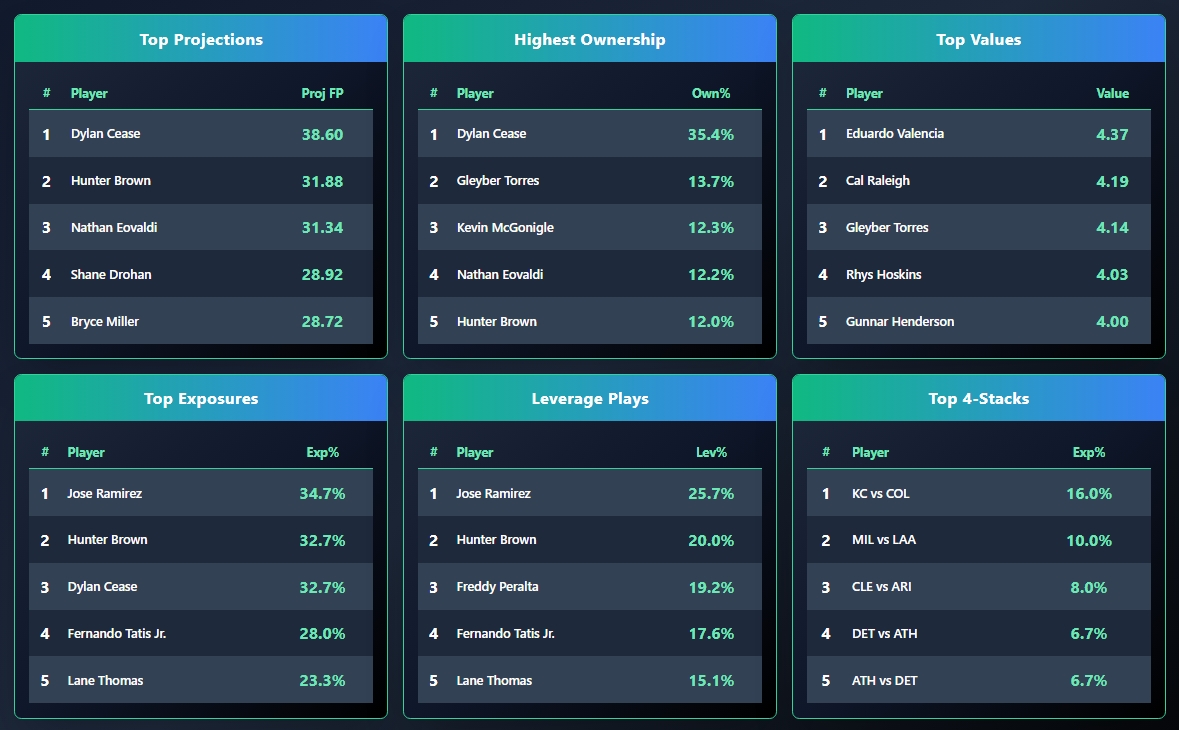
Stokastic's FanDuel MLB DFS cheat sheet is a free daily snapshot of what the Stokastic Sims produce for the slate: top projections, projected ownership, salary values, top-150 exposure, leverage plays, and the four-man team stacks the Sims build most often. Read the pitcher decision first, anchor a four-bat primary stack from the stack panel, then differentiate with the leverage column. The full panel-by-panel breakdown, the FanDuel-versus-DraftKings differences that change how you read it, and a worked example that turns one row into a lineup call are all below.
What The FanDuel MLB DFS Cheat Sheet Is
The FanDuel version condenses the entire simulation run into six panels of five rows each: the highest projected scorers, the highest projected ownership, the best points-per-dollar values, the top-150 exposure leaders, the leverage plays, and the top four-man stacks. Five of the panels list players; the last lists team stacks. It is the free preview of what the paid Sims produce in full.
The distinction matters for how you use it. The cheat sheet hands you the leaders in each category. Sims subscribers see the whole player pool behind those leaders, every stack at every legal size, and the complete pool of simulated lineups with exposure controls. The free version tells you who; the Sims tell you how much and next to whom. Code CHEAT takes 15% off the first payment on any Stokastic MLB DFS weekly or monthly package.
The Six Panels And What Each Number Means
Here is the whole sheet at a glance, then what I actually do with each panel.
| Panel | Stat | What It Tells You | Best Use |
|---|---|---|---|
| Top Projections | Proj FP | Median projected FanDuel points | Pitcher pick, cash anchors |
| Highest Ownership | Own% | Projected share of the field rostering a player | Context for every other read |
| Top Values | Value | Projected points per $1K of salary | Salary relief |
| Top Exposures | Exp% | Top-150 exposure: how often a player appears in the 150 highest sim-ROI lineups | Tournament core |
| Leverage Plays | Lev% | Gap between the Sims' exposure and projected field ownership | GPP differentiation |
| Top 4-Stacks | Exp% | The four-man team stacks the Sims build most often | Primary stack selection |
Top Projections is the panel most people read first, and for the pitcher slot that instinct is right. Arms dominate the top of it because FanDuel pays pitchers steadily: 3 points per inning, 3 per strikeout, 6 for the win, 4 for a quality start. Pitchers usually crowd out the bats here, so treat this panel first as your pitcher shortlist.
Highest Ownership is not a fade list. It is the denominator for everything else. A hitter at 30% ownership can be a fine play; you just need to know the field is there with you, because beating a tournament means beating those lineups somewhere else.
Top Values ranks projected points per $1,000 of salary. One caution from years of staring at this column: a raw points-per-dollar rank flatters cheap bats, since a minimum-priced hitter clearing his tiny bar "beats" a star clearing a much higher one. Cross-check value plays against the projection panel before you treat them as anything more than salary relief.
Top Exposures is where the sheet stops being a projections page and starts being a Sims product. Top-150 exposure measures how often a player shows up in the 150 highest simulated-ROI lineups for the slate. When a player's exposure runs well past his projection rank, the simulations are telling you his outcomes correlate with winning builds, not just with a decent median.
Leverage Plays is my favorite five rows in daily fantasy. The tool surfaces the gap between the Sims' top-150 exposure and the field's projected ownership, and that gap is the raw material of tournament equity. A modest hitter the field ignores can matter more to your win probability than a star everyone shares.
The one-line rule I build by: in tournaments, leverage can beat raw projection. When the ownership gap is wide enough, a 6%-owned bat the Sims want in a quarter of elite lineups does more for your win probability than a 35%-owned star, because you only gain ground where the field is wrong.
Top 4-Stacks ranks the team stacks the Sims build most often, at the four-batter size FanDuel allows, with its Exp% column showing how often each stack appears in the sim-built lineups. Rows read TEAM vs OPPONENT, with the first team being the stack, so the same game can show up twice when the Sims like both sides of it. On the MLB DFS Strategy show, our hosts play a guessing game with this panel most days, calling three stacks by combined exposure before the Sims' answer goes up, and the board still surprises them: a team with a big implied total does not automatically sim well once price, batting-order correlation, and who else shares the game get priced in.
The cross-panel read is the real skill. When one arm tops both the projection and the ownership panel at once, the whole slate reorganizes around a single question: pay up with everyone else, or pivot and accept the risk. Nothing on the page answers that for you, but it makes sure you are answering the right question.
Why FanDuel Reads Differently Than DraftKings
One pitcher, not two. A FanDuel roster is nine slots: P, C/1B, 2B, 3B, SS, three OF, and a UTIL. That single arm carries a share of your outcome no other slot approaches, with no second pitcher to smooth a blowup. So the projections panel is a pitcher decision first and a hitter list second, and paying up for the slate's clear best arm costs you proportionally less pain than on DraftKings, where two seats split the budget. Go cheap at pitcher only when the savings buy bats you can point to, because you are accepting slate-losing risk to get them.
Four batters per team, maximum. FanDuel caps you at four hitters from one team, which is exactly why the stack panel is built around four-man stacks while the DraftKings version thinks in fives. The practical effect: your primary stack ends sooner, and the four remaining hitter slots become the interesting part of the build. Strong FanDuel tournament lineups usually pair the primary four-stack with a two- or three-man secondary group, then spend the last slot or two on one-off leverage bats. Those freed slots are where the Leverage Plays panel earns its keep.
Flatter hitter scoring. FanDuel pays a walk exactly what it pays a single (3 points), with runs at 3.2 and RBI at 3.5; doubles, triples, and homers step up 6, 9, 12, with steals at 6. Patient, grinding offensive nights keep pace better than you would guess, which compresses the gap between chalk and contrarian bats. The consequence: you rarely need the violent full-fade. Getting different on FanDuel is more about stack shape and the one-off leverage bats than about zeroing the popular team entirely.
Quick reference, since the scoring drives all three reads:
| FanDuel Scoring | Points |
|---|---|
| Single / Walk / HBP | 3 |
| Double | 6 |
| Triple | 9 |
| Home Run | 12 |
| Run / RBI | 3.2 / 3.5 |
| Stolen Base | 6 |
| Pitcher: Inning / K | 3 / 3 |
| Pitcher: Win / Quality Start | 6 / 4 |
| Pitcher: Earned Run | -3 |
Platform rules and scoring do change occasionally, so confirm the current rules on FanDuel before a big session.
How The Stokastic Sims Build These Numbers
None of these panels is a hand-ranked list. Each one is a different summary of the same engine run: the Stokastic Sims simulate the slate tens of thousands of times, and every simulation plays out full games with correlated outcomes. Correlation is the point. When a leadoff man doubles in a simulated game, the two hitters behind him score more in that same simulation, which is why sim-built stacks arrive with batting-order logic already priced in. A static projection sheet cannot do that math; our guide to the MLB DFS Sims walks through the full engine if you want the deeper tour.
Two other proprietary inputs shape what you see. Stokastic's ownership projections model the field as a distribution rather than a single guess, which is what makes the Lev% column trustworthy: leverage is only as good as the ownership number you subtract. And the exposure panel comes from the ROI-ranked lineup pool, the Sims' stack of simulated tournament lineups sorted by how much simulated profit they generated. Top-150 exposure is literally a census of that pool's best 150 rows, and Lev% is that census minus projected ownership.
You can watch the engine disagree with the crowd on the sheet itself. The most instructive pattern shows up when one hitter leads both the exposure and leverage panels while appearing nowhere on the projection, ownership, or value boards: the Sims are not saying his median is special, they are saying his good nights land in winning lineups and the field is not coming. The opposite pattern, an ace who tops projections and ownership at once, is the crowd and the model agreeing, which is useful in a different way. Every panel's full table lives in the MLB DFS projections, ownership, and stacks DataHub.
One scope note: the exposure and leverage panels are tournament reads, because simulated ROI is a tournament concept. For cash games, stay with the projection and value panels and build the highest-floor lineup you can; correlation and leverage are GPP weapons, as our MLB DFS correlation strategy guide explains.
A Worked Example: One Leverage Row To A Full Roster
The numbers here are illustrative, but the mechanics are exactly how I use the sheet every slate.
Say tonight's Leverage Plays panel shows a third baseman priced at $3,100 with 22% top-150 exposure. I flip to the ownership panel and he is nowhere on it; the sheet's detail puts the field at 6%. The Sims want him in roughly one of every four or five elite lineups, and the field will barely roster him. That 16-percentage-point gap, exactly what the Lev% column computes, is the single loudest number on the sheet.
Now the roster walk. The projection panel does not love him; he is mid-pack, which is normal, because leverage is not about medians. The value panel likes him fine at his price. So the question becomes structural: where does he fit? My primary four-stack is already set from the stack panel, and remember the single-pitcher math from earlier: I paid up for the slate's best arm, so the budget wants one cheap bat somewhere. A $3,100 hitter the Sims quietly love is exactly what the UTIL slot is for. He does not replace the stack; he rides beside it, and if the low-owned bat delivers while the chalk bat he displaced has a quiet one, that single slot moves me past everyone who went the popular route there.
That is the whole discipline: the sheet flags the gap, the roster rules tell you where the gap fits, and no single panel ever makes the call alone.
A Daily Routine For The Cheat Sheet
My in-season loop, in order:
- Pitcher first. Open the projections panel and make the one-arm call before touching a hitter. Everything downstream is a consequence of what that slot costs.
- Anchor the stack. Take the stack panel's top few four-stacks and pick the one whose price fits your pitcher decision, not just the one ranked first.
- Fill with values. Use the value panel for the connective bats, cross-checked against projections so cheap does not quietly mean bad.
- Differentiate last. Spend your final slots on the leverage panel, tournament builds only.
- Re-check at lock. Lineups and weather move everything; a scratched leadoff hitter turns a top stack into a trap. Our MLB DFS late swap guide covers the rescue moves, and the MLB DFS glossary has any term this page did not define.
Want to see the loop run on a real slate? Watch us do it live, stacks game and all, on the MLB DFS Strategy show, where we take these same panels from screen to submitted lineup.
More on this: FanDuel MLB DFS Cheat Sheet: Aug. 28 Picks And Stacks · DraftKings MLB DFS Cheat Sheet: Projections, Ownership & Stacks For August 3 · FanDuel NFL DFS Cheat Sheet: Week 1 Picks And Stacks · FanDuel PGA DFS Cheat Sheet: Sims, Projections And Ownership · DraftKings NFL DFS Cheat Sheet: Week 1 Picks And Stacks
The Sheet Is The Map, Not The Lineup
Six panels, one question: where does tonight's FanDuel slate break, and where is the field wrong about it? The projections panel starts the answer, the stack panel gives it structure, and the leverage panel, the one I promised we would end on, shows you the shape of the edge the Sims model in full. The mistake I see new FanDuel players make most is running that leverage read in cash games, where it does not belong; keep it for tournaments and the sheet will point you the right way far more often than not. If the daily preview keeps earning its place in your routine, the full engine is the natural next step. Code CHEAT takes 15% off your first payment on any Stokastic MLB DFS weekly or monthly package.
Play within your means, and only where daily fantasy is legal for you. 21+.
Stokastic MLB DFS packages (Sims + projections) via pricing page with code CHEAT
Use code CHEAT
Get Started