
FanDuel PGA DFS Cheat Sheet: Sims, Projections And Ownership
By Sam Smith
August 12, 2026

Stokastic's free PGA DFS cheat sheet for FanDuel is six small tables that condense tens of thousands of tournament simulations into a two-minute read, and this week's FedEx St. Jude Championship board does something I almost never see it do. Scottie Scheffler appears on five of the six panels and leads all five: the highest salary at $14,200, the top projection at 94.3 FanDuel points, the heaviest ownership at 35.3%, the most top-150 exposure at 68.7%, and, here is the strange part, the most leverage at 32.7%. Most weeks the sheet's job is to pull you off the field's favorite golfer and onto a cheaper, quieter one. This week it looks you in the eye and says the most popular golfer on the board is still the most under-used one, because the Sims want him in close to double the share of lineups the field will actually play him in. By the end I will take that row and walk it into the anchor of a six-golfer FanDuel build under the $60,000 cap.
The Quick Answer
The FanDuel PGA DFS cheat sheet is a free weekly board built from a full Stokastic Sims run of the tournament, split into six panels: salaries, projections, ownership, value, top-150 exposure and leverage. Read the projection and salary panels to set your pecking order, then build your tournament core from the leverage panel rather than the ownership panel, which describes everyone else's lineup. The panel-by-panel breakdown, what a no-cut playoff event at TPC Southwind does to those numbers, and a worked example that turns Scheffler's five-panel sweep into a six-man roster are all below.
What The FanDuel PGA DFS Cheat Sheet Is
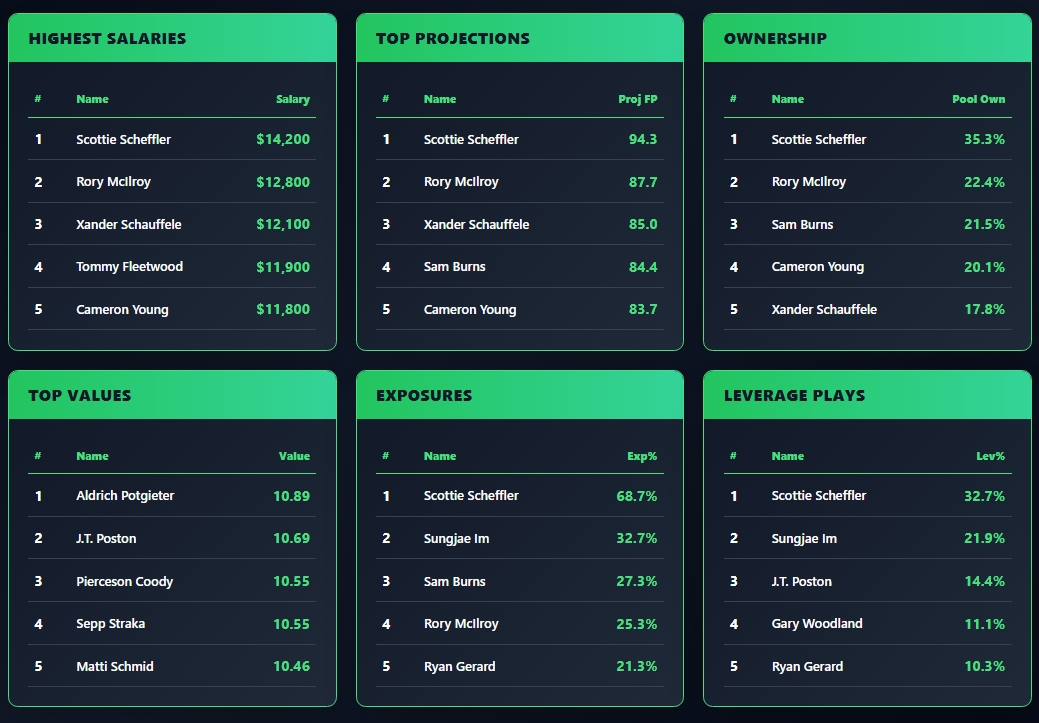
The cheat sheet is the free weekly summary of what the paid Stokastic Sims produce for the FanDuel golf slate. The Sims play the full 72-hole tournament tens of thousands of times, assemble a pool of lineups, rank that pool by simulated ROI, and the sheet skims the top of the output into six top-five panels. Everything on it is FanDuel-specific: the salaries are FanDuel's, the projections are scored to FanDuel's system, and none of it transfers to any other site's slate.
The sheet itself costs nothing, every week, no package required, and no promo code touches it because there is nothing to discount. The code below applies to the paid Stokastic packages behind the sheet, where the full PGA DFS projections, Ownership Projections, Boom/Bust and the Sims themselves live. Code ALL15 takes 15% off your first week or month of a Stokastic All Access package, which covers golf and every other sport on the site.
This week's capture is the good kind: every panel is fully populated, names and numbers both, so every figure in this article comes straight off the board.
The Six Panels And How To Read Each One
| Panel | What it shows | How I act on it |
|---|---|---|
| Highest Salaries | The most expensive golfers on FanDuel | Where the cap fight starts, not the pecking order |
| Top Projections (Proj FP) | Median projected FanDuel fantasy points | My baseline ranking of the field |
| Ownership (Pool Own) | Projected field ownership | Where the field will be, not where I should be |
| Top Values (Value) | Projected points per $1K of salary | The cheap golfers who fund the stars |
| Exposures (Exp%) | Top-150 exposure: how often a golfer appears in the 150 highest sim-ROI lineups | The Sims' actual shopping list |
| Leverage Plays (Lev%) | The gap between optimal exposure and field ownership | Where tournament edge comes from |
The salary panel runs Scheffler at $14,200, Rory McIlroy at $12,800, Xander Schauffele at $12,100, Tommy Fleetwood at $11,900 and Cameron Young at $11,800. Scheffler's $1,400 gap over second place is the widest on the board, and it should be: he enters the week No. 1 in the FedExCup standings at a tournament reserved for the season's top 70 points earners. Under a $60,000 cap that averages $10,000 per slot, a $14,200 golfer is a real construction decision, not a default click.
The projection panel explains why the price exists. Scheffler leads at 94.3 projected FanDuel points, McIlroy sits second at 87.7, then Schauffele at 85.0, Sam Burns at 84.4 and Young at 83.7. That is a 6.6-point drop from first to second and only a 4.0-point spread across the four golfers behind him. The board is drawing one golfer in his own tier and a tight shelf underneath.
Now the ownership panel, and the first thing worth noticing about this field's behavior: it lists the same five names as the projection panel, just shuffled below the top two. Scheffler at 35.3%, McIlroy at 22.4%, Burns at 21.5%, Young at 20.1% and Schauffele at 17.8%. There is no storyline chalk on this board, no name the field is rostering on narrative alone. A 69-man field of the season's best players leaves nowhere for a mystery favorite to hide, so the crowd is simply buying the projection panel's five names, nearly in order.
The row worth staring at: the field's discipline is exactly what creates this week's edge. When ownership tracks projection this cleanly, everyone's lineups start to look alike, and the Sims' response is printed one panel over: Scheffler's top-150 exposure is 68.7%, close to double his 35.3% ownership, and that gap is why the board's most-owned golfer is also its leverage leader at 32.7%. Rational chalk is still chalk, and the sheet quantifies exactly how much more of it you should own than your opponents will.
The last two panels belong to the Sims' own output. The value panel, projected points per $1,000 of salary, is where the engine spends the rest of the cap: Aldrich Potgieter at 10.89, J.T. Poston at 10.69, Pierceson Coody and Sepp Straka tied at 10.55 and Matti Schmid at 10.46, a spread of 0.43 across all five, which tells you the cheap end of this board is deep rather than top-heavy. The exposure panel runs Scheffler at 68.7%, Sungjae Im at 32.7%, Burns at 27.3%, McIlroy at 25.3% and Ryan Gerard at 21.3%. And the leverage panel goes Scheffler at 32.7%, Im at 21.9%, Poston at 14.4%, Gary Woodland at 11.1% and Gerard at 10.3%. Exactly three golfers make both Sims panels, exposure and leverage: Scheffler, Im and Gerard. Im is the quiet star of that group, second on both while never cracking the ownership panel's 17.8% cutoff, and Poston pulls the other classic double, second in value and third in leverage, the cheap golfer the engine likes at a price the field is ignoring.
What TPC Southwind And The Playoff Format Do To This Board
Panels do not exist in a vacuum, and this week's event explains most of the board's shape. The FedEx St. Jude Championship in Memphis is the first event of the FedExCup Playoffs: the top 70 in season-long points qualified, 69 of them are teeing it up, and there is no cut, so every golfer in the field plays all four rounds. The last man through the door is Michael Brennan, who won the Wyndham Championship on Sunday to steal the final playoff spot, and he is in this field too.
The no-cut format is the single biggest number-mover on this sheet. In a normal week, the scariest outcome in golf DFS is a golfer going home Friday and leaving a dead roster spot behind. This week that outcome does not exist, and you can see the consequences all over the board: the field concentrates its ownership on the top of the projection panel because the usual cut-risk discount on stars is switched off, and the value panel's numbers bunch within 0.43 of each other because even the cheapest golfers bank four full rounds. When nobody can zero out, the difference between lineups shrinks, and differentiation has to come from allocation, which is precisely the leverage panel's job.
TPC Southwind itself pushes the same direction. It is a demanding 7,233-yard par 70 that does not reward the bomb-and-gouge style of a regular tour stop; it is a placement course where approach play and position decide the scoring. On a course that narrows the gap between playing styles, in a field with no weak entries, the on-grass spread tightens, and the sheet's edge shifts from finding hidden golfers to sizing known ones correctly. That is why this board's leverage panel is topped by its most famous name rather than its most obscure one.
Two panels, one lesson: Tommy Fleetwood is this week's cleanest example of reading the board together rather than panel by panel. He holds the fourth-highest salary at $11,900 and appears on no other panel: not projections, not ownership, not exposure, not leverage. That is not the sheet saying he plays badly; it is the sheet saying that at that price, on a compressed board, the Sims found better ways to spend the money.
How FanDuel Roster Rules Change The Read
None of those numbers mean anything without the FanDuel format in front of you. Three rules shape every read on this board:
- Six Golfers, One $60,000 Cap. That is a $10,000 average per slot, and every dollar you spend above it on one golfer comes back out of another slot, which is why the value panel exists at all.
- FanDuel Scoring Leans Harder On Finishing Position Than DraftKings. Final leaderboard spot carries real weight on top of hole-by-hole scoring.
- This Week, Everyone Finishes. With no cut at TPC Southwind, all 69 golfers post a final position, so the finish-heavy part of FanDuel scoring never switches off for anyone.
That first rule makes golf the purest budget-allocation game on the site, and the PGA lineup-building guide covers the construction shapes in depth.
The finishing-position lean is the wrinkle most players miss, because it pulls projected points toward the top of the board: Scheffler's 94.3 is not just birdies, it is the Sims banking how often the No. 1 seed in the FedExCup standings contends on a course with no cut to survive. It also changes who is actually cheap. A mid-priced golfer who keeps finishing tournaments near the lead is worth more on FanDuel than his raw scoring suggests, and that finish-heavy lens is baked into every projection and value number on this sheet, which is precisely why you should never carry a number from this board to any other site's slate.
The no-cut rule deserves its own paragraph, because it rewires the risk math golf DFS players carry around in their heads. The usual price of a thin, contrarian golfer is that he might miss the weekend; this week the worst case is a bad 72-hole total, not a zero. That makes the leverage panel unusually cheap to use: rostering Woodland, on no panel but leverage at 11.1%, or Gerard, fifth on both Sims panels, costs you variance rather than survival. Weeks like this are why simulation output beats a static projection in golf, a point the full PGA DFS strategy guide builds from. One format warning belongs here too: everything in this article describes the full-tournament slate. Single-round Showdown contests are a different puzzle, and the PGA Showdown strategy guide is the right tool for those.
How The Stokastic Sims Build These Numbers
Every panel is one engine viewed from six angles. The Stokastic Sims do not rank this field off a static projection list; they play the entire FedEx St. Jude Championship tens of thousands of times, weekend pairings and final leaderboards included. That matters in golf because a 72-hole tournament is a long-tail outcome distribution: the same golfer finishes fifth in one sim, 40th in another and wins a third, and a median projection alone flattens that shape. Burns at 84.4 and Young at 83.7 are nearly identical as medians, yet Burns is third on the exposure panel and Young is absent from it, because the Sims also know how often each posts the tournament that wins a large-field GPP.
Ownership runs through the same engine as a distribution rather than a single guess. Stokastic's Ownership Projections estimate where the FanDuel field will land, the sim-ROI rankings say where the optimal lineups actually land, and leverage is the gap between the two. The 150 best lineups by simulated ROI become the exposure panel, which is why it is written as top-150 exposure: it is a count from the lineup pool, not anyone's opinion. The Stokastic PGA Sims walkthrough shows the full workflow, and the complete output behind the sheet, PGA DFS projections, ownership and leverage for every golfer in the field, lives in the Golf DataHub.
Six top-five panels are the skim. The paid layer is the same engine with the lid off, which is the honest version of the upsell: the sheet shows you the Sims' five favorite leverage plays, the packages show you all of them.
From One Row To A Roster: The Scheffler Worked Example
Now the promised walk-through, starting with Scheffler's full line across this week's board:
| Panel | Scheffler's rank | His number |
|---|---|---|
| Highest Salaries | 1st | $14,200 |
| Top Projections | 1st | 94.3 Proj FP |
| Ownership (Pool Own) | 1st | 35.3% |
| Exposures | 1st | 68.7% |
| Leverage Plays | 1st | 32.7% |
Read that bottom half again: the field will put Scheffler in roughly one lineup in three, while the Sims put him in nearly seven of every ten of their 150 best. On most boards, leading the ownership panel is a warning. On this one it is an invitation, because even the heaviest chalk of the week is still dramatically under-owned relative to optimal.
Start with the decision he forces. At $14,200, rostering Scheffler leaves $45,800 across five slots, an average of $9,160, which is a real squeeze against a $10,000 baseline. This is exactly what the value panel is for: Potgieter, Poston, Coody, Straka and Schmid are the five names the engine flags as points-per-dollar relief, and their value numbers sit within 0.43 of each other, so fitting two of them is how the build closes under $60,000 without strip-mining the middle. The middle slots then come from the Sims panels rather than the ownership panel: Im, below the 17.8% ownership cutoff yet second in both exposure and leverage, is the single clearest pairing on the board, and Gerard, fifth on both Sims panels, is the same argument at a smaller size.
The alternative build reads the projection panel's shelf the other way. If you would rather not pay the $1,400 premium, McIlroy at $12,800 keeps a top-two projection, raises the per-slot average to $9,440, and still carries the fourth-most top-150 exposure at 25.3%. What you give up is the leverage: McIlroy's 22.4% ownership already tracks his exposure closely, which is why he appears on the exposure panel but not the leverage one. And if you want the ceiling version, the double-star build at $27,000 for Scheffler plus McIlroy leaves $8,250 per slot for four golfers, an allocation that only works because a deep, flat value panel exists to close it.
One panel never came up in that build: ownership. It described the field, and then the Sims panels beat it, exactly as designed. Notice that the sheet never asked you to fade its most popular golfer this week. It asked you to own him more than the field does, and to spend your differentiation on Im, Poston, Woodland and Gerard, the four names on the Sims panels that the ownership panel never mentions.
Before you build your own version, this is the moment the sheet is designed for: the free panels found the argument, and the paid layer holds the numbers for the rest of the 69-man field. Code ALL15 takes 15% off your first week or month of a Stokastic All Access package.
One honest caveat. Exposure and leverage are tournament numbers built from simulated large-field ROI, not floor plays, and with no cut this week the punishment for a miss is a quiet leaderboard crawl rather than a zero, which changes the risk but does not remove it. If you are new to tournament thinking, the DFS tournament strategy guide explains why you judge the process over months of slates, not one Sunday leaderboard. The board also re-runs as the week develops, so check the sheet again before Thursday's lock, and cross-reference this week's PGA DFS picks for the golfer-by-golfer reasoning behind it.
More on this: DraftKings PGA DFS Cheat Sheet: Sims, Projections And Ownership · FanDuel NFL DFS Cheat Sheet: Week 1 Picks And Stacks · FanDuel MLB DFS Cheat Sheet: Projections, Ownership & Stacks · FanDuel NFL Showdown Cheat Sheet: Week 1 TNF · FanDuel NFL Showdown Cheat Sheet: Week 1 Kickoff
Six Panels, One Argument Per Entry
Read this week's board back to front and it tells a single story: a no-cut playoff field with nowhere to hide has made the crowd rational, the ownership panel is just the projection panel shuffled, and the only edge left is sizing, which the leverage panel resolves by pointing at the most famous golfer in the tournament. The way I turn that into entries is a split, not a coin flip: roughly seven in ten of my builds anchor Scheffler with Im or Gerard beside him and two value-panel golfers closing the cap, and the other three in ten go without him, matching the Sims' own top-150 pool, with Im, Poston and Woodland carrying the differentiation instead. A good PGA DFS cheat sheet never hands you a finished lineup; it hands you that argument, sized per entry, with the 68.7-versus-35.3 gap as your weekly reminder that even when the crowd is right about who the best golfer is, it can still be wrong about how much of him to own. You must be 21+ to play.
When you want the full pool behind the panels, the Sims, Ownership Projections and Boom/Bust are the paid layer, and the code takes 15% off your first week or month.