DraftKings PGA DFS Cheat Sheet: Sims, Projections And Ownership
By Sam Smith
August 5, 2026

DraftKings PGA DFS Cheat Sheet: Sims, Projections And Ownership
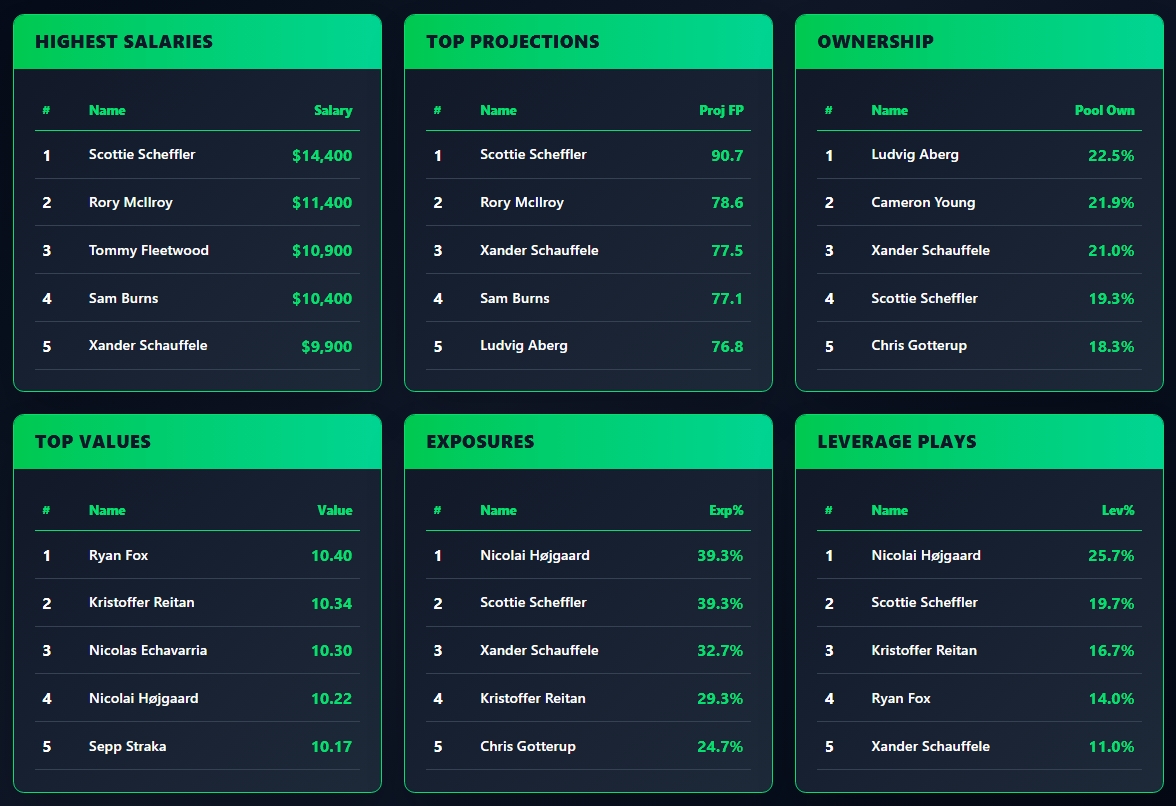
Stokastic's free PGA DFS cheat sheet is six small tables that condense tens of thousands of tournament simulations into a two-minute read, and this week's Wyndham Championship board is the perfect one to learn it on. Cameron Young, the defending champion at Sedgefield Country Club, sits first on four of the six panels: highest salary at $10,400, top projection at 90.5 DraftKings points, and the top name in both the ownership and exposure rankings. The two panels he does not touch are value and leverage, and leverage is the one that matters: there, Ryan Gerard, the board's fifth-highest salary at $9,300, leads the entire sheet at 20.9%. One golfer owns the popularity contest and a different golfer owns the panel where tournaments are won, and that gap is the whole reason the sheet exists. By the end I will take Gerard's row and walk it all the way into a six-golfer DraftKings build.
The Quick Answer
The DraftKings PGA DFS cheat sheet is a free weekly board built from a full Stokastic Sims run of the tournament, split into six panels: salaries, projections, ownership, value, top-150 exposure and leverage. Read the projection and salary panels to set your pecking order, then build your tournament core from the leverage panel, not the ownership panel. The panel-by-panel breakdown, what a short Donald Ross par 70 does to those numbers, and a worked example that turns Gerard's 20.9% leverage into a full $50,000 roster are all below.
What The DraftKings PGA DFS Cheat Sheet Is

The cheat sheet is the free weekly summary of what the paid Stokastic Sims produce for the DraftKings golf slate. The Sims play the full 72-hole tournament tens of thousands of times, assemble a pool of lineups, rank that pool by simulated ROI, and the sheet skims the top of the output into six top-five panels.
The sheet itself costs nothing, every week, no package required, and no promo code touches it because there is nothing to discount. The code below applies to the paid Stokastic packages behind the sheet, where the full PGA DFS projections, Ownership Projections, Boom/Bust and the Sims themselves live. Code ALL15 takes 15% off your first week or month of a Stokastic All Access package, which covers golf and every other sport on the site.
One honest note on timing before we read it. This week's capture was taken the day before the Wyndham Championship tees off, and three of the six panels, ownership, value and exposure, show their ranked names with the number columns still populating. Nothing is broken there; early-week boards work this way, with the names ordered first and the figures filling in as the Sims re-run toward Thursday's lock. So for those three panels I will talk about rank order only, and every number I quote comes from the three panels that are live: salaries, projections and leverage.
The Six Panels And How To Read Each One
| Panel | What it shows | How I act on it |
|---|---|---|
| Highest Salaries | The most expensive golfers on DraftKings | Where the cap fight starts, not the pecking order |
| Top Projections (Proj FP) | Median projected DraftKings fantasy points | My baseline ranking of the field |
| Highest Ownership (Own%) | Projected field ownership | Where the field will be, not where I should be |
| Top Values (Value) | Projected points per $1K of salary | The mid-range golfers who fund the stars |
| Top Exposures (Exp%) | Top-150 exposure: how often a golfer appears in the 150 highest sim-ROI lineups | The Sims' actual shopping list |
| Leverage Plays (Lev%) | The gap between optimal exposure and field ownership | Where tournament edge comes from |
The salary panel this week runs Young at $10,400, Jackson Koivun at $10,100, Hideki Matsuyama at $9,500, Justin Thomas at $9,400 and Gerard at $9,300. Notice how tight that is: $1,100 separates first from fifth. The Wyndham field runs lighter than a signature event, with the very top of the world rankings sitting the week out, and thinner fields compress salaries. Nobody on this board costs $11,000-plus, which changes roster construction more than any single pick does.
The projection panel mostly agrees with the salary panel, and that agreement is itself information. Young leads at 90.5 projected DraftKings points, then Koivun at 77.4, Matsuyama at 75.8, Ben Griffin at 75.7 and Gerard at 75.0. The 13.1-point gap between Young and second place is the loudest number on the board: the Sims see the defending champion as a class apart at a course he has already dominated. Below him, four golfers are separated by 2.4 points, which is no separation at all across 72 holes.
The ownership ranking reads Young, Koivun, Matsuyama, Griffin, Gerard, which is the projection panel in the exact same order, all five names, no exceptions. Chalk looks exactly like this: the field rosters the median almost perfectly. The value ranking is where the names change, led by Koivun with Davis Thompson, Brooks Koepka, Keegan Bradley and Alex Smalley behind him, and the exposure ranking runs Young, Koivun, Patrick Cantlay, Matsuyama, Thomas.
The row worth staring at: Ryan Gerard is fifth in salary, fifth in projections, fifth in the ownership ranking, and first in leverage at 20.9%. Leverage is optimal exposure minus projected field ownership, so a golfer the field already likes leading this panel means the Sims want him far beyond even his popular-pick ownership. That is a different, stronger signal than a forgotten longshot sneaking onto the board.
Behind Gerard the leverage panel goes Thompson at 13.1%, Rasmus Neergaard-Petersen at 12.6%, Ryo Hisatsune at 12.5% and Harris English at 11.8%. Thompson appearing on both the value and leverage panels is the classic double: cheap enough to fund the build and under-rostered relative to what the Sims want.
What Sedgefield Does To These Numbers
Panels do not exist in a vacuum, and this week's venue explains most of the board's shape. Sedgefield Country Club is a short, tree-lined Donald Ross par 70 at roughly 7,100 yards, the kind of positional course where driver is optional and scoring runs through short irons and wedges. The winning score reached 22 under last year. On a track like this, raw distance stops separating golfers, so the gap between a $10,400 star and a $9,300 mid-priced player shrinks on the course faster than it shrinks on the salary sheet. This is exactly the environment where the leverage panel earns its keep: when the course compresses skill edges, being different from the field matters nearly as much as being right.
The week's second storyline feeds the ownership panel. The Wyndham Championship is the final event of the PGA Tour regular season, and only the top 70 in FedExCup points advance to the playoffs, so part of this field is playing for its season. The field of DFS entrants tends to over-react to that narrative in one direction: famous names grinding for position attract rosters on story alone, while quieter bubble golfers get ignored. The cheat sheet does not care about either story. Leverage is just optimal exposure minus projected ownership, so when the field piles onto a name for narrative reasons, that golfer's leverage falls, and when the field sleeps on a live one, his leverage rises. You do not have to guess where the over-reaction is; the panel is already pricing it.
The course-history story in numbers: Young leading four rankings at once is the defending champion, at a venue that fits him, projected a full 13.1 points clear of the field. The sheet is not telling you to avoid him. It is telling you exactly what you will pay in salary and ownership to have him, and where the argument against paying it lives.
How DraftKings Golf Rules Change The Read
None of those numbers mean anything without the DraftKings roster rules in front of you. A classic golf lineup is six golfers under a $50,000 cap, no positions, no captain, nothing else. That makes golf the purest salary-allocation game in DFS: with no positional constraints, every decision is just which six numbers you can fit, and the PGA lineup-building guide covers the construction shapes in depth. Six slots into $50,000 is an average of $8,333 per golfer, so every dollar you spend above that line on one player has to come back out of another slot.
Scoring rewards aggression, and the per-hole values explain why:
| DraftKings Golf Scoring (Per Hole) | Points |
|---|---|
| Eagle | 8 |
| Birdie | 3 |
| Par | 0.5 |
| Bogey | -0.5 |
| Double Bogey Or Worse | -1 |
Bonus points layer on for birdie streaks and bogey-free rounds, and finishing-position points get added on top of the hole-by-hole scoring. A birdie is worth six pars, so at a 22-under birdie-fest like Sedgefield the scoring shape pushes the Sims toward birdie-makers over grinders, which is worth remembering when a par-machine's projection looks lower than his world ranking says it should.
The other rule that shapes everything is the cut. After 36 holes the field is trimmed, and a golfer who misses the weekend stops scoring entirely while forfeiting the finishing-position points. Lose one golfer to the cut and you are playing five against six; lose two and the lineup is dead in a tournament of any size. That risk is not abstract this week: a leverage build carrying Gerard, Thompson and Neergaard-Petersen lives or dies on Friday afternoon, and surviving that cut risk is the price of the 20.9% edge. This is the single biggest difference between golf and the daily team sports, and it is why simulation output beats a static projection here more than anywhere else. One number cannot describe a golfer who might miss the cut or win. The full PGA DFS strategy guide builds on that foundation, and one format warning belongs here: everything in this article describes the full-tournament classic slate. Single-round Showdown contests score one round with different dynamics, and the PGA Showdown strategy guide is the right tool for those.
How The Stokastic Sims Build These Numbers
Every panel is one engine viewed from six angles. The Stokastic Sims do not rank this field off a static projection list; they play the entire Wyndham Championship tens of thousands of times, cuts, weekend pairings, final-round leaderboards and all. That matters in golf because a 72-hole tournament is a long-tail outcome distribution: the same golfer misses the cut in one sim, finishes 40th in another and wins a third. A median projection alone flattens that shape. Gerard at 75.0 and Griffin at 75.7 look identical as medians, but the Sims also know how often each of them posts the tournament that wins a large-field GPP, and that is the information the exposure and leverage panels are built from.
Ownership runs through the same engine as a distribution rather than a single guess. Stokastic's Ownership Projections estimate where the field will land, the simulated-ROI rankings say where the optimal lineups actually land, and leverage is the gap between the two. The top 150 lineups by simulated ROI become the exposure panel, which is why it is written as top-150 exposure: it is a count from the lineup pool, not anyone's opinion. The Stokastic PGA Sims walkthrough shows the full workflow, and the complete output behind the sheet, PGA DFS projections, ownership and leverage for every golfer in the field, lives in the Golf DataHub.
Six top-five panels are the skim. The paid layer is the same engine with the lid off, which is the honest version of the upsell: the sheet shows you the Sims' five favorite leverage plays, the packages show you all of them.
From One Row To A Roster: The Gerard Worked Example
Now the promised walk-through. Gerard's line across this week's board: $9,300 salary, 75.0 projected points, a top-five name in the ownership ranking, and first in leverage at 20.9%, the widest gap on the sheet between what the Sims want and what the field will do.
Start with the decision he actually forces. The projection panel says Young is worth paying for, and at $10,400 you can pay for him: Young plus Gerard costs $19,700, which leaves $30,300 across four slots, an average of $7,575, entirely livable on a compressed salary board. That is the both-stories build, the class of the field plus the leverage leader, and it only works because Sedgefield's thin-field pricing left the top salary at $10,400 instead of $11,500.
The alternative reads the 13.1-point projection gap the other way. If you believe a birdie-fest at a positional par 70 compresses Young's edge on the course, you swap him for Koivun at $10,100, first in the value ranking and second in projections at 77.4. The savings are small at $300, but the ownership savings are the real purchase: you keep an elite projection while stepping out of the board's heaviest chalk. From there the leverage panel fills the middle of the build, Thompson at 13.1% leverage with a value-panel appearance to match, Neergaard-Petersen at 12.6% or Hisatsune at 12.5% as the differentiation slots, and English at 11.8% as the steadier veteran version of the same idea.
Either way, the last slots come down to the value ranking, where Koepka, Bradley and Smalley are this week's flagged names, mid-priced golfers the Sims see as cap-relief with real projections. Fit two of them and the build closes under $50,000 with room to move.
One panel never came up in that build: ownership. It described the field, and then the leverage panel beat it, exactly like it is designed to. Ownership describes everyone else's roster; the leverage panel points at which shared beliefs are worth breaking from, and this week the break it recommends is raising Gerard from a fifth-place afterthought to a core piece rather than fading Young for a longshot.
Before you build your own version, this is the moment the sheet is designed for: the free panels found the argument, and the paid layer holds the other 150-plus golfers' numbers. Code ALL15 takes 15% off your first week or month of a Stokastic All Access package.
One honest caveat. Exposure and leverage are tournament numbers built from simulated large-field ROI, not floor plays, and the board's top leverage golfer can absolutely miss the cut. If you are new to tournament thinking, the DFS tournament strategy guide explains why you judge the process over months of slates, not one Sunday leaderboard. And because the sheet posts before the numbers finish populating, check back before Thursday's lock, and cross-reference this week's PGA DFS picks for the golfer-by-golfer reasoning behind the board.
FAQ
Is the DraftKings PGA DFS cheat sheet free? Yes. It posts free on Stokastic every tournament week, no package required, as the free preview of what the paid Stokastic Sims produce for the DraftKings golf slate.
Does code ALL15 discount the cheat sheet? No. The sheet is already free. ALL15 takes 15% off your first week or month of a paid Stokastic All Access package, which includes the full golf Sims output along with every other sport.
What does top-150 exposure mean? It is the share of the 150 highest simulated-ROI lineups that include a golfer. It is a count from the Sims' lineup pool, not a subjective rating, which is why the exposure panel can disagree with both the projection and ownership panels.
Why is leverage so important at the Wyndham Championship specifically? Sedgefield is a short par 70 where scoring bunches up and 22 under wins, so on-course skill edges compress and large-field golf tournaments get decided by roster differentiation. Add the FedExCup bubble narrative pushing ownership toward famous names, and the gap between optimal exposure and field ownership, which is exactly what the leverage panel measures, gets wider than usual.
Why do some panels show names but no numbers early in the week? The sheet posts before the tournament locks, and the ownership, value and exposure figures keep populating as the Sims re-run toward Thursday. The rank order is live first; the numbers firm up closest to lock, which is why it is worth re-checking the board before you enter.
Six Panels, One Decision Per Entry
Read this week's board back to front and it tells a single story: the defending champion is priced and projected like the class of the field, the course compresses the edge you are paying for, and the leverage panel answers with a promotion rather than a fade: Gerard moves from fifth-place prices to first-place priority. The way I turn that into entries is a split, not a coin flip: the Young-plus-Gerard build carries my safer tournament entries, the Koivun pivot builds carry the contrarian share, and Gerard sits in both, because when one golfer leads the leverage panel while the field already half-likes him, he is the piece you anchor across the portfolio rather than debate. A good PGA DFS cheat sheet never hands you a finished lineup; it hands you that decision, sized per entry. You must be 21+ to play.
When you want the full pool behind the panels, the Sims, Ownership Projections and Boom/Bust are the paid layer, and the code takes 15% off your first week or month.
Stokastic All Access packages, code ALL15 for 15% off your first week or month
Use code ALL15
Get Started