
DraftKings MLB DFS Cheat Sheet For August 11: Projections, Ownership, And Stacks
By Sam Smith
August 11, 2026
Most nights, an MLB DFS cheat sheet earns its keep by telling you where the field is wrong. Tonight's board does something stranger: it tells you the field is right about both pitchers and still not on them hard enough. Dylan Cease (TOR) at 42.1% projected ownership and Sean Burke (CWS) at 32.0% are the chalk arms on the Tuesday, August 11 DraftKings main slate, 12 games running from the 7:05 p.m. ET first pitch in the Bronx to the 10:10 p.m. ET finale at Dodger Stadium, and the Stokastic Sims make those same two arms the top two leverage plays on the entire sheet. When that happens, the pitcher decision stops being where you get different, and every drop of your creativity moves to the bats. That is tonight's thesis, and the sheet backs it with the most lopsided pitching number it points at anywhere, which belongs to an arm nobody wants to roster. I will show you that number when we reach the stack panel.
Dylan Cease — one of the featured players on today's slate.
The Quick Answer
Play both chalk pitchers. Dylan Cease (23.0 projected DraftKings points, 42.1% ownership) sits in 84.7% of the top-150 sim lineups, and Sean Burke (19.7, 32.0%) sits in 76.0%, which makes them the two biggest leverage plays on the board at 41.9% and 44.0%. Skip Blake Snell (LAD) at 16.7% ownership; the Sims leave him off every panel that matters. Spend the savings on Tampa Bay Rays and Texas Rangers bats: Junior Caminero (30.7% top-150 exposure) and Jonathan Aranda headline a Rays stack against one of the two most homer-prone arms the stack board points at, while the board's number one five-stack, Texas at 12.0%, attacks the very worst of them. The full six-panel board, the case for each row, and a worked Rangers build are below.
Today's Board: Twelve Games, Six Panels
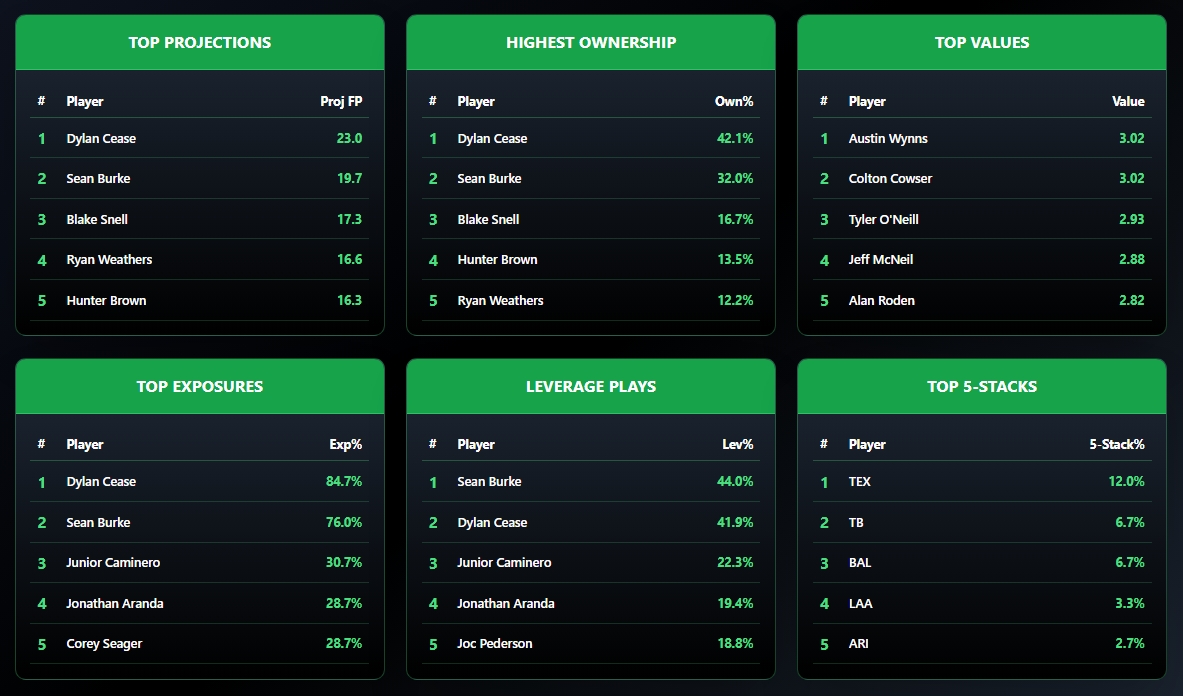
Every number in this article comes off today's free DraftKings MLB DFS cheat sheet, which the Stokastic Sims regenerate every morning by simulating this exact slate, these 12 games and these starting pitchers, tens of thousands of times. Here is the August 11 board in full:
| Panel | 1st | 2nd | 3rd | 4th | 5th |
|---|---|---|---|---|---|
| Top Projections (Proj FP) | Dylan Cease 23.0 | Sean Burke 19.7 | Blake Snell 17.3 | Ryan Weathers 16.6 | Hunter Brown 16.3 |
| Highest Ownership (Own%) | Dylan Cease 42.1% | Sean Burke 32.0% | Blake Snell 16.7% | Hunter Brown 13.5% | Ryan Weathers 12.2% |
| Top Values (Value) | Austin Wynns 3.02 | Colton Cowser 3.02 | Tyler O'Neill 2.93 | Jeff McNeil 2.88 | Alan Roden 2.82 |
| Top Exposures (Exp%) | Dylan Cease 84.7% | Sean Burke 76.0% | Junior Caminero 30.7% | Jonathan Aranda 28.7% | Corey Seager 28.7% |
| Leverage Plays (Lev%) | Sean Burke 44.0% | Dylan Cease 41.9% | Junior Caminero 22.3% | Jonathan Aranda 19.4% | Joc Pederson 18.8% |
| Top 5-Stacks (5-Stack%) | TEX 12.0% | TB 6.7% | BAL 6.7% | LAA 3.3% | ARI 2.7% |
Four quick definitions and then we work. Proj FP is a median projection in DraftKings scoring. Own% is the share of the field the engine expects on each player. Value is projected points per $1K of salary. Top-150 exposure counts how often a player appears in the 150 sim lineups with the best simulated ROI, and Lev% is the gap between that optimal exposure and field ownership, the number tournament strategy is built on.
The row that sets tonight apart is the exposure panel's top line. Cease at 84.7% is not an endorsement; it is close to a demand. The engine looked at 42.1% ownership, the heaviest chalk on the slate, and answered that the field is still more than 40 points light.
The board itself is free every day. Code CHEAT takes 15% off your first week or month of the paid Stokastic MLB DFS packages that generate it.
The Chalk Arms Are Also The Leverage Arms
DraftKings classic rosters two pitchers next to eight bats, with scoring that pays 2.25 points per inning and 2 per strikeout, so the format hands nearly half your outcome to two clicks. That usually makes the SP slots the place to differentiate. Not tonight. Burke leads the leverage panel at 44.0% and Cease sits second at 41.9%, and when the two most-owned players on the slate are simultaneously the two most underowned relative to the sims' optimal, the read is unambiguous: double-tap the chalk and be glad most of the field will only single-tap it.
The season lines explain why the engine is this insistent. Cease has struck out 184 hitters in 126.1 innings for Toronto, a 13.11 K/9 with a 2.28 ERA and 0.50 homers per nine, and he hosts a Boston lineup at Rogers Centre in the 7:07 p.m. ET game. At 2 points per strikeout, a realistic double-digit strikeout night is the whole projection gap between his 23.0 and the rest of the board. Burke is the quieter version in Chicago: a 3.08 ERA and 1.12 WHIP across 128.2 innings with better than a strikeout per inning, at home against Cincinnati. Neither arm asks you to squint. The MLB DFS Sims guide covers why endorsed chalk and faded chalk are different species; tonight is the endorsed kind twice over.
So if both pitcher slots are solved, where did the field's other pitcher money go? That is the interesting part, because the sheet spends an entire panel row saying no to it.
The Name The Sims Refuse To Pay For
Blake Snell projects third at 17.3 and draws 16.7% ownership, and then he vanishes. He is absent from the exposure panel, absent from leverage, nowhere in the sims' preferred pool. The reason is not the name; it is the sample. Snell has thrown exactly three major-league innings in 2026, one start back on May 9, five strikeouts against four earned runs, and tonight against Kansas City is his first big-league appearance in more than three months. A sixth of the field is paying a season-ticket price for a talent the engine has three innings of current evidence on. The Sims would rather own more of the arms they can verify, and that discipline, talent versus track record, is precisely what a simulation is for.
The two arms below Snell on the projection panel are the honest alternatives if you refuse the double-chalk build. Ryan Weathers, now a New York Yankee, gets Seattle at home with a 3.79 ERA over 121 innings and comes cheaper in ownership at 12.2%. Hunter Brown carries a 3.53 ERA into San Francisco at 13.5%. Both are defensible SP2s; neither carries a leverage row, so understand that either one is a mild concession to the field, not an edge over it. Full pitcher tables for all 12 games, with salaries and ownership attached, live in the MLB DFS projections, ownership and stacks in the DataHub.
Tonight's pitcher call: Cease plus Burke, together, at ownership the field will not match. The sheet prints no other pitcher pairing with a leverage argument, and it prints this one twice.
The Stack Board Points At One Arm
Here is the number I promised in the opening. Ryan Johnson, the right-hander the Angels send out against Texas at 9:38 p.m. ET, has allowed 2.31 home runs per nine innings this season, 13 homers in just 50.2 frames, around a 7.11 ERA and a 1.60 WHIP. Angel Stadium plays close to neutral for home runs, so nothing about the venue rescues him. That one stat line is why the Texas Rangers lead the five-stack panel at 12.0%, nearly double the second row, and it is the most extreme single matchup number this sheet points at anywhere.
The board names three Rangers across its panels, and they sketch the stack's shape:
- Joc Pederson, fifth in leverage at 18.8%, is the platoon hammer: 20 of his 21 home runs this year came against right-handed pitching, where he hits .258 with a .505 slug. Johnson throws from exactly the wrong side for the Angels' sake.
- A .195 season average sits in plain sight on Corey Seager's page, and the engine ties him for fourth in top-150 exposure at 28.7% anyway, because his damage still runs through right-handed pitching (.410 slugging against righties versus .288 against lefties). That is a trust-the-matchup row, not a trust-the-season one.
- Austin Wynns, the value panel's top row at 3.02, is the cost enabler behind both, and we will deal with him honestly in the next section.
Tampa Bay and Baltimore split the second stack row at 6.7%, and both cases rhyme with the Texas one. The Rays draw Mason Barnett of the Athletics, who has allowed 2.12 homers per nine across his 34 innings; the sheet's counterweight is the venue, since Sutter Health Park in Sacramento shades home-run production downward, so a Rays stack is a bet on the pitcher losing the fight before the ballpark can referee it. Junior Caminero, third in exposure and leverage alike, brings a .560 slug and 27 of his 34 homers against right-handed arms, and Jonathan Aranda, a .302 hitter against righties, gives the stack its on-base spine. Baltimore's argument is Bailey Ober at Target Field: a 6.10 K/9 contact profile that has already surrendered 1.35 homers per nine is the kind of arm five Orioles bats can wear down even in a modest year for the lineup.
The two short rows are live-ball lottery tickets. The Angels at 3.3% counter-stack the Texas game against Cody Bradford, a lefty with all of 4.1 innings thrown this season, which makes that side pure volatility in both directions. Arizona at 2.7% quietly draws Tomoyuki Sugano and his 22 home runs allowed at Chase Field; at that usage, a Diamondbacks stack is the cheapest way on the board to be alone with a real matchup. Just hold the pairing rule: whichever side of the Texas-Angels game you stack, do not roster the opposing arm in front of it, per the logic in the correlation strategy guide.
The Value Panel Reads As Salary, Not Talent
Value is projected points per $1K of salary, and near the roster minimum the denominator does the talking, so this panel is a list of roles rather than a list of hitters. Read each row for the job it does:
- Austin Wynns (TEX), 3.02 — a catcher hitting .123 with one home run. The row is not about him; it is about what he buys. A minimum-priced catcher inside the slate's top stack is how a build affords Cease and Burke at the same time.
- Colton Cowser (BAL), 3.02 — the value row with an actual matchup case. He swings left-handed at Ober's homer-prone right arm, with all nine of his home runs against righties this season.
- The honesty check comes third: Tyler O'Neill (BAL), 2.93, whose power lives against left-handed pitching, where he slugs .525. Against righties like Ober he has managed a .287 slug, so he is salary relief wearing a slugger's name, and I would take Cowser first every time tonight.
- Nobody on this panel draws a tougher assignment than Jeff McNeil (ATH), 2.88, whose contact profile runs into Tampa Bay's Nick Martinez and his 2.65 ERA. Cheap, real, and capped.
- Alan Roden (MIN), 2.82 — 57 plate appearances, no home runs, a .208 average since arriving in Minnesota. Pure ballast. If he is not in the confirmed lineup, nothing about the row survives.
Notice what the panel just did: its two most usable rows, Wynns and Cowser, point back at the Texas and Baltimore stacks the previous section already built. When the value panel and the stack panel agree on the same games, that is the sheet handing you a finished roster skeleton, which is a different reading skill than FanDuel demands; the FanDuel versus DraftKings guide walks through why one slate prints two different boards.
Worked Example: The Pederson Five-Stack
Take one leverage row and walk it all the way to a saved lineup. Pederson: 18.8% leverage, 20 homers against righties, facing the worst homer rate on the slate.
- Lock Cease and Burke first. On a two-pitcher site the arms set the budget, and tonight they are also the leverage. Every dollar decision downstream starts from these two clicks.
- Build the Texas five. Pederson and Seager are the panel-named core, Wynns is the discount battery slot, and the last two bats come from the full stack order in the DataHub's MLB tables, kept adjacent in the batting order so one Angels mistake feeds three Rangers. Five hitters from one team is the DraftKings cap, so that is the primary stack complete.
- Add a three-man mini. Cowser plus two more Orioles takes the Ober matchup as insurance, and Caminero-Aranda-plus-one is the equally board-supported alternative if your Baltimore exposure is full elsewhere.
- Run the conflict check. Neither Cease (facing Boston) nor Burke (facing Cincinnati) opposes any stack this board recommends, which is part of why the double-chalk pairing is so clean. The one collision to avoid is rostering Angels bats in a Texas-stack build; they are the other side of the same bet.
- Recheck lineups before 7:05 p.m. ET. Wynns is a backup-profile catcher and Roden is a part-time bat; a Tuesday scratch erases a minimum-salary row instantly. Nothing on this page outranks the confirmed batting order.
What makes this build more than a hunch is the machinery underneath it. The Stokastic Sims play tonight's 12 games tens of thousands of times with correlation intact, so when Pederson connects, the sim already knows Seager's odds of scoring ahead of him just moved. Stokastic's Ownership Projections enter that engine as a distribution rather than one number, the top-150 pool ranks the lineups that came out of it by simulated ROI, and Boom/Bust separates the plays that got there on ceiling from the ones that got there on floor. The free cheat sheet is the daily excerpt of that system, and it stays free; CHEAT discounts the paid packages underneath it, 15% off your first week or month.
More on this: MLB DFS Hub: Every Live Stokastic MLB Page · DraftKings MLB DFS Cheat Sheet: Projections, Ownership & Stacks For August 3 · FanDuel MLB DFS Cheat Sheet: Projections, Ownership & Stacks · DraftKings NFL DFS Cheat Sheet: Week 1 Picks And Stacks · DraftKings PGA DFS Cheat Sheet: Sims, Projections And Ownership
Where I Land On The August 11 Slate
Tonight's board argues one idea from six panels: agreement is not the same as saturation. The field found the right two pitchers and stopped some 40 leverage points short of the sims' conviction, so my builds take Cease and Burke together, everywhere, and treat the bat pool as the entire creative surface. That means Rangers first against the slate's most generous arm, Rays and Orioles behind them, and the value panel used for what it is, a salary column whose only two real arguments point at those same stacks. The failure mode is symmetrical and worth saying out loud: a two-arm night where either starter stumbles sinks a double-chalk build faster than any stack can bail it out, and Johnson throwing six clean innings would strand the board's whole Texas thesis. Holding that risk is exactly what the leverage numbers pay you for. You must be 18+ to play (19+ or 21+ where your state requires it). Play responsibly. This page covers August 11 only; tomorrow's slate prints its own board and will deserve its own read.
Stokastic MLB DFS packages, code CHEAT for 15% off your first week or month
Use code CHEAT
Get Started