
DraftKings MLB DFS Cheat Sheet For August 12: Projections, Ownership, And Stacks
By Sam Smith
August 12, 2026
An MLB DFS cheat sheet is supposed to settle arguments. Tonight's free DraftKings board starts three of them on purpose: of the five stacks it recommends, three attack pitchers the very same sheet projects inside its top five. The Wednesday, August 12 slate is a fifteen-game night league-wide, but the board pulls every one of its 30 rows from just six games, from the 7:05 p.m. ET first pitch in the Bronx to the 10:10 p.m. ET finales in Los Angeles and Anaheim, and inside that window the Stokastic Sims keep betting both sides of the same coin flips. That is not indecision; it is a variance map. One of those three collisions is the one the engine actually wants you to resolve toward the hitters, and the biggest leverage number on the entire sheet marks the spot. I will point at it when we get to the Bronx.
Luis Castillo — one of the featured players on today's slate.
The Quick Answer
Luis Castillo (CWS) is the arm to build around: 15.7 projected DraftKings points at 30.6% ownership, yet he sits in 60.0% of the top-150 sim lineups, making him the rare pitcher who is chalk and the board's No. 2 leverage play (29.4%) at once. José Soriano (TOR) at 34.2% ownership is fine but carries no leverage row, and Shohei Ohtani at 32.1% is the fade; the sims give him no exposure or leverage row at all. The bat edge lives in two places: Jazz Chisholm Jr., the No. 1 leverage play on the sheet at 36.5% against homer-prone Bryce Miller, and the board-leading Texas Rangers five-stack (9.3%) against George Klassen and his 14.54 walks per nine. The full six-panel board, the three chalk-versus-stack collisions, and a worked Bronx build are below.
Today's Board: Six Games Carry Six Panels
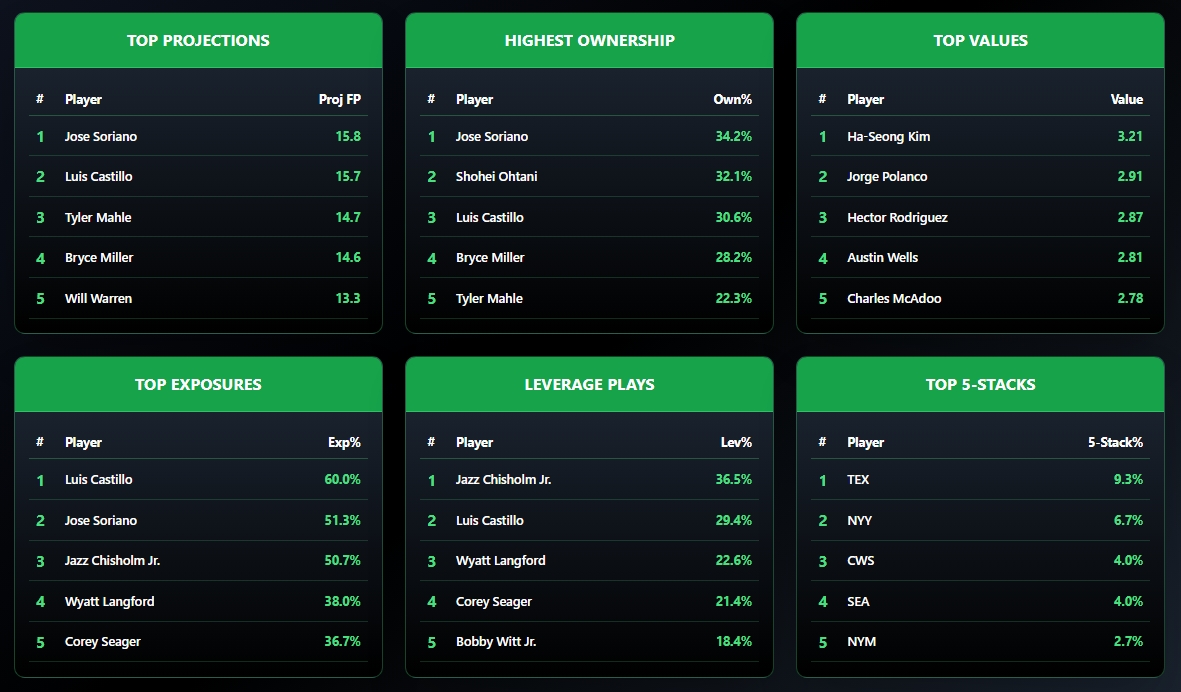
Every number here comes off today's free DraftKings MLB DFS cheat sheet. Each panel comes out of the Stokastic Sims, which simulates the slate tens of thousands of times, these exact games and these exact probables. The August 12 board:
| Panel | 1st | 2nd | 3rd | 4th | 5th |
|---|---|---|---|---|---|
| Top Projections (Proj FP) | Jose Soriano 15.8 | Luis Castillo 15.7 | Tyler Mahle 14.7 | Bryce Miller 14.6 | Will Warren 13.3 |
| Highest Ownership (Own%) | Jose Soriano 34.2% | Shohei Ohtani 32.1% | Luis Castillo 30.6% | Bryce Miller 28.2% | Tyler Mahle 22.3% |
| Top Values (Value) | Ha-Seong Kim 3.21 | Jorge Polanco 2.91 | Hector Rodriguez 2.87 | Austin Wells 2.81 | Charles McAdoo 2.78 |
| Top Exposures (Exp%) | Luis Castillo 60.0% | Jose Soriano 51.3% | Jazz Chisholm Jr. 50.7% | Wyatt Langford 38.0% | Corey Seager 36.7% |
| Leverage Plays (Lev%) | Jazz Chisholm Jr. 36.5% | Luis Castillo 29.4% | Wyatt Langford 22.6% | Corey Seager 21.4% | Bobby Witt Jr. 18.4% |
| Top 5-Stacks (5-Stack%) | TEX 9.3% | NYY 6.7% | CWS 4.0% | SEA 4.0% | NYM 2.7% |
Definitions, quickly, so the rest of this reads fast. Proj FP is a median projection in DraftKings scoring. Own% is projected field ownership. Value is projected points per $1K of salary. Top-150 exposure counts how often a player shows up in the 150 sim lineups with the best simulated ROI, Lev% is the gap between that optimal exposure and field ownership, the raw material of tournament edge. And 5-Stack% counts the five-batter team stacks the sims build most often.
The row that frames the whole night sits in the stack panel: three of those five teams (the Mets, Yankees, and Mariners) are hitting against Tyler Mahle, Bryce Miller, and Will Warren, the third, fourth, and fifth names on the projection panel. The sheet is deliberately long the arm and the opposing bats in the same games, and your only forbidden move is holding both in the same lineup.
The cheat sheet itself is free every day. Code CHEAT takes 15% off your first week or month of the paid Stokastic MLB DFS packages that generate it.
One Chalk Arm Is Also The Leverage Arm
DraftKings classic hands you two pitcher slots at 2.25 points per inning and 2 per strikeout, so the SP decision is the biggest single call on the roster before a single bat is picked. Tonight the panel splits the two chalk arms into different species. Castillo's season line, a 5.30 ERA with 1.48 homers per nine across 103.2 innings between Seattle and the White Sox, is honestly mediocre, and the Sims do not care, because the engine prices tonight, not the season: a home date with Cincinnati and rookie Rhett Lowder (5.26 ERA, 1.48 WHIP over 89 innings) opposite him. Sixty percent of the top-150 pool owns Castillo against 30.6% of the field. That 29.4-point gap is the second-biggest leverage number on the sheet, and it belongs to a pitcher — on a two-pitcher site, that is the panel handing you a structural head start, the kind of read the MLB DFS Sims guide is built around: chalk the engine endorses rather than merely tolerates.
Soriano is the other kind. The slate's ownership leader (34.2%) hosts Boston at Rogers Centre at 7:07 p.m. ET with a 3.24 ERA, 9.16 K/9, and just 0.85 homers per nine. That is a strong line with one honest wart: the 4.23 walks per nine that cap his ceiling. His 51.3% top-150 exposure endorses him, but no leverage row does: his exposure-minus-ownership gap runs about 17 points, just under the panel's cutoff. Play him for floor with a sliver of edge, not as your differentiator. Warren at 13.3 projected is the bridge if you want a third arm in the pool, with a caveat the stack panel is about to raise.
One conflict warning before we leave the arms: Hector Rodriguez, third on the value panel, is a Cincinnati bat. He is priced like a lineup screw, but he opposes Castillo directly, and a Castillo build that also rosters Reds is betting against itself.
Three Stacks Pick A Fight With The Projection Panel
Here is the collision the opening promised, and the number that resolves it. Jazz Chisholm Jr. is the No. 1 leverage play on the entire sheet at 36.5%: in 50.7% of the sims' best lineups while the field, by the panel's own arithmetic, arrives somewhere in the mid-teens. He is the Yankees' side of the 7:05 p.m. ET Bronx game, hitting against Bryce Miller, whose shiny 3.08 ERA and 0.95 WHIP sit on top of a real flaw: 13 home runs in 79 innings, a 1.48 HR/9 that Yankee Stadium (the most homer-friendly park factor on tonight's board, 114) exists to punish. Chisholm's season average is an ugly .217, but the sims are not buying the average; they are buying 13 of his 17 homers coming against right-handed pitching and 31 stolen bases on a site that pays 10 points for a homer and 5 for a steal. Austin Wells, fourth on the value panel, is the discount catcher who makes the same Yankees five-stack (6.7%) affordable.
The same building hosts the counter-argument. Seattle is the board's No. 4 stack (4.0%) against Will Warren and his 1.18 HR/9, in the identical 114 park. The engine is telling you the Bronx game is tonight's run environment and it refuses to pick a winner; you pick one per lineup and let the game decide which of your entries cashes. The third collision is quieter: the Mets at 2.7% attack Tyler Mahle, whose 4.83 season ERA and 1.25 HR/9 look nothing like the six shutout innings with nine strikeouts he threw in his Atlanta debut. Jorge Polanco, second on the value panel at 2.91, is the sheet cross-referencing itself — the cheap Met who funds that contrarian stack. Whichever side of these games you take, correlation rules apply in both directions: never the arm and the opposing bats together.
The Bronx pivot, in one line: Miller at 28.2% ownership and the Yankees stack at 6.7% cannot both be right in one lineup; the No. 1 leverage number on the sheet says the bats are the side the field is missing.
The Texas Stack Doesn't Need A Coin Flip
The board's top stack carries none of that ambiguity, which is exactly why it leads the panel. Texas at 9.3% draws George Klassen in Anaheim at 10:10 p.m. ET, and Klassen's three-start line reads like a stack invitation: a 7.27 ERA and 2.88 WHIP across just 8.2 innings, with 14.54 walks per nine, the highest walk rate of any starter in the board's six games and more than triple the next-worst mark. Walks are stack fuel; every free baserunner turns a solo homer into a crooked number. No Rangers arm appears anywhere on the projection panel, so the stack conflicts with nothing the sheet likes.
The two named Rangers tell you how the sims want it built. Wyatt Langford (38.0% exposure, 22.6% leverage) is the straightforward row: .255 with 13 homers on the season, and no platoon excuse needed, since he hits righties at .265 with an .808 OPS and 9 of those 13 homers. Corey Seager (36.7% exposure, 21.4% leverage) is the row that tests whether you trust process over results: a .192 season average against a 14.4% barrel rate, .451 xSLG, and 46% hard-hit rate. The contact quality says the average is lying, the left-handed swing gets the platoon edge on Klassen, and the sims keep drafting him anyway, fifth on the exposure panel. The fifth leverage row, Bobby Witt Jr. (18.4%), is the same logic as a one-man play: a .311 hitter against lefties (.869 OPS) drawing Eric Lauer, whose 2.15 home runs allowed per nine is the worst rate of any starter tonight's board touches. Kansas City has no stack row, so Witt is the rare leverage bat you can drop into any build without buying the whole offense.
The Value Panel Is A Salary Column, Not A Pick List
Value is points per $1K of salary, and tonight the denominator is doing almost all the talking. Read these five rows as jobs, not endorsements:
- Ha-Seong Kim (ATL), 3.21: an .067 average over 84 plate appearances. The row exists because his salary has cratered; he is the infield screw that lets a build hold Castillo plus a full Texas five. Nothing more.
- Jorge Polanco (NYM), 2.91: .137 with 2 homers this season, but the one value row that points back at a board stack (the NYM 2.7% against Mahle). Salary relief with a thesis attached.
- Hector Rodriguez (CIN), 2.87: 19 big-league plate appearances. The conflict row: he opposes Castillo, the sheet's best pitcher play. Use him only in builds that skip the chalk arm.
- Austin Wells (NYY), 2.81: .177 with 8 homers, and a .644 OPS against righties, so this is not a matchup call; it is the catcher-slot discount that makes the Yankees stack solvent.
- Charles McAdoo (TOR), 2.78: 32 plate appearances, a .172 average, 2 homers. The right-handed side of a platoon drawing lefty Ranger Suárez; if he is not in the confirmed lineup, the row evaporates.
Notice the pattern: the two usable rows, Polanco and Wells, are the cheap halves of stacks the board already recommends. That is the sheet handing you roster skeletons, and it is a distinctly DraftKings read — the two-pitcher format makes minimum-salary bats load-bearing in a way FanDuel's single-SP slate never demands.
Worked Example: Resolving The Bronx Collision
Take the sheet's loudest row, Chisholm at 36.5% leverage, and walk it to a saved lineup.
- Start with Castillo. The only pitcher with a leverage row goes in every build; his 60.0% optimal exposure says the sims want him closer to always than sometimes.
- Pick a Bronx side, once. This build takes the Yankees five: Chisholm and Wells are the panel-named core, and the remaining three bats come off the full stack order in the MLB DFS projections, ownership and stacks in the DataHub, kept adjacent in the batting order. Five is the DraftKings cap, so that is the primary stack done, and it locks Bryce Miller out of this lineup permanently.
- Fill SP2 by what the stack left behind. A Yankees five pairs fine with Will Warren, their own arm; the conflict rule only bars the opposing pitcher, and Miller already left in step 2. Take the Seattle five instead and the exclusions flip: Warren is out, Miller is back in play. Either way, Soriano is the clean, well-owned floor play, and Mahle works too, but only in builds that skip the Mets mini.
- Spend the savings on a Texas mini. Langford plus Seager as a two-man correlation against Klassen's walks. The callback is the point: the same free-baserunner chaos that makes the five-stack the board's No. 1 gives even a two-man cut of it real correlated upside.
- Recheck confirmed lineups before 7:05 p.m. ET. Wells and McAdoo are platoon-profile bats and Kim is a bench-priced infielder; one scratch deletes a value row. The confirmed batting order outranks everything on this page, including me.
What separates this from guesswork is the machinery underneath. The Stokastic Sims play tonight's slate tens of thousands of times with correlation intact: when Chisholm homers in a sim, the model already knows what that run environment did for the hitters due up behind him. Stokastic's Ownership Projections feed that engine as a distribution rather than a single number, the top-150 pool ranks the survivors by simulated ROI, and Boom/Bust splits the ceiling plays from the floor plays, which is how a .192 hitter and a .217 hitter end up as two of the five biggest edges on the board. The projection methodology guide covers the difference in full. The cheat sheet stays free; CHEAT takes 15% off your first week or month of the packages that build it.
More on this: MLB DFS Hub: Every Live Stokastic MLB Page · DraftKings MLB DFS Cheat Sheet: Projections, Ownership & Stacks For August 3 · FanDuel MLB DFS Cheat Sheet: Projections, Ownership & Stacks · DraftKings NFL DFS Cheat Sheet: Week 1 Picks And Stacks · DraftKings PGA DFS Cheat Sheet: Sims, Projections And Ownership
Where I Land On The August 12 Slate
Tonight's sheet argues one idea six different ways: agreement is optional, structure is not. It puts three arms in its own top five — and stacks against them anyway, because a two-pitcher site pays whoever holds the right half of a coin flip, not whoever avoids the flip. So my builds start with the one row that requires no flip at all, Castillo at 29.4% leverage, put the Texas stack against the slate's wildest arm next to him, and spread the Bronx collision across entries: Yankees five in some, Mariners five in others, never both, never with the opposing arm. Ohtani sits tonight, and that will feel terrible exactly once if he homers off a lefty who almost never allows one. The failure mode is just as symmetric: if Klassen suddenly finds the strike zone and Miller keeps the ball in the yard despite the 114 park, the field's simpler chalk builds beat mine. Leverage is the price of being right alone, and tonight the sheet is unusually explicit about where to pay it. You must be 18+ to play (19+ or 21+ where your state requires it). Play responsibly. This page covers August 12 only; tomorrow's slate prints a new board and will earn its own read.