
DraftKings MLB DFS Cheat Sheet For August 5: Projections, Ownership, And Stacks
By Sam Smith
August 5, 2026

Wednesday, August 5 is a seven-game DraftKings MLB main slate with a 7:05 PM ET first pitch, and today's free MLB DFS cheat sheet from Stokastic has a strange shape: four of the five arms on its projections panel are packed into just two games. Paul Skenes and Kyle Harrison, first and second in projections, face each other in Milwaukee. Sean Burke and Sonny Gray, fourth and fifth, face each other at Fenway. When the pitcher chalk is that concentrated, the arms stop being where lineups separate, and the board says the separation lives with the bats instead: Bobby Witt Jr. owns the biggest leverage number on the sheet at 31.6%, and the five stack rows sit within four points of each other. I will read the board top to bottom, resolve the head-to-head pitcher problem DraftKings forces tonight, and finish by turning Witt's row into an actual entry for the August 5 slate.

Paul Skenes — one of the featured players on today's slate.
The Quick Answer
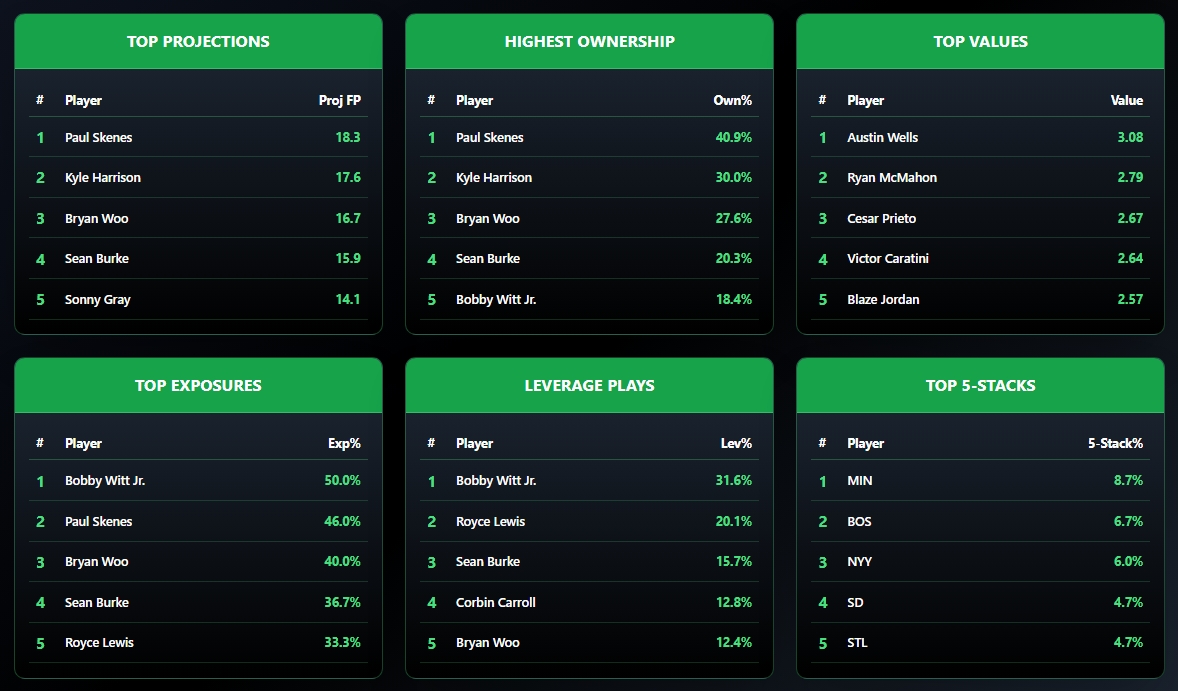
Play Paul Skenes, even at 40.9% ownership, and get Bobby Witt Jr. into everything you can. Skenes leads the projections panel at 18.3 and carries a 30.5% strikeout rate into Milwaukee, while Witt is the board's loudest disagreement with the field: the Sims put him in 50.0% of their 150 best lineups against just 18.4% projected ownership, and he draws Dean Kremer, whose 3.00 HR/9 is the worst number attached to any starter on the slate. The stack answer is Minnesota at 8.7%, but tonight's panel is flat enough that the second through fifth stacks are all live. The full board, the two-pitcher call, and a step-by-step Witt build are below.
Today's Board: Chalk Arms In Two Parks, One Bat Above The Field
Here is the top of each panel on today's sheet, straight from the free page:
| Panel | 1st | 2nd | 3rd | 4th | 5th |
|---|---|---|---|---|---|
| Top Projections (Proj FP) | Paul Skenes 18.3 | Kyle Harrison 17.6 | Bryan Woo 16.7 | Sean Burke 15.9 | Sonny Gray 14.1 |
| Highest Ownership (Own%) | Paul Skenes 40.9% | Kyle Harrison 30.0% | Bryan Woo 27.6% | Sean Burke 20.3% | Bobby Witt Jr. 18.4% |
| Top Values (Value) | Austin Wells 3.08 | Ryan McMahon 2.79 | Cesar Prieto 2.67 | Victor Caratini 2.64 | Blaze Jordan 2.57 |
| Top Exposures (Exp%) | Bobby Witt Jr. 50.0% | Paul Skenes 46.0% | Bryan Woo 40.0% | Sean Burke 36.7% | Royce Lewis 33.3% |
| Leverage Plays (Lev%) | Bobby Witt Jr. 31.6% | Royce Lewis 20.1% | Sean Burke 15.7% | Corbin Carroll 12.8% | Bryan Woo 12.4% |
| Top 5-Stacks (5-Stack%) | MIN 8.7% | BOS 6.7% | NYY 6.0% | SD 4.7% | STL 4.7% |
The short decoder, because tonight is about the picks: Proj FP is median projected DraftKings fantasy points, Own% is projected field ownership, Value is projected points per $1K of salary, top-150 exposure is how often a player appears in the 150 highest sim-ROI lineups, and Lev% is the gap between how often the Sims want a player and how often the field will roster him. That gap is the tournament edge, and the tournament strategy guide explains why it matters more than raw projection.
Witt's row is the one worth sitting with, because the math is printed right on the sheet: 50.0% top-150 exposure minus 18.4% projected ownership is his 31.6% leverage, first in the leverage panel and more than 11 points clear of the next bat. The only hitter the field is treating as chalk tonight is also the hitter the Sims want most. That does not happen often, and it is the thesis of this slate.
Two Pitcher Slots, Four Chalk Arms, Two Games
DraftKings rosters two pitchers, so pitching carries roughly double the build weight it does on one-pitcher sites, and tonight that math comes with a wrinkle: the top of the projections panel keeps pairing arms who face each other. Skenes takes the ball for Pittsburgh in Milwaukee against Harrison, who has quietly been the better run preventer this year, a 3.01 ERA and 29.6% strikeout rate to Skenes' 3.90 and 30.5%. Burke starts for the White Sox at Fenway against Gray, and that duel is just as tight on season numbers, Burke at a 3.04 ERA with a 27.7% strikeout rate, Gray at 2.93 with less swing-and-miss. You can legally roster both arms from one game on DraftKings, but only one of them can collect the 4-point win bonus, which is why I treat Skenes-Harrison and Burke-Gray as either-or choices, not pairings. The DraftKings and FanDuel differences matter here: on a one-pitcher site tonight's board is a single pick; on DraftKings it is a routing problem.
The router the board itself suggests is Bryan Woo, the one top-five arm who does not share a game with another one. Woo starts at home for Seattle against Detroit at 9:40 PM ET, sits third in projections at 16.7, and his leverage row reconciles on the sheet the same way Witt's does: 40.0% top-150 exposure minus 27.6% ownership is his 12.4%. Pairing Skenes with Woo takes the best projection and the cleanest structural fit and skips the win-bonus conflict entirely. In tournaments, Burke at 20.3% ownership, roughly half of Skenes' 40.9%, is the pivot the leverage panel endorses, third in leverage at 15.7%.
A Flat Stack Panel Means A Wide-Open Hitting Night
DraftKings caps you at five hitters from one team, which is why this sheet surfaces 5-stacks, and five correlated bats remains the classic DraftKings tournament shape, with the correlation math doing the ceiling-raising. What is different tonight is how little the panel commits. Minnesota leads at 8.7%, Boston sits second at 6.7%, and the gap from first to fifth is four points. Compare that with a runaway-stack night and the message is clear: the Sims see no Coors-style hammer on this slate, so stack choice is a real decision instead of a default.
The case for the Twins at the top is the matchup. Minnesota visits Kansas City and draws Noah Cameron, who has run a 4.59 ERA with a 1.34 WHIP and a modest 21.4% strikeout rate, plenty of baserunners and balls in play for a stack to feed on. Royce Lewis, second in the leverage panel at 20.1% and fifth in top-150 exposure at 33.3%, is the board-named Twin with the power to cash the stack's ceiling; he has 12 home runs and a .186 ISO this season. Victor Caratini, fourth in value at 2.64, is the cheap catcher route into the same lineup. Boston at 6.7% carries the board's one honest tension: the Red Sox bats rate second on the stack panel while their opponent, Sean Burke, rates fourth in projections. The Sims are allowed to like both sides of a game, that is what a distribution of outcomes means, but you are not: a lineup that starts Burke should not also stack Boston against him.
The Value Panel Lives In The Bronx
Four of the five value rows come from one game, Cardinals at Yankees, and that is not a coincidence; it is the sheet quietly telling you where the cheap bats that fund the pitcher chalk live. Austin Wells, first in value at 3.08, and Ryan McMahon, second at 2.79, are both Yankees facing Andre Pallante, who strikes out just 17.3% of the hitters he faces, a contact profile that keeps balls in play all night. They are also the discount doors into the Yankees' 6.0% stack row. Going the other way, Cesar Prieto at 2.67 and Blaze Jordan at 2.57 are Cardinals facing Will Warren, whose 1.24 HR/9 and 1.36 WHIP explain why St. Louis holds a stack row at 4.7% at Yankee Stadium. One honesty note the board cannot print: Prieto has all of six big-league games this season, so his value number is about salary, not track record. He is a fine last-slot punt inside a Cardinals stack and a bad reason to feel safe. The full projections behind every one of these rows, including the names the top-five panels cut off, live in the MLB DFS projections, ownership and stacks in the DataHub.
San Diego's 4.7% stack row is the panel's quietest line and its most matchup-driven: the Padres draw Mitch Bratt in Arizona, a starter walking 15.3% of hitters with a 1.84 WHIP over 20.2 innings this season. No Padre cracks a top-five panel, so the sheet is pointing at the team, not a bat, and the full tables are where you pick the five.
Worked Example: Witt's Row Into A DraftKings Build
Now the promised walk-through, one row into a real entry. Witt's full line tonight: fifth in ownership at 18.4%, first in top-150 exposure at 50.0%, first in leverage at 31.6%. He faces Dean Kremer, who has allowed 12 home runs in 36 innings this year, a 3.00 HR/9 no other arm on tonight's slate comes close to, and Witt's own season line, a .283 average with 13 homers and 30 steals, is exactly the profile DraftKings scoring overpays: steals are worth 5 points, singles 3, and he collects both. Here is the build, decision by decision:
- Lock Witt first, then choose his context. He is a Royal, and Kansas City has no stack row, so Witt goes in as a one-off or as the anchor of a mini-stack. The clean version: Witt plus one or two Royals teammates from the full projections as a secondary stack behind a five-man core.
- Set the pitcher pairing around the Kansas City game. Witt hitting against Kremer does not conflict with any board arm. Skenes plus Woo is my cash pairing, best projection plus the only conflict-free chalk arm. In tournaments, swap Skenes down to Burke at 20.3% ownership and bank the leverage.
- Pick the primary stack the Witt build allows. Minnesota at 8.7% is the board's answer, and Lewis at 20.1% leverage is its engine. The spicy detail: a Twins 5-stack and Witt oppose each other in the same game, and that is a feature, not a bug, since a high-scoring night in Kansas City feeds both.
- Fund it from the Bronx. Wells at 3.08 and McMahon at 2.79 are the value column's two loudest rows, and both fit any build that is not stacking St. Louis. Caratini at 2.64 is the swap-in when you need the cheaper catcher inside the Minnesota stack itself.
- Save one tournament bullet for Corbin Carroll. Fourth in leverage at 12.8%, he owns the best power number on the board, a .227 ISO with 16 home runs, but draws the toughest arm, Casey Mize at a 2.70 ERA and 0.52 HR/9. That is a ceiling-only play, sized accordingly, and if lineup news moves after lock, the late swap guide covers how to react without breaking correlation.
Every number in that build comes out of the same engine. The Stokastic Sims play the slate tens of thousands of times with correlation intact, so a Twins rally and a Witt homer in the same game score together the way they would in the real park. Stokastic's Ownership Projections run through the engine as a distribution rather than a single guess, which is how a leverage panel can exist at all. The resulting lineup pool is ranked by simulated ROI, the top 150 become the exposure panel you read above, and the Boom/Bust tables show each player's full outcome range instead of one median number. The MLB DFS Sims guide walks through the whole pipeline. The cheat sheet itself is free every day, and no code discounts it, because there is nothing to discount. Code CHEAT takes 15% off your first week or month of the paid Stokastic MLB DFS packages behind it, where the complete projections, Ownership Projections, Boom/Bust tables and the Sims themselves live.
More on this: DraftKings MLB DFS Cheat Sheet: Projections, Ownership & Stacks For August 3 · FanDuel MLB DFS Cheat Sheet: Projections, Ownership & Stacks · DraftKings NFL DFS Cheat Sheet: Week 1 Picks And Stacks · DraftKings PGA DFS Cheat Sheet: Sims, Projections And Ownership · DraftKings MMA DFS Cheat Sheet: Sims, Projections And Ownership
Where My Entries Land Tonight
Tonight's sheet is a compressed pitcher board and an open hitting board, and the split should say so. Most of my entries start Skenes and Woo with Witt anchored in front of a Minnesota core, the five-decision build above. A real minority pivot the second pitcher slot to Burke and let the Boston tension resolve the other way, no Red Sox bats in those builds. And the last tranche is the flat-panel play: a Yankees stack out of the value column, Witt still in the middle, Carroll as the ceiling bat. The board's one real signal is the gap between the field and the Sims, and tonight that gap has a name on it, Bobby Witt Jr. at 31.6%. You must be 21+ to play. Tomorrow's board will say something different, and it should.
When you want the full lineup pool behind tonight's panels instead of the top-five skim, the paid layer is where the Sims live, and the discount applies to your first week or month.
Stokastic MLB DFS packages, code CHEAT for 15% off your first week or month
Use code CHEAT
Get Started