
DraftKings MLB DFS Cheat Sheet For August 9: Projections, Ownership, And Stacks
By Sam Smith
August 9, 2026

Sunday, August 9 brings an afternoon MLB board, and today's free DraftKings MLB DFS cheat sheet from Stokastic opens with a number you will not see many times a season: Jacob Misiorowski projects for 24.0 DraftKings points, more than five clear of the next arm, at 49.9% projected ownership. Half the field on one pitcher usually screams fade, and this board says the opposite. Misiorowski sits at 72.7% top-150 exposure and still shows up third on the leverage panel at 22.1%, which means the Sims want him more often than even a 50% field will play him. So the first pitcher slot is all but decided, and the real tournament questions move to the bats, where the board gets downright strange: the top stack is built around a hitter batting .202, and the second stack row attacks a starter carrying a 1.16 ERA. I will read the whole sheet, route the second pitcher slot, and close by turning Jarren Duran's leverage row into a real DraftKings entry for this afternoon.

Jacob Misiorowski — one of the featured players on today's slate.
The Quick Answer
Start Jacob Misiorowski despite the 49.9% ownership, play Cam Schlittler as the tournament version of the second slot, and build bats around Boston's 19.3% stack with Jarren Duran and Caleb Durbin. Duran leads the leverage panel at 24.2% because his .202 average scares the field off a 16-homer, 17-steal season, and the Red Sox draw J.T. Ginn, who has walked 51 hitters in 115⅓ innings. The other bat argument is one ballpark: the board stacks the Cubs at 16.7% against Randy Dobnak's four-start 1.16 ERA while playing Bobby Witt Jr. and Salvador Perez as one-offs from the other dugout. The full board, the pitcher routing, and the step-by-step Duran build are below.
Today's Board: The Chalk Is Right And The Bats Are Wide Open
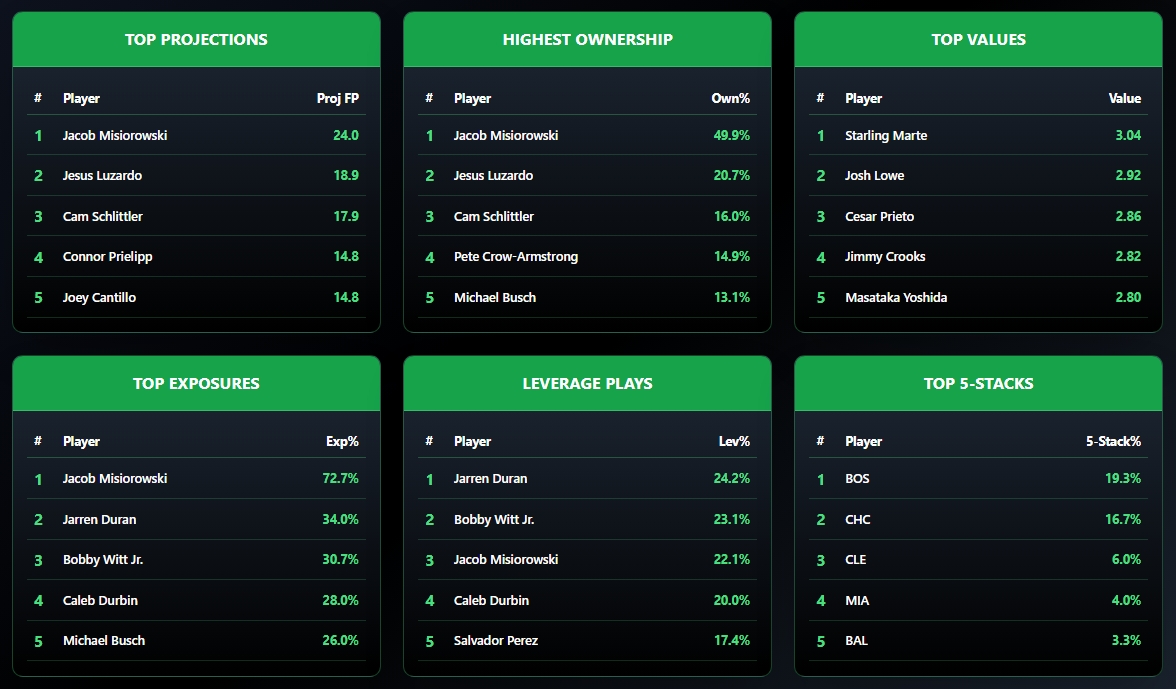
Here is the top of each panel on today's sheet, straight from the free page:
| Panel | 1st | 2nd | 3rd | 4th | 5th |
|---|---|---|---|---|---|
| Top Projections (Proj FP) | Jacob Misiorowski 24.0 | Jesus Luzardo 18.9 | Cam Schlittler 17.9 | Connor Prielipp 14.8 | Joey Cantillo 14.8 |
| Highest Ownership (Own%) | Jacob Misiorowski 49.9% | Jesus Luzardo 20.7% | Cam Schlittler 16.0% | Pete Crow-Armstrong 14.9% | Michael Busch 13.1% |
| Top Values (Value) | Starling Marte 3.04 | Josh Lowe 2.92 | Cesar Prieto 2.86 | Jimmy Crooks 2.82 | Masataka Yoshida 2.80 |
| Top Exposures (Exp%) | Jacob Misiorowski 72.7% | Jarren Duran 34.0% | Bobby Witt Jr. 30.7% | Caleb Durbin 28.0% | Michael Busch 26.0% |
| Leverage Plays (Lev%) | Jarren Duran 24.2% | Bobby Witt Jr. 23.1% | Jacob Misiorowski 22.1% | Caleb Durbin 20.0% | Salvador Perez 17.4% |
| Top 5-Stacks (5-Stack%) | BOS 19.3% | CHC 16.7% | CLE 6.0% | MIA 4.0% | BAL 3.3% |
The quick decoder before the picks: Proj FP is median projected DraftKings fantasy points, Own% is projected field ownership, Value is projected points per $1K of salary, top-150 exposure is how often a player appears in the 150 highest sim-ROI lineups, and Lev% is roughly the gap between how often the Sims roster a player and how often the field will. That gap is the whole reason to read past the first panel, and the tournament strategy guide covers why it matters more than raw projection.
The loudest row today sits at the bottom of the ownership panel: Pete Crow-Armstrong at 14.9% and Michael Busch at 13.1% are the only bats that crack it, and both are Cubs. The Sims agree with the field's read on that game and disagree about everything else, which sets up the entire bat section below.
Half The Field Is On One Pitcher, And The Sims Say That Is Still Short
DraftKings rosters two pitchers, so a slate-breaking arm does not just anchor your build, it anchors half your salary decisions, and Misiorowski is that arm. The Brewers right-hander hosts Minnesota carrying a 1.63 ERA, a 0.73 WHIP and 195 strikeouts in 127 innings, a 13.82 K/9 that DraftKings scoring pays at 2 points per punchout before the 4-point win bonus even enters it. When a pitcher this dominant projects five-plus points clear of the slate, 49.9% ownership is not an overreaction, it is the market catching up. The leverage panel's 22.1% row is the sheet saying the catch-up is not finished. Be honest about what half-owned chalk buys, though: you are neutral against the half of the field that has him, and you swing hard in both directions against the half that does not, losing that swing outright on his bad days. The Sims' answer, printed right there in the exposure column, is that his good days come often enough to take that trade. In cash games he is the clear default.
The second slot is the actual choice, and the board frames it as Jesus Luzardo against Cam Schlittler. Luzardo projects higher at 18.9 and starts at home for the Phillies against Toronto, with a 10.80 K/9 behind a 3.36 ERA. Schlittler projects a point lower at 17.9 for the Yankees against Atlanta, and his season line is the better one: a 2.26 ERA, a 0.95 WHIP and 171 strikeouts in 139⅔ innings. The ownership panel splits them 20.7% to 16.0%, so the field is paying for Luzardo's projection while the sharper ratios go slightly cheaper. My routing: Misiorowski in nearly every build, Schlittler as the tournament pairing, Luzardo in cash builds where the extra point of projection is the whole argument. On DraftKings, unlike FanDuel, you get to make both calls in one lineup.
The tie at the bottom of the projections panel resolves on details. Connor Prielipp and Joey Cantillo both project 14.8, neither cracks the ownership panel, and both come with warts: Prielipp carries a 4.75 ERA into the hardest assignment on the board, because he is the Twins arm starting opposite Misiorowski in Milwaukee, while Cantillo takes a 3.87 ERA and 56 walks to the South Side against the White Sox. If you need a discount arm, Cantillo's matchup is the softer landing, and he pairs legally with the Cleveland stack row below since pitchers do not count against DraftKings' five-batter team cap.
A Top Stack Built On A .202 Average, And A Stack Row That Calls Out A 1.16 ERA
Boston at 19.3% is today's top stack, and its engine is the most counterintuitive row on the sheet. Jarren Duran leads the leverage panel at 24.2% and sits second in top-150 exposure at 34.0%, all while hitting .202 on the season. The average is exactly why the leverage exists: the field sees .202 and moves on, the Sims see 16 home runs, 17 steals and a Fenway date with J.T. Ginn, whose 3.51 ERA is perfectly respectable while his profile is the problem: 51 walks in 115⅓ innings, a walk rate near four per nine, with a league-average 8.19 strikeouts per nine behind it, not enough swing-and-miss to erase that much traffic. DraftKings pays 5 points per stolen base and 3 per single, so a Duran who reaches twice can outscore a Duran who bats .300 quietly. Caleb Durbin, fourth in leverage at 20.0% and fourth in exposure at 28.0%, gives the stack a second board-named bat with a .251 average, 11 homers and 14 steals, and Masataka Yoshida closes the loop from the value panel at 2.80, a .273 contact bat with only 28 strikeouts in 272 plate appearances. Three of the sheet's rows point at the same Fenway lineup. That is a correlation argument written in three different panels.
The Cubs row makes a bolder argument. Chicago at 16.7% visits Kansas City to face Randy Dobnak, whose 1.16 ERA across four starts looks like a stay-away until you read the process: 15 strikeouts against 13 walks in 31 innings, a 4.35 K/9 that says the run prevention is living well ahead of the skill underneath it. The Sims attack the profile rather than the ERA, and the field is already halfway there, since Crow-Armstrong, hitting .287 with 26 homers and 30 steals, and Busch, at .244 with 14 homers, are the ownership panel's only two bats. The twist is what the sheet does with the other dugout. There is no Royals stack row, but Bobby Witt Jr. is second in leverage at 23.1% and third in exposure at 30.7% against Cubs starter Matthew Boyd, with Salvador Perez fifth in leverage at 17.4% and Starling Marte topping the value panel at 3.04. My read of those panels together: the board makes a case for both sides of the same ballpark, stacking the Cubs while one-offing the Royals, and letting a high-scoring afternoon at Kauffman pay the whole position player pool.
The bottom three stack rows are matchup bets at a discount, and only one of them earns a place in my pool. Miami's 4.0% gets Grayson Rodriguez, now an Angel, whose 7.24 ERA and 1.59 home runs per nine sit next to Lorenzen's line as the two most attackable starter profiles on the slate; at 4.0%, that is the pivot I would take off the Boston chalk in large-field tournaments, built from the full projections since no Marlin cracked a board panel. Cleveland's 6.0% against Davis Martin and his 4.13 ERA is worth keeping only as the row that pairs with Cantillo, and Baltimore's 3.3% against Kumar Rocker's 4.08 ERA is a pass for me, the thinnest matchup case of the three.
Five Value Rows, Two Of Them Needing An Honesty Check
Two of today's five value rows are a referendum on one pitcher. Cesar Prieto at 2.86 and Jimmy Crooks at 2.82 are both Cardinals, and their case is entirely Michael Lorenzen, the Rockies starter visiting St. Louis with a 6.94 ERA, a 1.85 WHIP and 17 home runs allowed in 107⅔ innings. The honest reading: Prieto is 0-for-23 this season, and Crooks is batting .190 in 110 plate appearances. Those value numbers are about salary and matchup, not track record, so treat them as one-per-lineup fill against Lorenzen and never as the reason a lineup exists. Marte's 3.04, the panel's top row, is the trustworthy version of the same logic, a .250 veteran bat in the same Royals lineup the leverage panel already likes, priced down after just 154 plate appearances this season. Josh Lowe at 2.92 is the row I pass on: he is hitting .202 for the Angels with eight homers and four steals in 224 plate appearances, nothing like Duran's power-speed case, in the Miami game the sheet would rather attack from the Marlins side. Yoshida at 2.80 was covered above, and he is the only value row that doubles as a stack piece. The names below the top-five cutoff, and the full board behind every panel here, live with the MLB DFS projections, ownership and stacks in the DataHub.
Worked Example: Duran's Leverage Row Into A DraftKings Entry
The promised build, one row at a time. Duran's full line today: first in leverage at 24.2%, second in top-150 exposure at 34.0%, and no appearance on the ownership panel, meaning the field's chalk bats are in a different city. One housekeeping note before the steps: every bat named below was on an active roster as of this morning with none on the injured list, but Sunday lineups post close to first pitch, so confirm each one is actually starting before your contests lock. Here is how that becomes a lineup:
- Anchor the Boston five-stack. Duran, Durbin and Yoshida are all board-named, covering the leverage, exposure and value panels at once; the last two spots come from the full projections. The 19.3% stack row is the highest conviction number the Sims printed on any team today.
- Start Misiorowski and remember the callback. His 22.1% leverage row means the biggest chalk on the board still carries an edge. Milwaukee against the Twins does not conflict with a single bat in this build.
- Route the second slot by contest. Schlittler at 16.0% ownership with the 0.95 WHIP is the tournament arm; swap to Luzardo in cash, where his 18.9 projection is the point and ownership is irrelevant.
- Fill the last three bats from the Kauffman one-offs. Witt at 23.1% leverage, Perez at 17.4% and Marte from the top of the value panel give the build three Royals, a five-plus-three split that fits under DraftKings' five-batter team cap as long as the positions cooperate, so let eligibility decide which two full-projection bats round out the Boston side. The honest matchup note: Cubs starter Matthew Boyd's 3.59 ERA is a solid line, so this trio is not a matchup attack. It is a bet on Witt's matchup-proof steal equity, 31 bags at 5 points apiece, and on a Kauffman game the field is only playing from the Cubs side.
- Keep the Cardinals rows as the salary valve. When the build pinches, Crooks or Prieto swaps in against Lorenzen's 6.94 ERA as the cheap piece, one per lineup at most, and if lineup news moves before the early-afternoon locks, the late swap guide covers adjusting without unwinding the stack.
The board numbers in that build all come out of the same engine, with the season stats above supplying the why behind each row. The Stokastic Sims play the slate tens of thousands of times with correlation intact, so a Fenway rally scores Duran and Durbin together the way Ginn's walks would produce it in the real game. Stokastic's Ownership Projections run as a distribution rather than a single guess, and the leverage arithmetic on top of them is simple: the Sims roster Misiorowski in 72.7% of their best lineups against a field that will play him at 49.9%. The lineup pool is ranked by simulated ROI, the top 150 of those lineups become the exposure panel, and the Boom/Bust tables show each player's full range of outcomes instead of one median. The MLB DFS Sims guide walks through the pipeline end to end. The cheat sheet itself is free every day, and no code touches it. CHEAT takes 15% off your first week or month of the paid Stokastic MLB DFS packages behind it, where the complete projections, Ownership Projections, Boom/Bust tables and the Sims themselves live.
More on this: DraftKings MLB DFS Cheat Sheet: Projections, Ownership & Stacks For August 3 · FanDuel MLB DFS Cheat Sheet: Projections, Ownership & Stacks · DraftKings NFL DFS Cheat Sheet: Week 1 Picks And Stacks · DraftKings PGA DFS Cheat Sheet: Sims, Projections And Ownership · DraftKings MMA DFS Cheat Sheet: Sims, Projections And Ownership
Where My Entries Land This Afternoon
Today's sheet made one loud claim and one strange one, and my entry pool follows both. Most of my lineups start Misiorowski with Schlittler behind him and the Boston core in front, the five-step build above, with Witt and Perez working the Kauffman game from the quiet side. A second tranche swaps into the Cubs stack against Dobnak's borrowed ERA and lets Crow-Armstrong carry the ceiling. The portfolio rule underneath all of it: one concentrated stack per entry, at least three of Duran, Durbin and Yoshida whenever I am in the Boston version, and a Witt or Perez bring-back whenever I am in the Cubs version, never scattered one-offs. And my cash builds take Luzardo's projection over Schlittler's ratios while keeping everything else intact. The number that decided the day was never the 24.0 projection; it was the 22.1% leverage row underneath it, the board telling you that this time, half the field is not too many. The split to carry to lock: eat the Misiorowski chalk, get different with the Boston and Kauffman bats, and never let the cheap Cardinals become the reason a lineup exists. You must be 21+ to play.
When you want the full lineup pool behind today's panels instead of the top-five skim, the paid layer is where the Sims live, and the discount applies to your first week or month.