
AFC North Odds: The Right Favorite At The Wrong Price
By Jake Hari
August 12, 2026 · Updated August 22, 2026
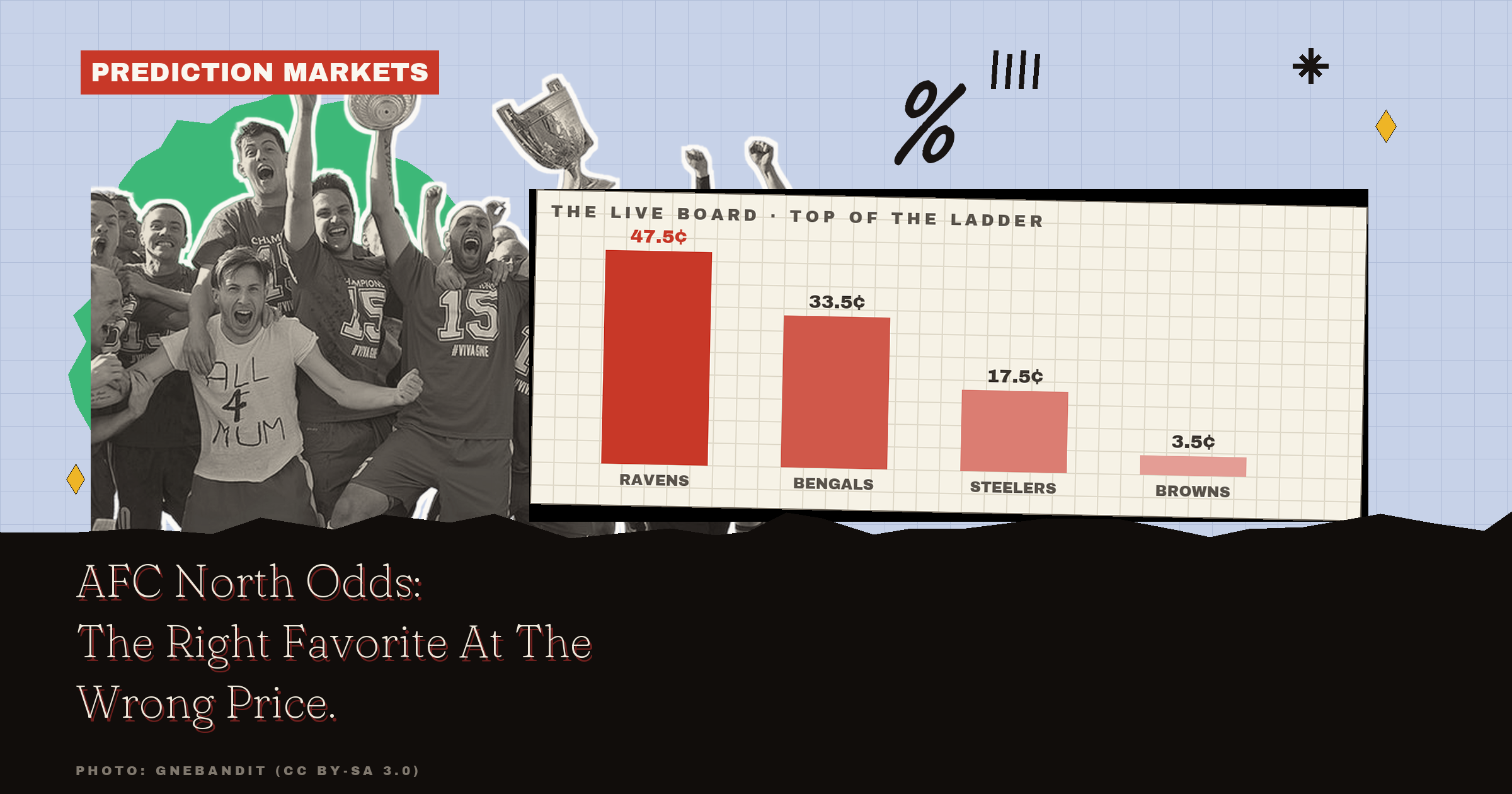
The AFC North odds on Kalshi describe a division the standings page does not. Pittsburgh won this thing at 10-7 last season, and the market has already benched them: the Steelers trade third at 19.5 cents, behind a Baltimore team that went 8-9 and a Cincinnati team that went 6-11. We handed all four teams to eight AI models without letting any of them see a price. Every one came back with Baltimore first, which is where the market has it too. Then every one of the eight priced Baltimore below what the market is paying, and every one of the eight put more than double the market's price on the team trading at four cents.
The Quick Answer
AFC North odds on Kalshi price Baltimore at 44.5 cents, Cincinnati at 33.5, Pittsburgh at 19.5 and Cleveland at 4, as of August 22, 2026. An eight-model panel scored the same four teams price-blind and agreed on the order, but not the shape: Baltimore 38.5%, Cincinnati 30%, Pittsburgh 22%, Cleveland 10%. The panel's tightest agreement of all sits on the market's cheapest contract, and the reason is a number the 2025 standings hide.
New to event contracts? How to trade NFL on Kalshi covers how these contracts price and settle before you read a board like this one.
The Market
Kalshi's AFC North event (KXNFLAFCNORTH-27) lists the division's four teams as four separate yes-or-no contracts. The settlement language is one sentence with the team name swapped. Baltimore's reads: "If Baltimore wins the Pro Football AFC North Division, then the market resolves to Yes." Kalshi names the league itself as the settlement source.
Two features of that rule matter for pricing. It settles on the division title rather than on record, so if two teams finish level the NFL's published tiebreaker sequence decides it: head-to-head first, then division record, then common games, then conference record. And exactly one team is named champion every season, so unlike some championship boards there is no split payout. These four contracts describe one winner.
It is also not a playoff market, and this division proved the point in the other direction last season. Pittsburgh won the AFC North at 10-7, and no other team in the division reached the postseason at all. A division title here is the only thing that pays.
The four contracts have traded about 512,700 contracts between them, the deepest of the four AFC division markets on the exchange: the AFC West board has traded roughly 339,100, the AFC East 174,500 and the AFC South 165,200. Contracts close early once a champion is declared, and the exchange lists an expected expiration of January 11, 2027.
Prices below are the midpoint of the live bid and ask as of August 22, 2026, and the panel's numbers were generated the same day. Prices and panel numbers on this page are re-scored when the story moves, and the dated stamp changes with them.
The Board
The AI blend is the median of eight independent models after a revision round in which each read the others' reasoning.
| Team | 2025 record and point differential | Kalshi | AI blend |
|---|---|---|---|
| Baltimore Ravens | 8-9, +26 | 44.5¢ | 38.5% |
| Cincinnati Bengals | 6-11, -78 | 33.5¢ | 30.0% |
| Pittsburgh Steelers | 10-7, +10 | 19.5¢ | 22.0% |
| Cleveland Browns | 5-12, -100 | 4.0¢ | 10.0% |
How To Read This Board
A price in cents is roughly the market's implied probability. Baltimore at 44.5¢ means traders collectively give the Ravens about a 44.5 percent chance, close to +125 at a sportsbook, and a contract that resolves yes pays $1. Cincinnati at 33.5¢ is about +199, Pittsburgh at 19.5¢ about +413, Cleveland at 4¢ about +2400.
Because the NFL always names one champion, the four contracts cover every outcome between them. They are still four separately quoted markets, so the midpoints need not total exactly 100. Here they sum to 101.5 cents. Three of the four sit inside a one-cent spread; Cleveland's two-cent spread, three to five, is the widest on the board and the caveat that rides with its number below.
The blend column is a median of eight independent estimates rather than a single distribution, so it also need not total exactly 100. It sums to 100.5.
More live boards from the same panel: NFC East, where Philadelphia leads at 40.5¢ and Dallas sits 3 cents back · AFC Championship 2027, where Buffalo leads at 15.5¢ and Baltimore, this division's favorite, trades second at 12.5¢ · AFC West, where Kansas City leads at 34.5¢ and last season's 14-3 champion trades second at 32.5¢. Prices fetched August 22, 2026.
Every Seat's Number
The full per-model board, after the revision round. On a phone this table scrolls sideways; the board above carries the headline numbers.
| Team | ChatGPT | Gemini | Claude Fable | Claude Opus | Claude Sonnet | GLM | Kimi | DeepSeek |
|---|---|---|---|---|---|---|---|---|
| Baltimore Ravens | 40.0% | 41.0% | 39.0% | 38.0% | 38.0% | 40.0% | 38.0% | 38.0% |
| Cincinnati Bengals | 31.0% | 30.0% | 30.0% | 27.0% | 27.0% | 28.0% | 30.0% | 34.0% |
| Pittsburgh Steelers | 20.0% | 20.0% | 22.0% | 25.0% | 25.0% | 22.0% | 22.0% | 18.0% |
| Cleveland Browns | 9.0% | 9.0% | 9.0% | 10.0% | 10.0% | 10.0% | 10.0% | 10.0% |
Read the bottom row first. Eight models built eight separate views of this division and landed on Cleveland between 9 and 10 percent, a one-point spread, the tightest agreement anywhere on the board. The market has the Browns at 4 cents. The panel's widest disagreement is a seven-point spread, and it happens twice: on Cincinnati, where DeepSeek sits at 34 and the two Claude seats at 27, and on Pittsburgh, where DeepSeek is at 18 and those same two Claude seats at 25.
Every seat on this panel is graded against real market settlements — records to date: Claude Fable 82% on 576 graded calls · Claude Opus 83% on 646 graded calls · Claude Sonnet 82% on 624 graded calls · GPT 84% on 5,658 graded calls · Gemini 86% on 4,423 graded calls · GLM 81% on 2,437 graded calls · Kimi 82% on 2,414 graded calls · DeepSeek 80% on 2,462 graded calls. Recomputed daily; the full scoreboard is public.
Model estimates generated August 22, 2026, price-blind from live fetched data. Models are frequently wrong; the market price reflects real traders' money.
Every number in this piece gets graded in public once the market settles. The running tally lives on the full graded scoreboard. All eight seats returned a board for this market.
Hottest Prediction Markets Right Now
- 2028 Democratic presidential nominee · $188M traded
- 2027 Pro Football Champion · $69M traded
- 2028 U.S. Presidential Election winner? · $61M traded
- 2028 Republican presidential nominee · $59M traded
- Pro Baseball Champion · $58M traded
- Bitcoin price at the end of 2026 · $32M traded
Every market above links to our full AI model verdict; browse them all on the Stokastic prediction markets hub, and see how every settled call actually scored on the full graded scoreboard.
The One Number The 2025 Standings Hide
Before any team-by-team read, the fact every seat built its board on. The 2025 AFC North standings are not a table of how good these teams were. They are a table of who had a quarterback.
Aaron Rodgers played 16 of Pittsburgh's 17 games. Lamar Jackson played 13 of Baltimore's. Joe Burrow played 8 of Cincinnati's. Deshaun Watson played none of Cleveland's, and rookie Shedeur Sanders played eight with a 68.1 passer rating and 10 interceptions. The two teams the market now prices first and second missed a combined 13 quarterback-games. The team that won the division missed one.
Look at what happened underneath. Baltimore finished 8-9 and still posted the division's best point differential at +26, better than the 10-7 champion's +10. Cincinnati finished 6-11 and still scored 414 points, twelfth in the league, because Burrow ran a 100.7 rating in the games he played. Pittsburgh's 10-7 came with +10, which is the thinnest point differential of any AFC North champion in the 24 seasons since 2002. The next-thinnest is the 2009 Bengals at +14. Every other champion in that table reached at least +45.
That is the whole disagreement between the panel and the market in one paragraph, and the rest of this page is the four teams it produces.
Baltimore Ravens: Every Seat's Favorite, And Every Seat's Fade
Baltimore is the strangest result on the board, because there is no disagreement about the team and a six-point disagreement about the price. All eight models ranked the Ravens first. All eight put them between 38 and 41 percent. The market has them at 44.5.
The case for Baltimore is the card's cleanest. Best point differential in the division with a quarterback who missed four games. Eleventh in the league in points scored. Derrick Henry still in the backfield. And the offseason's single biggest move in this division: Trey Hendrickson, a back-to-back 17.5-sack edge rusher, signed away from Cincinnati on March 11 for four years and $112 million, with $60 million of it fully locked in at signing. One signing added an elite pass rusher to Baltimore and removed one from a team it plays twice a year.
So why does no seat go past 41? Because Baltimore changed almost everything else. John Harbaugh was dismissed on January 6 after 18 seasons, a 180-113 record and a Super Bowl. Jesse Minter, who has never been an NFL head coach, was hired on January 22. And offensive coordinator Todd Monken, who built the offense that produced that +26, left to become head coach of Cleveland, a team Baltimore plays twice a year.
"I discount Baltimore from where several forecasters put it (44-45) because the card documents two simultaneous losses — Harbaugh dismissed for a zero-experience head coach, and the coordinator who built that offense now coaching a division rival twice a year — plus Pinter's season-ending patella tear on the interior line. In a division this flat, that is real variance, not a footnote." — Claude Opus
The panel's position is not that Baltimore is the wrong favorite. It is that a team replacing its head coach and its offensive coordinator in one offseason, and losing an interior lineman for the season in camp, is a 38-to-41 percent favorite in a four-team race, not a 44.5 percent one.
Cincinnati Bengals: A 6-11 Record With Eight Quarterback Games In It
Cincinnati is where the panel moved most, and where it still disagrees with itself. The median came in at 26.5 percent in the first round and rose to 30 after the models read each other, against a 33.5-cent price.
The bull case is the simplest on the board. Burrow played eight games at a 100.7 rating with 17 touchdowns and five interceptions, and Cincinnati still scored 414 points, twelfth in the league, with Ja'Marr Chase and Tee Higgins intact. Cincinnati also drew the softest schedule of the three contenders, .450 by opponents' 2025 win percentage, against Baltimore's .479 and Pittsburgh's .495. Only Cleveland's .429 is lower.
The cap is the defense, and it is a large one. Cincinnati allowed 492 points last season, thirtieth of 32. The club traded the tenth overall pick to the New York Giants for defensive tackle Dexter Lawrence II to attack that, which is a real answer at one position. In the same offseason it let Hendrickson walk to Baltimore without using the franchise tag. Several seats made the same point in different words: one interior tackle does not replace a 17.5-sack edge rusher, and the team that got him plays you twice.
"Cincinnati gets my #2 slot over the incumbent Steelers for two reasons the record hides: Cincinnati's realistic 2026 schedule is the softest among the contenders (.450 vs Pittsburgh's league-hardest .495 for this group), and Pittsburgh's title profile itself was the weakest point-differential champion in the 24-year table …" — Claude Sonnet
Sonnet also filed the dissent that keeps Cincinnati from going higher, and it is worth reading against the bull case: Burrow's 2025 absence was not his first extended one, which argues the missed time is a recurring risk rather than a fluke. That is the seven-point spread on this row in one sentence.
Pittsburgh Steelers: The Thinnest Champion In The Table
Pittsburgh is the row where the panel is above the market, 22 percent against 19.5 cents, and it is the row with the most honest split inside the panel.
The bear case is heavy and mostly numeric. The +10 differential is the weakest of any AFC North champion since 2002. The defending champion has repeated only 6 times in 23 chances in this division, 26 percent. Champions here average 11.5 wins; Pittsburgh won 10. The Steelers drew the division's hardest 2026 schedule at .495. They had no first-round pick. Mike Tomlin stepped away in January after 19 seasons without a losing record, Mike McCarthy replaced him, and Aaron Rodgers re-signed at 42 on a one-year deal for what he has called his final season. Jalen Ramsey and Joey Porter Jr. both opened camp on the physically-unable-to-perform list.
And then the season ended the way it ended: a 30-6 wild-card loss to Houston in which Pittsburgh managed 175 yards of total offense. It was the franchise's seventh consecutive playoff loss, the longest active streak in the NFL, and it made Pittsburgh the first team in league history to lose five straight playoff games by 10 or more points.
Against all of that, two seats still put the Steelers at 25 percent, and Claude Opus made the argument the others did not:
"Where I most disagree with the group is Pittsburgh at 18-23. Everyone applies the 26% repeat rate in the same direction, but that rate already averages over weak defenders; Pittsburgh keeps the only quarterback in the division who played essentially every week, hires the most experienced coach on the board, and went 4-2 in-division." — Claude Opus
That is the tension on this contract. The reasons to fade Pittsburgh are real and the market has applied them. The panel's read is that the market applied them about two and a half cents too hard, because a team with continuity at quarterback and 18 seasons of head-coaching experience on the sideline is not a 19.5-cent team in a division where nobody wins 12 games.
Cleveland Browns: The Panel's Tightest Number Is On The Market's Longshot
This is the board's finding. Cleveland trades at 4 cents, and it has been drifting down: the contract closed at 6 cents on August 2 and 3 cents on August 22. Eight models, working independently, put the Browns between 9 and 10 percent. There is no other row on this board where the panel agrees with itself that closely, and there is no other row where it disagrees with the market by that multiple.
The case is not that Cleveland is good. Every seat said the opposite in some form: a -100 point differential, 279 points scored which ranked 31st of 32, and no named Week 1 starter among Deshaun Watson, Shedeur Sanders, Dillon Gabriel and rookie Taylen Green, with the opener at Jacksonville on September 13 three weeks out.
The case is that 4 cents prices a team out of a race the card says is unusually open. Three separate facts do the work. Cleveland's defense allowed 379 points last season, 14th in the league and the fewest of any team in the AFC North, ahead of Pittsburgh's 387 and Baltimore's 398. The roster's failure was on one side of the ball. The Browns drew the easiest 2026 schedule in the division at .429. And they used two first-round picks, ninth and 24th, on offensive tackle Spencer Fano and receiver KC Concepcion.
There is one more, and it is the kind of detail a price this low tends to ignore. Cleveland's new head coach spent 2023 through 2025 as Baltimore's offensive coordinator. Todd Monken now game-plans twice a year against the offense he built, on the schedule of the team the market has as the favorite.
"Cleveland at 10 gets the softest slate (.429), a 14th-ranked defense, two first-rounders and Monken's Ravens intel — but -100, 279 points (31st), and an unresolved four-way QB competition isn't a title profile." — Kimi
That quote is the honest ceiling on this row: 10 percent is not a call that Cleveland wins the division. It is a call that in a division whose 2025 champion won it at +10, in a season where the Browns have the division's easiest schedule and last year allowed the division's fewest points, one team in ten is closer to right than one team in 25. The two-cent bid-ask spread on this contract is the widest on the board, which is the standing caveat on any number this small.
Where The Panel Changed Its Mind
Each model was shown the other seven boards, anonymized, and invited to revise. Revision was optional. Three things moved.
Cincinnati moved the most. The median rose from 26.5 to 30 percent, and the movement was concentrated: Kimi went from 24 to 30, Claude Fable from 25 to 30, Claude Sonnet from 22 to 27. What pulled the low seats up was reading seven other forecasters make the same case: a 414-point offense built on only eight Burrow games is a contender profile, not a 6-11 one.
Cleveland converged rather than moved. In the first round the seats ranged from 8 to 17 percent, a nine-point spread. After the revision round the range was 9 to 10. Claude Sonnet came down from 17 to 10, and the rest tightened around it. The number that survived is the one every seat can defend.
Baltimore came down. Kimi cut the Ravens from 45 to 38 and Claude Fable from 44 to 39, both while moving those points to Cincinnati. Kimi's revised board carried the reason:
"Baltimore leads at 38: best underlying profile, a healthy Jackson, and the offseason's single biggest swing — Hendrickson, a back-to-back 17.5-sack rusher, taken directly from Cincinnati. The discount keeping them under 45 is the documented coaching shock: Harbaugh dismissed, a zero-experience head coach in Minter, and Monken carrying three years of offensive inside knowledge to a division rival they play twice." — Kimi
And one seat held. Claude Opus did not move Baltimore at all, keeping it at 38 across both rounds, and finished at the top of the panel's range on Pittsburgh at 25. Its stated reason was that the 26 percent repeat rate the other seats leaned on already averages over weak defending champions, and Pittsburgh is not weak in the one way that mattered last season.
What Would Change The Panel's Mind
Four triggers the seats named, each event-shaped and checkable, with the direction it pushes the number.
- Joe Burrow misses any regular-season time. This is the single largest swing factor on the board and the seats agreed on it unprompted. A confirmed Burrow absence pushes Cincinnati down toward 18 to 20 percent and moves most of it to Baltimore, with a smaller share to Pittsburgh. A clean September of full Burrow snaps pushes Cincinnati higher, with the seats that already have the Bengals at 30 or better naming the ceiling.
- Cleveland names a Week 1 starter. Multiple seats made this conditional explicit and split on the direction. Sanders or Gabriel winning it with a clean preseason pushes Cleveland toward 13 to 14 percent. Watson starting by default, after a season with no snaps, confirms the Browns near 8.
- Lamar Jackson misses a game before Week 6. Baltimore's number is built on a 16-plus game Jackson season. An early absence drops the Ravens 8 to 10 points and splits the difference between Pittsburgh and Cincinnati, because Baltimore has no established backup profile behind him.
- Pittsburgh loses two of its first three, including Cincinnati at Pittsburgh in Week 3. Several seats flagged the September stretch as the read on whether Rodgers at 42 holds. That result pushes the Steelers down 6 to 8 points; a healthy Ramsey and Porter secondary with a sharp Rodgers pushes them to 25.
When one of these fires, this page gets re-scored and the new board replaces the one above.
When This Settles
| Settles | When the NFL declares an AFC North champion. Contracts close early on that declaration. |
| Expected expiration | January 11, 2027 |
| Week 3, September 27, 2026 | Cincinnati at Pittsburgh, the first divisional game on the board |
| Week 15, December 20, 2026 | Baltimore at Pittsburgh |
| Week 17, December 31, 2026 | Baltimore at Cincinnati, Thursday night |
| Week 18, January 10, 2027 | Pittsburgh at Baltimore and Cleveland at Cincinnati, both division games, the day before expiration |
| Re-scored | When the story moves. Board and panel numbers as of August 22, 2026. |
Read that table next to the schedule and the shape of this race is obvious: if the AFC North is close, it is settled in the last four weeks by these teams playing each other, and Baltimore holds direct control of three of those games.
What The Prices Mean For Fantasy Football Draft Boards
A division price is relative by construction. Win environments set fantasy football value, because teams the market expects to win feed their stars positive game scripts and red-zone volume while teams it expects to trail lean on garbage-time passing. Read that way, each price turns into a draft-table instruction:
- Baltimore at 44.5% is the market's best win environment in the division, and the panel agrees on the ranking even while calling the price rich. That supports the Lamar Jackson ecosystem broadly, and it is why the fantasy QB1 market treats him as a front-of-board name rather than a bounce-back gamble.
- Cincinnati at 33.5% is the leverage read. The market says rebound, not coin flip, yet drafters burned by 6-11 will hesitate on Bengals pass-catchers. Chase and Higgins are still the tandem, and if draft rooms stay anchored to last year's record while both the market and the panel price a rebound, that anchoring is exactly the gap our Sims and ownership projections quantify all season.
- Pittsburgh at 19.5% is the row where the panel is more generous than the market, and the fantasy read follows the panel rather than the price: a team whose quarterback was the only one in the division to play essentially every week last year is likelier to play from ahead than a 19.5-cent number implies.
- Cleveland at 4% is a fade of the environment, not of every player. The 14th-ranked defense that the models kept citing is the same fact that makes late-round Browns shares fine at cost; what the price argues against is building around anyone who needs positive script.
The same logic scales division by division, which is what our win totals as a fantasy signal guide and the full fantasy football prediction markets map walk through.
How A 44-Cent Contract Becomes 44%
The methodology, briefly. Kalshi division markets are CFTC-regulated event contracts, not sportsbook bets: each contract pays $1 or $0, so price in cents equals implied probability. Because exactly one team can win the division, the four prices should sum to about 100 cents. At pull time the live Yes books were Baltimore 44-45, Cincinnati 33-34, Pittsburgh 19-20 and Cleveland 3-5. The four asks sum to 104 cents and the four bids to 99, so buying all four Yes contracts costs more than the dollar they can pay between them, and selling all four collects less. That is a wider book than this board showed on August 12, when the four asks summed to 99, and the widening is entirely Pittsburgh. Its daily settlement price closed at 16 cents on August 12, dipped to 15 on August 14, closed at 20 on August 15 and has closed between 17 and 20 every day since. Over the past three weeks it is the board's biggest mover in raw cents, a 5-cent range against Baltimore's 2 and Cincinnati's 1. The other team that moved is Cleveland, and it moved the other way: from a 6-cent close on August 2 to 3 cents on August 22.
Compare that to a sportsbook futures page, where the same four teams' implied probabilities routinely add up to well over 100 before you de-vig. Two honest caveats: Kalshi's taker fee, 0.07 times price times one minus price per contract, is largest in raw cents on coin-flip prices, but as a share of what you risk it lands hardest on longshots, about 6.7% of stake on Cleveland at 5 cents versus 3.5% on a 50-cent contract. Access is 18+, and state availability varies; as of August 2026 the platform's own eligibility screen is the thing to check rather than assuming.
A Worked Example: What Cincinnati At 34 Cents Actually Pays
Take the board's most actively debated price and run the full math. A Yes contract on Cincinnati costs 34 cents at the ask, so the raw payout if the Bengals win the division is 66 cents of profit on 34 risked, the equivalent of about +194 in sportsbook terms. The taker fee formula on that entry is 0.07 x 0.34 x 0.66, about 1.6 cents per contract, and Kalshi rounds each order's total fee up to the next cent: a single contract pays a full 2 cents while a 100-lot pays $1.58, so the true cost is roughly 35.6 cents at size and 36 on a one-lot. Your effective break-even is therefore about 35.6%, not 34%, and the fee-adjusted payout works out closer to +181. That 1.6-cent haircut is the honest price of a nearly vig-free board, and it is still a fraction of the overround a typical sportsbook futures page buries in the same four prices.
The Bottom Line
The market and the panel agree on more than they disagree. Both have Baltimore first, both have Cincinnati second, both treat Pittsburgh's 10-7 title as the least repeatable thing in the division. The split is about shape. The market has built a top-heavy board where two teams hold 78 cents of the 101.5 on offer. Eight models that never saw a price built a flatter one, where the same two teams hold 68.5 and the bottom two hold 32.
The single sharpest number on this page is Cleveland's. Four cents against a panel that agreed, eight seats out of eight, on 9 or 10 percent. That is not a call that the Browns win the AFC North. It is a call that a division whose reigning champion won it at +10, in a year when the last two games on the calendar are both division games played the day before these contracts expire, is not a division where anybody should be priced at one in 25.
Every number above gets graded against the settlement in January 2027, and the record goes on the public scoreboard whether it is right or wrong.
More on this: Fantasy Rookie Rankings 2026: The Market Is Selling The No. 1 Pick · NFL MVP Odds 2026 · Eagles vs Commanders Odds: Kalshi's Two Boards Disagree · Coach Speak: The Single Biggest NFL Preseason Betting Edge · 2028 Democratic Nominee Odds: Is Newsom the Favorite?
NONE (deliberate) — PM pilot measures organic traffic; funnel via DataHub + free Sims links
Get Started