
Hall Of Fame Game Fantasy Signal: The Market Beat Our Models
By Jake Hari
August 6, 2026 · Updated September 1, 2026
Sixty-Three Points In A Game Priced For Thirty-Five
The Hall of Fame Game is a fantasy scouting trip before it is a football game, and the 2026 edition refused to behave like one. Haynes King ran five yards into the end zone as the clock hit triple zero in Canton, and Carolina beat Arizona 33-30. An undrafted rookie quarterback threw for 180 yards, ran for 39 more, accounted for three touchdowns and won a preseason opener on the last snap of the night. The two teams combined for 63 points in a game the sportsbooks had set at 34.5.
The 63 points, rather than the final score, are what everything below is about.
Before kickoff there were 29 player-prop contracts trading on this exhibition at Kalshi, the CFTC-regulated event-contract exchange where you buy a Yes contract for cents and it pays a dollar if the stat line happens. Fifteen of them made up the usage board we tracked here: passing ladders, rushing ladders, touchdown-scorer contracts on backups and depth-chart players nobody outside Canton had heard of. We also had six AI models price those same 15 contracts without ever showing them a market price, so we would have two independent forecasts of the same night.
Add up what the market charged for those 15 contracts and you get about five expected hits. Ten of them settled Yes. The models were lower still. Both instruments read this game the same way, and both were wrong in the same direction, which turns out to be the useful part.
What The Board Was Actually Forecasting
Preseason game one answers questions no camp report can, and in August it was the only live depth-chart evidence anyone had. The setup, as it was announced:
- Monday, August 3 (Carolina): Kenny Pickett started at quarterback with Bryce Young and the starters resting. Head coach Dave Canales said Pickett was expected to play "a few series" and would not put a number on it. Haynes King, undrafted, was set to handle every quarterback snap after that.
- Tuesday, August 4 (Arizona): first-year head coach Mike LaFleur named rookie Carson Beck the starter, with Jacoby Brissett rested and Gardner Minshew II "unlikely" to play. That left the Arizona quarterback night to Beck and second-year passer Kedon Slovis.
- Wednesday, August 5 (Arizona): No. 3 overall pick Jeremiyah Love was ruled out. The exchange halted trading on all seven Love contracts within the hour.
None of the snap splits inside those rotations were announced, which is exactly why the props were interesting. If event contracts are new territory, our guide for DFS players covers how the mechanics transfer.
The prices below are the exchange bid-ask midpoints as they stood at 7:02 AM ET on Thursday, August 6, the final stamp this page recorded before kickoff. The model numbers were generated the evening of August 5, before the panel saw any price. Neither has been touched since. That is the point of grading them.
What The Overnight Tape Said
The most interesting 12 hours on this board happened before anyone kicked off. Compare the 7:02 AM prices to the same contracts at 9:30 PM ET the night before and you can watch a market do depth-chart analysis in public. Every move below was a revised opinion about playing time, not about talent.
- Kenny Pickett 100+ Passing Yards Collapsed From 23.5¢ To A Low Of 7.5¢, and sat at 11.5¢ that morning on 4,200 contracts traded. The market had decided that "a few series" meant exactly that. His 50+ contract only slipped from 55¢ to 50.5¢: a short night, not a cameo.
- Carson Beck 100+ Passing Yards Jumped From 55.5¢ To 65¢ on a two-cent book with 7,200 traded, with no new announcement out of Arizona. That was the market lengthening Beck's night, the mirror image of the Pickett move.
- Haynes King 50+ Passing Walked From 79¢ To 81.5¢, converging almost exactly onto the models' 81%, while his 100+ book widened to 17 cents. Confident about the floor, openly unsure about the ceiling.
- The Touchdown Cluster Deflated. Ja'seem Reed fell from 20¢ to 14¢, Evan Hull from 19¢ to 13¢ without a single contract ever trading, Corey Kiner from 21¢ to 19¢.
- King 25+ Rushing Did Not Move, holding 62.5¢ to 61.5¢ on 7,400 contracts with a five-cent spread, in a twenty-point standoff with the models.
Both of the big overnight repricings were right. Pickett finished with 62 passing yards and Beck with 188. The winner market, meanwhile, never budged from Carolina at 52-53¢, and DraftKings closed the total at 34.5, which sharpens the point: the game had not changed overnight, only the workload estimates had.
How Canton Turned Into A Shootout
The board was priced for the game Canton usually gets. What it got instead was 12 scoring drives.
Arizona opened the scoring four minutes into the second quarter on a Corey Kiner one-yard run, and from there neither set of backups stopped anything. AJ Dillon answered on a one-yard run. Carson Beck found Simi Fehoko from five yards out. Haynes King hit Ja'seem Reed from 15. The two teams traded field goals to close the half level at 17. Arizona edged ahead on a 43-yarder in the third, King answered on the first drive of the fourth with a five-yard touchdown pass to Anthony Tyus III, and the two kickers traded again to make it 27-23.
Then the part nobody had a contract on. Kedon Slovis, the Arizona third-stringer with no announced role and no market at all, came on and threw a one-yard touchdown to Bryson Green with 1:55 left to put Arizona in front 30-27. King took the ball back and ran it in himself as the clock expired.
Seven touchdowns, five field goals, four quarters, no weather delay, and 18,116 people at Tom Benson Hall of Fame Stadium watching a preseason opener finish on a walk-off. Every yardage threshold and every touchdown-scorer contract on the board got easier at the same moment, for the same reason.
The Graded Board
Read this the way you would read a projections column against a box score. The Result column is the exchange's own settlement, and the last column says which of the two forecasts sat closer to what happened.
| Contract | Price (Aug 6) | Models | Result | Closer |
|---|---|---|---|---|
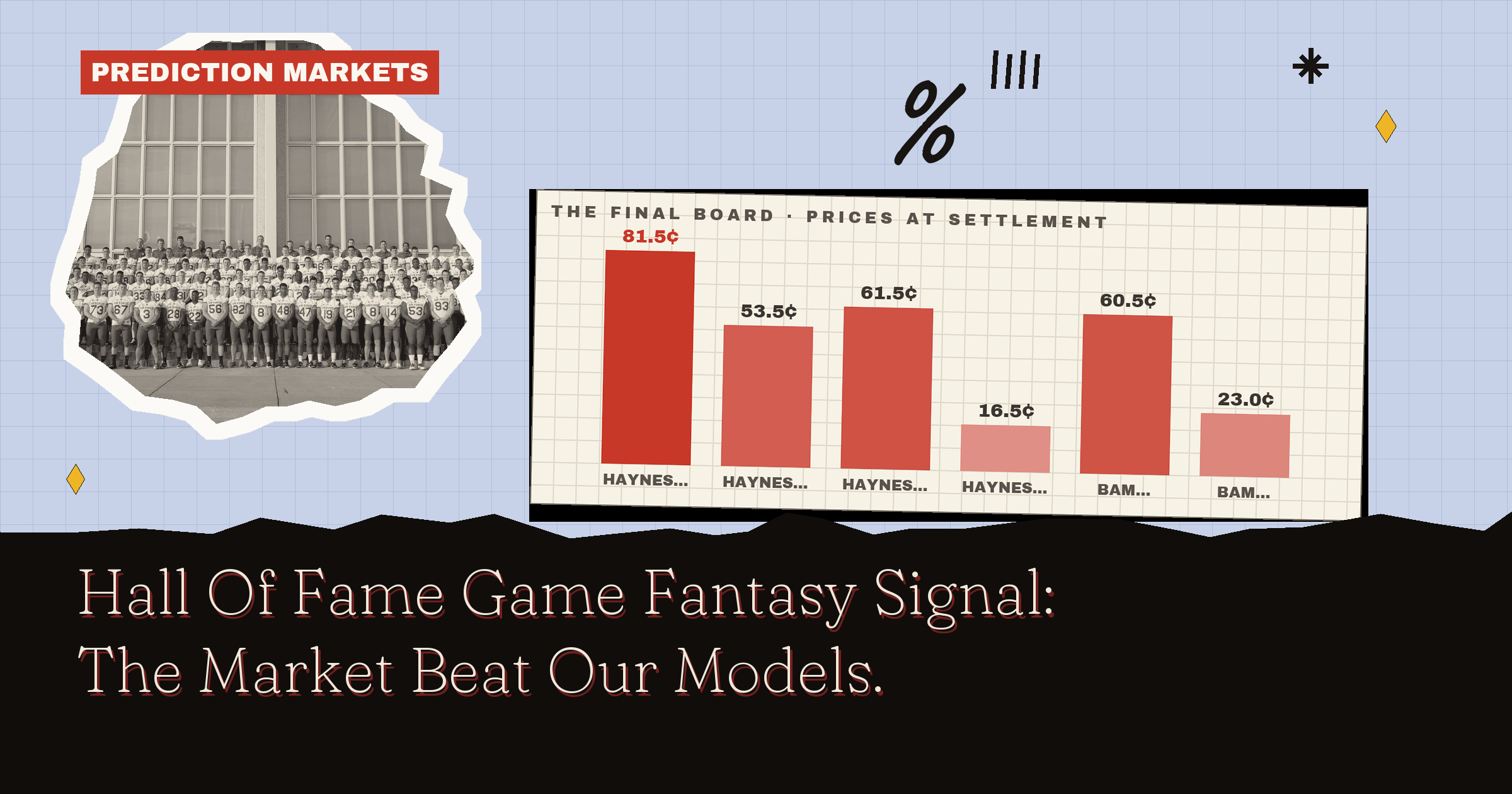
| Haynes King 50+ Pass Yds | 81.5¢ | 81% | Yes (180) | market |
| Haynes King 100+ Pass Yds | 53.5¢* | 45% | Yes (180) | market |
| Haynes King 25+ Rush Yds | 61.5¢ | 41% | Yes (39) | market |
| Haynes King 50+ Rush Yds | 16.5¢ | 12% | No (39) | models |
| Bam Knight 25+ Rush Yds | 60.5¢* | 41% | Yes (58) | market |
| Bam Knight 50+ Rush Yds | 23¢* | 9% | Yes (58) | market |
| Haynes King 1+ TD Scored | 15.5¢ | 19% | Yes (5-yd run) | models |
| Bam Knight 1+ TD Scored | 17.5¢ | 21% | No | market |
| Corey Kiner 1+ TD Scored | 19¢* | 16% | Yes (1-yd run) | market |
| Ja'seem Reed 1+ TD Scored | 14¢ | 13% | Yes (15-yd catch) | market |
| Evan Hull 1+ TD Scored | 13¢* | 12% | No | models |
| Carson Beck 1+ Pass TD | 45.5¢* | 42% | Yes | market |
| Carson Beck 2+ Pass TD | 23¢* | 11% | No | models |
| Haynes King 1+ Pass TD | 35.5¢ | 45% | Yes (2) | models |
| Kenny Pickett 1+ Pass TD | 27¢* | 22% | No | models |
Models are frequently wrong; the market price reflects real traders' money.*
Starred contracts sat on a spread of 10¢ or more at that stamp, meaning the midpoint was a market maker's opening guess rather than a price anyone had traded at size. That distinction turns out to matter enormously, and we will come back to it.
The headline scorecard: the market was closer on nine of the 15, the models on six. Scored properly, by squared error against the settled outcome, the market finished at 0.278 and the models at 0.317, where lower is better and zero would be perfect foresight. By that measure the market finished ahead.
But look at the column of results rather than the column of winners. Ten Yes settlements out of 15. The market's 15 prices summed to 5.07 expected hits and the models' summed to 4.30. Reality delivered ten. Both forecasts landed at roughly half the real number, which is a different kind of miss from being a little conservative.
Every Seat's Number, Graded
The per-model detail. On a phone this table scrolls sideways; the board above carries the headline numbers.
| Contract | ChatGPT | Fable | Opus | Sonnet | Gemini | Kimi | Result |
|---|---|---|---|---|---|---|---|
| King 50+ Pass Yds | 80% | 84% | 83% | 78% | 82% | 80% | Yes |
| King 100+ Pass Yds | 45% | 40% | 44% | 42% | 48% | 50% | Yes |
| King 25+ Rush Yds | 38% | 42% | 43% | 38% | 42% | 45% | Yes |
| King 50+ Rush Yds | 11% | 13% | 13% | 13% | 11% | 14% | No |
| Knight 25+ Rush Yds | 39% | 45% | 42% | 40% | 42% | 40% | Yes |
| Knight 50+ Rush Yds | 8% | 9% | 9% | 10% | 8% | 8% | Yes |
| King 1+ TD Scored | 14% | 20% | 17% | 20% | 19% | 22% | Yes |
| Knight 1+ TD Scored | 17% | 23% | 19% | 22% | 20% | 26% | No |
| Kiner 1+ TD Scored | 14% | 17% | 15% | 17% | 15% | 17% | Yes |
| Reed 1+ TD Scored | 13% | 14% | 13% | 15% | 13% | 11% | Yes |
| Hull 1+ TD Scored | 11% | 12% | 11% | 13% | 11% | 12% | No |
| Beck 1+ Pass TD | 37% | 43% | 46% | 42% | 42% | 40% | Yes |
| Beck 2+ Pass TD | 9% | 10% | 13% | 12% | 12% | 10% | No |
| King 1+ Pass TD | 39% | 45% | 48% | 48% | 46% | 42% | Yes |
| Pickett 1+ Pass TD | 21% | 22% | 22% | 22% | 22% | 20% | No |
Every seat on this panel is graded against real market settlements — records to date: GPT 85% on 7,395 graded calls · Claude Fable 87% on 1,322 graded calls · Claude Opus 87% on 1,392 graded calls · Claude Sonnet 86% on 1,369 graded calls · Gemini 86% on 6,067 graded calls · Kimi 84% on 2,988 graded calls. Recomputed daily; the full scoreboard is public.
Models are frequently wrong; the market price reflects real traders' money.* Every number on this page gets graded in public once its market settles, which is what you are reading.
More live boards from the same panel: the 2026 Offensive Rookie of the Year board, where Jeremiyah Love, the No. 3 pick who was scratched from this game, still leads at 15.5¢ · the fantasy RB1 board, with Jahmyr Gibbs on top at 21¢ · the fantasy QB1 board, where Josh Allen sits at 26.5¢. Prices fetched September 1, 2026.
The Two Contracts That Decided It
Two rows carried most of the gap between the two forecasts, and both were rushing contracts.
Haynes King 25+ rushing yards. Market 61.5¢, models 41%, settled Yes. This was flagged before kickoff as the board's cleanest live experiment: does a market price preseason quarterback rushing on college tape, or on how August football is actually coached? The models took the second view and reasoned from the record, noting that the recent quarterback rushing high in this game was 36 yards, set in 2023. King ran three times for 39, including a 26-yard scramble and the winning touchdown. The market read the dual-threat profile and the three-quarter workload correctly, and the 20-point disagreement resolved entirely in the market's favour.
Bam Knight 50+ rushing yards. Market 23¢, models 9%, settled Yes. This was the models' single hardest fade on the board, and the reasoning behind it was that no running back of any kind had reached 50 rushing yards in Canton since at least 2023. Knight carried 12 times for 58. A three-year base rate is a real fact and it was still the wrong instrument, because those three years of small rushing lines came from games that stayed close to 35 points, rather than from any rule about how running backs are used in Canton.
A Worked Example: What A 23¢ Contract Paid
That contract is also the clearest illustration of what these prices mean in payout terms, which is the only unit that matters on an exchange. A Yes contract that settles Yes pays exactly $1.00. Knight's contract was quoted at a 23¢ midpoint, so a Yes that settled Yes returned a little over four times what the quote implied: roughly $4.35 back per dollar, before fees, and only for anyone who actually got filled near that midpoint on a ten-cent-wide book. The 81.5¢ King passing contract, the highest-priced on the tracked board, returned about $1.23 per dollar. Cheap contracts pay more precisely because they are supposed to lose more often, and the board's cheapest contracts were the ones this game kept turning over.
That is the shared assumption. Every model conditioned on a low-scoring exhibition. So did the market, which had the total at 34.5. Opus wrote it out explicitly in its reasoning, working from "roughly 37-41 combined points" to a cap of about one passing touchdown per team. The game produced 63 points and four passing touchdowns. Once that prior broke, every threshold on the board became easier at once, which is why ten contracts hit against a board priced for five.
There is a second finding underneath the scorecard, and it cuts the other way. Split the 15 contracts by whether they had a real two-sided book. On the seven tight-spread contracts the market scored 0.301 and the models 0.308, effectively a tie, with the market closer on four of seven. The market's whole margin came from the eight wide-book contracts, where its midpoints were quotes nobody had traded against. The market beat the models on this board, and it did so overwhelmingly on the contracts nobody could have traded at those prices.
Where The Panel Changed Its Mind
Each model saw the other five sets of reasoning, anonymised, and could revise. Three of those revisions are worth reading against the box score.
The one that paid, from Opus:
"I also nudged the TD-scored cluster up a few points each (I had underweighted King's own goal-line/scramble rushing equity as a dual-threat with three quarters)." (Claude Opus, revision note)
That move produced the panel's best call of the night. King 1+ touchdown scored went out at 19% against a 15.5¢ market, and King scored the game-winner on a five-yard run. It is the one contract where the models were both above the market and right.
The one that did not, from Fable:
"The panel's allocation math is right that ~4-5 total TDs get spread across a dozen-plus candidates including WRs/TEs, and Knight faces both a three-way committee and unannounced veteran exposure, so my 55/28 was too aggressive." (Claude Fable, revision note, trimming Bam Knight)
[Editor's note: the game produced seven touchdowns, not the four or five this reasoning allocates. The committee logic held up on its own terms, and Knight did not score, but the pool being divided was half again as large as assumed.]
And the one that held, from Gemini:
"I kept 50+ rushing yard tail events firmly suppressed (11% and 8%) since no player has hit that mark in three years and weather shortening remains a 30% risk." (Gemini, revision note)
[Editor's note: the weather risk never materialised. The forecast cleared before kickoff, the game went a full four quarters, and Knight cleared 50 rushing yards. This seat held its ground on an accurate historical base rate and an explicitly stated risk, and the outcome went against it anyway.]
The transferable lesson sits underneath the direction of the miss. All six models, and the market alongside them, were reasoning from the same three-year sample of quiet Canton football, and none of them carried a wide enough distribution for the night that sample could not describe.
What The Night Actually Signalled For The Season
The usage reads, which were the reason to watch, mostly survived contact with the box score. Haynes King took the announced three-quarter workload and produced 21-for-34 for 180 yards with two touchdown passes. Carson Beck went 15-for-19 for 188 and a score before giving way. Kedon Slovis, named here beforehand as the invisible variable every Arizona number quietly depended on, went 9-for-10 for 106 yards and threw the touchdown that put Arizona ahead with 1:55 left. The Arizona backfield split almost exactly three ways: Knight 12 carries, Corey Kiner 14, Evan Hull six. A three-way committee is the single hardest thing to price in fantasy, and it is the reason we run projections as simulations rather than point estimates: you can see the whole range of a split backfield in our NFL projections, ownership and stacks in the DataHub, or try the Sims free and watch what a fourteen-carry share does to a lineup's ceiling.
Four weeks on, with the regular season about to start, the market has taken very little of that at face value. On the Offensive Rookie of the Year board this morning, Jeremiyah Love is still the favourite at 15.5¢ despite never taking a snap in Canton, while Beck sits at 2.5¢ and King at half a cent. A preseason opener against backups moved almost nothing, which is itself the most honest signal on this page: the board treats one August night as close to zero evidence about a season.
Three things worth watching, each checkable:
- Whether the Arizona backfield split narrows. A three-way committee in game one is normal. If Kiner keeps the goal-line work he had here into September, the touchdown share stops being a lottery.
- Whether Slovis holds a job. He was the unpriced variable in August and outperformed the quarterback in front of him on a per-attempt basis. Roster cuts answer this before anything else does.
- Whether the market keeps pricing Canton as a normal game. Next August the three-year sample the models used will include a 63-point outlier. Watch whether the totals and the prop ladders widen to reflect it, or whether the 2026 game gets treated as noise.
What Settled, And When
| When | What happened |
|---|---|
| August 5, Evening | Model numbers generated for the fifteen-contract usage board, without sight of any price |
| August 6, 7:02 AM ET | Final pre-kickoff price stamp, the prices in the table above |
| August 6, 8:00 PM ET | Kickoff in Canton; Carolina won 33-30 |
| After The Final Whistle | Twenty-two of the 29 player-prop contracts settled Yes or No on the official box score, alongside the two winner contracts. The seven Jeremiyah Love contracts were voided rather than settled either way, because he never played |
| Now | Every number above is graded and closed. Nothing on this page is tradable |
The panel's calls are on the record. Our AI panel has a live, public verdict on the 2026 rookie class that came out of this game, and you can see the board for Offensive Rookie of the Year with every model's number on it.
Hottest Prediction Markets Right Now
- 2028 Democratic presidential nominee · $209M traded
- 2027 Pro Football Champion · $77M traded
- Pro Baseball Champion · $65M traded
- 2028 U.S. Presidential Election winner? · $64M traded
- 2028 Republican presidential nominee · $62M traded
- Bitcoin price at the end of 2026 · $34M traded
Every market above links to our full AI model verdict; browse them all on the Stokastic prediction markets hub, and see how every settled call actually scored on the full graded scoreboard.
The Bottom Line
The box score is a preseason box score and nobody will remember it. The scorecard is worth keeping.
A real-money market and six AI models, working independently, both looked at a preseason opener in Canton and priced it off the same three years of quiet, low-scoring football. Both were right about the shape of the night, who would play and in what order, and both were badly wrong about its size. The market was closer, by a margin it earned almost entirely on contracts too thinly quoted to trade. On the seven contracts with real two-sided books they finished close to level: 0.301 for the market against 0.308 for the models, with the market nearer the outcome on four of the seven.
The usable habit from all of this is narrow and worth having: when a market and a model agree, check what they are agreeing about. Here they agreed on the workload and the rotation, which they both read correctly, and they also agreed on a scoring environment neither of them had questioned. The second agreement is the one that cost.
Model estimates for the fifteen-contract usage board were generated the evening of August 5, 2026, without sight of any market price, from a fetched game-week data card covering the dated starter announcements, the ruled-out list, the National Weather Service forecast for Canton and the full 2023-2025 Hall of Fame Game box scores. Six of the panel's eight seats returned that board. Prices are exchange bid-ask midpoints as of August 6, 2026 at 7:02 AM ET. Settlement results are Kalshi's own, read from the exchange on September 1, 2026; the box score is the official one. Models are frequently wrong; the market price reflects real traders' money.
More on this: Recent Stokastic Hall of Fame Winners (August 2026) · NFL Win Totals As A Fantasy Draft Signal · Fantasy RB1 Odds 2026: Gibbs Leads, Bijan Is The Value · How To Read NFL Futures Markets As Fantasy Draft Signals · Fantasy Defense Rankings 2026: The D/ST1 Odds Board, Priced Blind