
NBA Western Conference Odds 2027: 8 AI Models Score The Race
By Jake Hari
July 27, 2026
The NBA Western Conference odds 2027 board on Kalshi tells a tidy story: a two-horse West. San Antonio trades at 34 cents, Oklahoma City at 33, and the field's ceiling is Minnesota at 10. The crowd is pricing a rubber match between the conference's last two champions and treating everyone else as scenery. So we put the same question to eight AI models that never saw a single price, armed only with complete current rosters, and they came back with a different map. The panel breaks the coin flip decisively toward Oklahoma City, quietly ranks a 6-cent team second in the entire conference, and makes one 3-cent team more than four times as likely as its price. The disagreement, not any single number, is the story. One team's row hides the strangest split of the whole run.
TL;DR
- The Market: San Antonio 34¢, Oklahoma City 33¢, Minnesota 10¢, the Lakers at 8¢, Denver at 6¢, and ten teams at 4¢ or less. The crowd sees a Spurs-Thunder duopoly.
- The Panel: eight price-blind AI models blend to Oklahoma City 30%, Denver 17%, San Antonio 15%. The machines fade the reigning West champs and promote a 6-cent team to second on the board.
- The Three Biggest Gaps: San Antonio (34¢ market vs. 15% blend), Denver (6¢ vs. 17%), and Houston (3¢ vs. 14%).
- The Widest Internal Split: Portland, where two models say 22% and two say 2-3%. When seats disagree that hard, the blend is an average of arguments, not a consensus.
- The Rails: every verdict was generated July 27, 2026, price-blind from live fetched rosters, and gets graded against the real settlement on our public scoreboard. Model estimates, not betting or financial advice.
The Market Sees A Two-Horse West
Start with what the crowd believes, because everything else in this article is a reaction to it. On the Kalshi Western Conference champion market for 2026-27, San Antonio's YES contract costs 34 cents and Oklahoma City's costs 33. Third place isn't close: Minnesota sits at 10 cents, the Lakers at 8, Denver at 6, Golden State at 4, Houston at 3, Portland at 2, and seven more franchises are bunched at a single penny.
That pricing is recency with a straight face. The Spurs are the reigning Western Conference champions: Victor Wembanyama's team beat Oklahoma City in the 2026 conference finals before falling to the Knicks in five in the NBA Finals. The Thunder are the 2025 NBA champions San Antonio knocked out of the West this past June. Two Junes, two different West winners, and the market prices the rubber match within a single cent while giving the field almost nothing.
That framing is exactly what the panel had to rule on. The models never saw those cents; they were handed complete current rosters and asked for a probability that each team wins the West. The question underneath their answers: is the duopoly real, or is the tier below closer than a ten-cent gap implies?
A Worked Example: Cents To Probability
Before the board, the one conversion that makes every number below legible. A Kalshi contract settles at $1.00 if the outcome happens and $0.00 if it doesn't, so the price in cents is, to a first approximation, the market's probability in percent. San Antonio at 34 cents means the crowd's money says roughly a 34% chance the Spurs win the West. Our full Kalshi odds guide walks through the conversion in both directions; in sportsbook terms, 34¢ is about +194. One structural difference from a sportsbook futures board is worth a sentence: at a book like DraftKings or FanDuel, every price on a futures page carries hold, so you have to de-vig the entire board to back out fair probabilities. Kalshi's two-sided order book quotes the probability directly, which is exactly why it makes such a clean benchmark for a price-blind model panel.
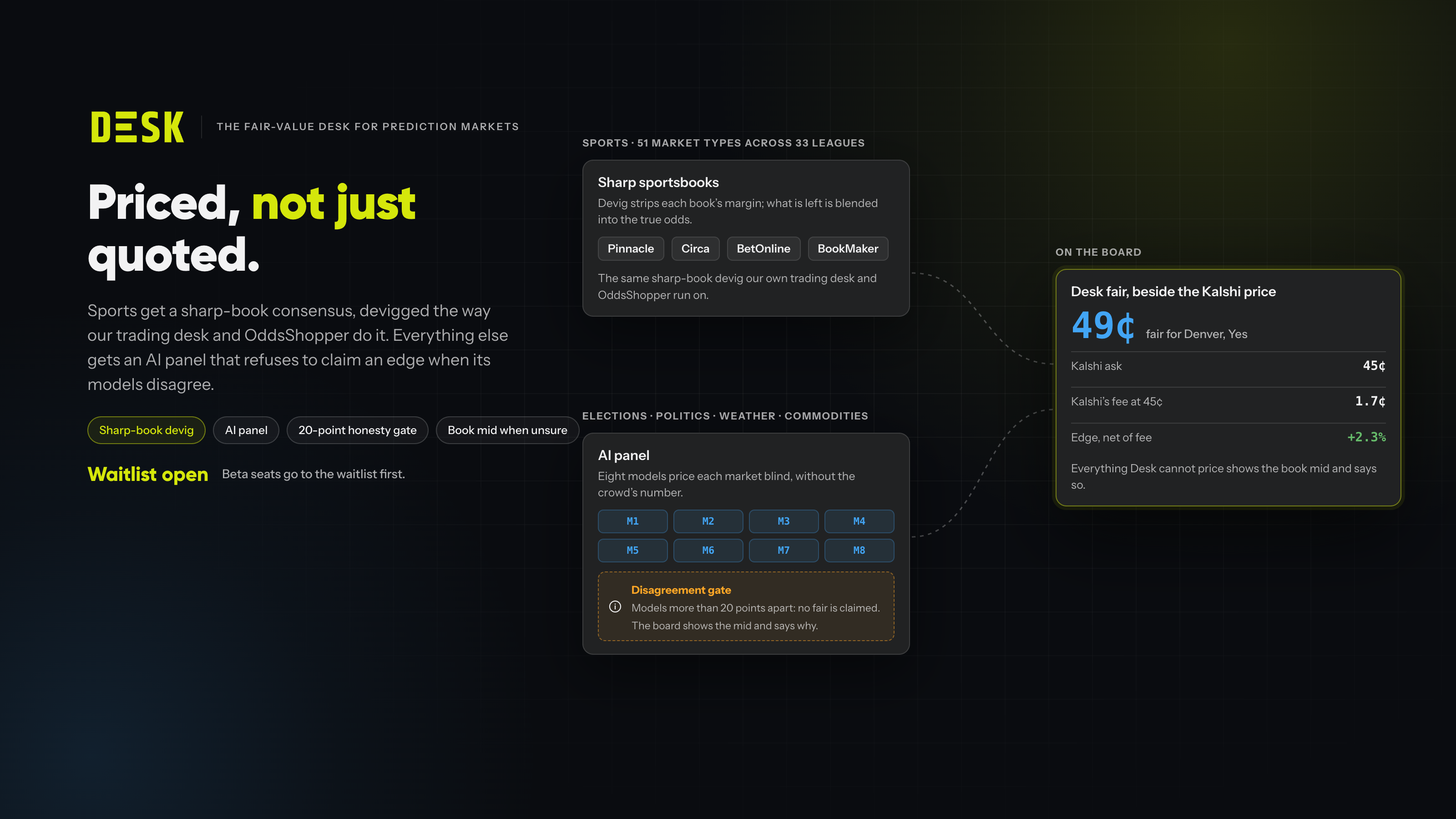
Here is the worked example that matters on this board. Denver trades at 6 cents. Buying one YES contract risks $0.06; if the Nuggets win the West in June 2027, it settles at $1.00. Six cents implies a 6% probability. The AI blend says 17%. If the blend were exactly right, a contract "worth" 17 cents would be on sale for 6, roughly a third of the model-estimated fair value. That's the entire logic of comparing a price-blind estimate to a market: not "the machine knows," but "here is where the machine and the money can't both be right."
Two honest caveats before anyone gets excited. Kalshi charges a small trading fee that scales with price and nudges your effective break-even above the raw cents. And a model estimate is exactly that: an estimate, frequently wrong, which is why every verdict below gets graded in public.
The Full Board: Kalshi Price Vs. Eight Models
Every number in this table is frozen from the July 27, 2026 run. A dash means that model returned no estimate for that team in its pass.
| Outcome | Kalshi | AI blend | ChatGPT (GPT-5.5) | Claude Fable | Claude Opus | Claude Sonnet | Gemini 3.1 Pro | GLM 5.2 | Kimi K3 | DeepSeek V4 |
|---|---|---|---|---|---|---|---|---|---|---|
| Oklahoma City | 33¢ | 30% | 24% | 38% | 42% | 27% | 22% | 32% | 28% | 30% |
| Denver | 6¢ | 17% | 19% | 13% | 19% | 16% | 17% | 18% | 15% | 22% |
| San Antonio | 34¢ | 15% | — | 10% | 20% | — | 16% | 20% | 12% | 10% |
| Houston | 3¢ | 14% | 12% | 12% | 14% | 15% | 18% | 13% | 15% | 8% |
| Minnesota | 10¢ | 10% | 12% | 9% | 11% | — | 8% | 12% | 9% | 9% |
| Los Angeles Lakers | 8¢ | 10% | 12% | 9% | 12% | 11% | 12% | 10% | 5% | 8% |
| Portland | 2¢ | 10% | 8% | 4% | 3% | 12% | 22% | 6% | 2% | 22% |
| Golden State | 4¢ | 7% | 4% | 5% | 6% | 11% | 7% | 10% | 3% | 8% |
| Dallas | 1¢ | 5% | 6% | 5% | 5% | 10% | 1.5% | 6% | 4% | 2% |
| Los Angeles Clippers | 1¢ | 4% | 4% | 3% | 3% | 4% | 4% | 4% | 3% | 4% |
| Phoenix | 1¢ | 3% | 6% | 2% | 2% | 3% | 2% | 4% | 2% | 4% |
| Utah | 1¢ | 2% | 4% | 1.5% | 2% | 1.0% | 4% | 2% | 1.2% | 2% |
| New Orleans | 1¢ | 1.7% | 2% | 1.5% | 1.2% | 2% | 1.5% | 2% | 1.0% | 2% |
| Sacramento | 1¢ | 1.6% | — | 1.5% | 2% | 3% | 1.2% | 2% | 1.0% | 0.2% |
| Memphis | 1¢ | 1.1% | 0.6% | 1.5% | 1.0% | 4% | 0.1% | 1.5% | 0.5% | 0.2% |
Every seat on this panel is graded against real market settlements — records to date: GPT 83% on 1,693 graded calls · Claude Fable 85% on 331 graded calls · Claude Opus 86% on 382 graded calls · Claude Sonnet 84% on 363 graded calls · Gemini 85% on 1,718 graded calls · GLM 80% on 1,874 graded calls · Kimi 84% on 1,863 graded calls · DeepSeek 80% on 1,877 graded calls. Recomputed daily; the full scoreboard is public.
Model estimates generated July 27, 2026, price-blind from live fetched data. Models are frequently wrong; the market price reflects real traders' money.
The single strangest row is Portland. The market has the Trail Blazers at 2 cents, eighth on the board by price and a penny above the basement, and the blend says 10%. But that 10% is a fiction no individual model actually holds, and the spread hiding inside it is the strangest split of the run. Hold that row; it gets its full breakdown two sections down.
Where The Machines Split From The Money
Three gaps on that board are big enough to be the story. Here they are side by side, with the gap measured in probability points (AI blend minus market price):
| Team | Kalshi price | AI blend | Gap |
|---|---|---|---|
| San Antonio | 34¢ | 15% | −19 |
| Denver | 6¢ | 17% | +11 |
| Houston | 3¢ | 14% | +11 |
Each of those gaps comes with the model's own reasoning attached.
San Antonio: market 34¢, AI blend 15%. A 19-point fade of the market's favorite. Claude Fable's read: "Wembanyama-Fox core is ascending but young; OKC, Denver, and other elite West contenders make a Finals run plausible yet unlikely." Notice what the market and the model are each looking at. The crowd sees the banner: the Spurs just won this conference, and the De'Aaron Fox trade gave Wembanyama a proven lead guard. The models see a core whose stars are still early-career, in a conference where the team they beat in June returns SGA's intact young core. Two seats, ChatGPT and Claude Sonnet, declined to score the Spurs at all; even the abstentions tell you the machines found this one harder than a 34-cent price implies.
Denver: market 6¢, AI blend 17%. That's 11 points above the crowd, and second on the panel's board. DeepSeek V4's read: "Led by prime Jokic and Murray with solid depth, Denver is a top West contender, but a tough conference limits their probability." The market has Denver fifth, behind Minnesota and the Lakers. The models, reading the fetched roster, saw Nikola Jokic's supporting cast held together and priced a team the crowd has half-forgotten. This is the cleanest philosophical split on the board: the market weights the last two postseasons; the models weight who is actually on the roster.
Houston: market 3¢, AI blend 14%. More than four times the market's number. Gemini 3.1 Pro's read: "Adding Kevin Durant to a deep core featuring Sengun gives Houston elite two-way versatility, making them strong contenders in a tough Western Conference." Every single model scored Houston at 8% or better; the lowest AI number on the board is nearly triple the Kalshi price. When eight independent models with different training and different priors all land well above the market on the same team, that isn't one seat's quirk. It's a systematic disagreement about what a Durant-plus-Sengun roster is worth.
The pattern across all three gaps: the crowd is pricing the last two postseasons, and the models are pricing the rosters as they sit today. Every big disagreement on this board reduces to that one split.
The Disagreement Is The Story
Here's the promised payoff: the reason to read a model-verdict board isn't the blend column, it's the spread inside it. Three rows tell the whole story:
| Team | Lowest seat | Highest seat | Spread |
|---|---|---|---|
| Oklahoma City | 22% (Gemini 3.1 Pro) | 42% (Claude Opus) | 20 pts |
| Portland | 2% (Kimi K3) | 22% (Gemini 3.1 Pro, DeepSeek V4) | 20 pts |
| Los Angeles Clippers | 3% | 4% | 1 pt |
On Oklahoma City the panel spans 20 points, from Gemini 3.1 Pro's 22% to Claude Opus's 42%. Both seats read the same SGA-led roster — the 2025 champions, still intact, still young. What differs is the prior: Opus treats sustained elite depth as compounding, while Gemini treats a stacked conference as a tax on everyone, favorites included. The blend's 30% splits the difference, which is useful shorthand and also a number nobody on the panel actually believes.
Portland is the extreme case, the row I told you to hold. Gemini 3.1 Pro and DeepSeek V4 both put the Trail Blazers at 22%, a number that would rank second on the blend board, ahead of Denver. Kimi K3 says 2% and Claude Opus says 3%. Same roster, same data, an elevenfold disagreement between seats. A 20-point internal split on one team usually means the models are weighting one input completely differently: a young roster that either "arrives" on schedule or doesn't. Contrast that with the Clippers row, where every model lands between 3% and 4% against a 1-cent price. When the seats agree that tightly, the blend is sturdy. When they span 20 points, treat the blend as the midpoint of an argument, and read the individual reasoning before you conclude anything.
Which side is right? Nobody knows yet, and that's precisely what makes this board worth tracking. The market says the reigning champs and the 2025 champs, within a cent. The machines say the 2025 champs clearly, then a team priced at 6 cents. One of those maps is wrong by a lot, and it settles in public in June 2027.
What The Models Actually Read
Method, briefly, because the numbers only mean something if the process is clean. Each of the eight models (ChatGPT, Claude Fable, Claude Opus, Claude Sonnet, Gemini, GLM, Kimi, and DeepSeek) received the complete current roster for all 15 Western Conference teams, fetched live at generation time, and returned an independent probability for each team with a one-line rationale. No model saw the Kalshi price, any sportsbook line, or another model's answer. The blend is a straight aggregation of the seats.
Price-blind matters because it makes the comparison falsifiable: a model that can see the market can just echo it. And roster-first matters because every surprise on this board traces to a roster read. The same fetched depth charts that showed DeepSeek a Denver supporting cast "held together" showed two seats a Portland roster arriving at 22% and two other seats the same roster stuck at 2-3%; the inputs were identical, the weightings weren't. It's the same opportunity-first lens we apply to nightly NBA, where usage, minutes and role data drive our NBA DFS projections, ownership and stacks in the DataHub; night to night, the tool surfaces the same usage and minutes shifts the panel is reasoning about here at season scale. A conference-champion market is that same read stretched across a year instead of a slate.
Every verdict from this run is logged and will be graded against the actual 2027 settlement on our public scoreboard, alongside every other board in the series, including our NBA Eastern Conference verdict, which ran the mirror-image question. If the models' San Antonio fade is wrong, the scoreboard will say so, permanently.
Related Model Verdicts
The same eight-model, price-blind protocol runs across the whole series:
- NBA Eastern Conference 2027: 8 AI models score the East
- NHL Western Conference 2027: the hockey mirror of this board
- S&P 500 year-end 2026: the panel prices the bands
- NYC high temp tomorrow: the panel vs. a weather market
And if you're newer to event contracts, how to bet NBA on Kalshi covers the market types, settlement rules and mechanics this whole series is built on.
More on this: NBA Eastern Conference Odds 2027: LeBron's 76ers Lead At 23\u00a2 · Kalshi NBA Free Agency Odds: The Player-Movement Hub · Kalshi NBA Playoffs Odds: Champion, Conference And Play-In Boards · NBA Rookie Of The Year 2027 Odds: AI Panel Prices The Class · NBA MVP 2027 Odds: AI Panel Verdict on the Full Field
NONE by design for this class — single contextual DataHub link only, no promo code
Get Started